TL;DR
- HS code classification starts with a precise, plain-language English description of your goods. CBP requires it regardless of value under 19 CFR § 4.7a, 122.48a, 123.91, 123.92, and 128.21.
- The importer (often the buyer when purchasing from foreign sources) is responsible for ensuring goods comply with U.S. state and federal import regulations.
- In Fiscal Year 2024, total De Minimis shipments reached 1.36 billion with a declared value of $64.6 billion, so classification errors scale fast.
- There is no single official tool that fully automates HS code classification for ecommerce products. You can combine CBP guidance, the ITA Global Business Navigator beta chatbot, and EU customs resources, but always verify outputs.
- Use the checklist below as a repeatable SOP for product data, description writing, and classification review.
Introduction
If you sell or ship ecommerce products across borders, you already know that the description on your customs paperwork is not marketing copy. It is a legal declaration that determines the classification number and duty rate Customs assigns when the item arrives in the United States. When goods move from any foreign country to the United States, they are being imported and are subject to specific rules and regulations. That means every SKU in your catalog needs a defensible, specific description and a classification you can stand behind.
The operational problem is scale. A small catalog of 50 SKUs can be classified manually with spreadsheets and patience. A catalog of 5,000 SKUs, updated weekly with new variants, colors, materials, and bundle configurations, cannot. In Fiscal Year 2024, total De Minimis shipments reached 1.36 billion with a total declared value of $64.6 billion. Errors in classification can lead to fines, penalties, detention, or destruction by CBP when goods are unsafe, fail health code requirements, or violate quota restrictions. Even when goods are compliant, vague descriptions can trigger holds, returns, or seizure if paperwork is missing.
This article explains how to approach automation realistically. It does not promise a magic button. Instead, it shows how to structure product data, how to write precise cargo descriptions, how to use official resources such as the ITA's beta AI chatbot and EU customs pages, and where a software workflow can help. Use it as a reference to build your own classification SOP, and always double-check outputs against the source pages listed at the end.
Main Content
Why HS code classification is a data quality problem first
Automating HS code classification fails when the underlying product data is vague. CBP states that a precise cargo description must be clear, concise, in plain language, and detailed enough for U.S. Customs to identify the size, shape, and characteristics of the commodity. If your product feed says "gift item" or "accessories," no tool can classify it reliably. The first step in any automation project is to enrich each SKU with structured attributes: material composition, function, dimensions, weight, power source, packaging form, and intended use.
Consider a seller shipping stainless steel insulated water bottles. A weak description is "water bottle." A precise description is "18/8 stainless steel vacuum-insulated water bottle, 750 ml, screw-on lid, for personal hydration." The second version gives a classifier enough signal to distinguish it from plastic promotional bottles or glass containers. The same logic applies to apparel: "men's 100% cotton knitted T-shirt" is classifiable; "summer top" is not.
This is where a tool angle becomes practical. Most ecommerce platforms already store attributes in product information management (PIM) systems or marketplace listings. A classification workflow can pull those attributes, normalize them, and generate a draft description. But the tool is only as good as the attributes you feed it. Treat data enrichment as the foundation, not an afterthought.
What CBP requires in the description field
CBP is explicit about what belongs in the commodity description field. Only the cargo description should be included in the field of transmission; superfluous information such as personally identifiable information (PII), type of packaging, and carrier disclaimers should not be transmitted. This matters for automation because many ecommerce order systems append order numbers, customer names, or marketing phrases to item names. Those must be stripped before transmission.
The description of the item(s) in English is a legal requirement and determines the classification number and duty rate that Customs assigns the item upon arrival in the United States. All paperwork for sending packages internationally has a section for providing CBP information, and a U.S. Customs and Border Protection Declaration form should include a full and accurate description of the merchandise and be securely attached to the outside of the shipment. If foreign shipments are not accompanied by a declaration form and an invoice, they may be subject to seizure, forfeiture, or return to sender.
For automation, this means your workflow should generate a clean, English-only description string per line item, separate from internal order metadata. A practical rule: if the description field contains anything a customs officer would not need to identify the goods, remove it. That includes SKU codes, internal notes, and promotional language.
How to use official resources without over-relying on them
The International Trade Administration (ITA) offers a beta AI chatbot called the Global Business Navigator, built with Microsoft Azure AI services, to provide general information on the exporting process and resources for U.S. exporters. It is trained on ITA's export-related content and is designed to understand non-expert language, idiomatic expressions, and foreign languages. However, as a beta product, its responses may occasionally be inaccurate or incomplete, and its knowledge is limited to public information on the Export Solutions web pages of Trade.gov.
The chatbot cannot provide responses specific to a company's product or a specific foreign market, but its reference pages guide users to other government resources and market research. Users are advised to double-check the chatbot's responses using provided references or by visiting the Export Solutions web pages on Trade.gov, and not to use its responses as legal or professional advice. It also does not collect user information or use chat history to learn new information; all feedback is anonymous, and users should not enter PII, sensitive, or proprietary information. Conversations may be reviewed to help ITA improve the tool.
For HS code classification, the chatbot can help you understand the exporting process and point you to resources, but it is not a classification engine. Use it for orientation, not for final code assignment. Similarly, the European Commission's Directorate-General for Taxation and Customs Union publishes information on EU customs procedures for importing and exporting goods, including the Union Customs Code, rules of origin, customs controls, prohibitions and restrictions, and the Authorised Economic Operator (AEO) program. It also lists EU Customs Reform and Electronic customs as topics and provides online services and databases. But the content does not mention any tool for automating HS code classification for ecommerce products. So for EU-bound goods, you still need a manual or semi-automated classification process.
Building a semi-automated classification workflow
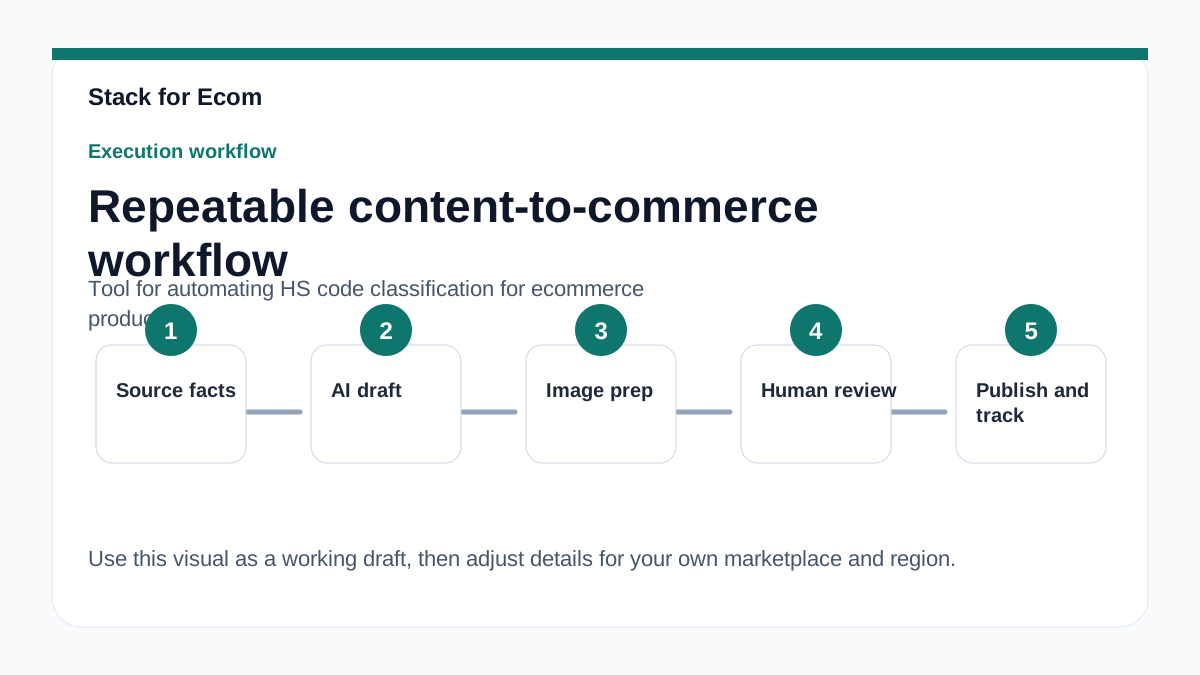
A realistic automation workflow combines data normalization, description generation, and human review. Start by extracting product attributes from your PIM or marketplace listings. Then apply rules to generate a precise English description. For example, if material is "cotton" and product type is "T-shirt" and gender is "men's," generate "men's 100% cotton knitted T-shirt." If material is missing, flag the SKU for manual enrichment.
Next, map descriptions to HS codes using a rules engine or a classification database. Many teams maintain an internal mapping table of SKU families to HS codes, reviewed quarterly. When a new SKU is added, the system suggests a code based on similar products and routes it to a customs specialist for approval. This is not full automation, but it reduces manual work and creates an audit trail.
Finally, validate the output against CBP requirements. Ensure the description is clear, concise, in plain language, and detailed enough to identify size, shape, and characteristics. Remove PII, packaging details, and carrier disclaimers. For shipments under $2,500 in value that are not subject to quota and not restricted or prohibited, a CBP official will usually prepare the paperwork, assess the proper duty, and release it for delivery. But that does not remove your responsibility to provide accurate information. The importer, which is the buyer when purchasing from foreign sources, is responsible for assuring that the goods comply with state and federal government import regulations.
Where software fits and where it does not
Software can help with data extraction, description templating, code suggestion, and audit logging. It cannot replace the judgment required for ambiguous goods, nor can it guarantee compliance. CBP's E-Commerce Strategy focuses on four primary goals and identifies private industry and foreign governments as key resources in assessing the e-commerce environment. It includes efforts to educate the public and trade community about importer responsibilities and enforcement initiatives such as streamlining enforcement processes, leveraging partnerships, and improving data collection.
A practical tool angle is to integrate classification into your order management or shipping workflow. When an order is created, the system pulls the enriched description, checks it against a rules engine, and either assigns a suggested code or flags it for review. The output is a clean description string and a code that can be printed on the declaration form. For merchants using marketplaces, this can be a middleware layer that sits between the marketplace and the carrier.
Do not expect a single tool to handle every jurisdiction. The EU customs framework includes the Union Customs Code, rules of origin, customs controls, and prohibitions and restrictions, but the European Commission page does not mention an HS code automation tool. Details may vary; check references. Your workflow should be modular: one module for U.S. CBP requirements, another for EU requirements, and a review queue for exceptions.
Step-by-step checklist
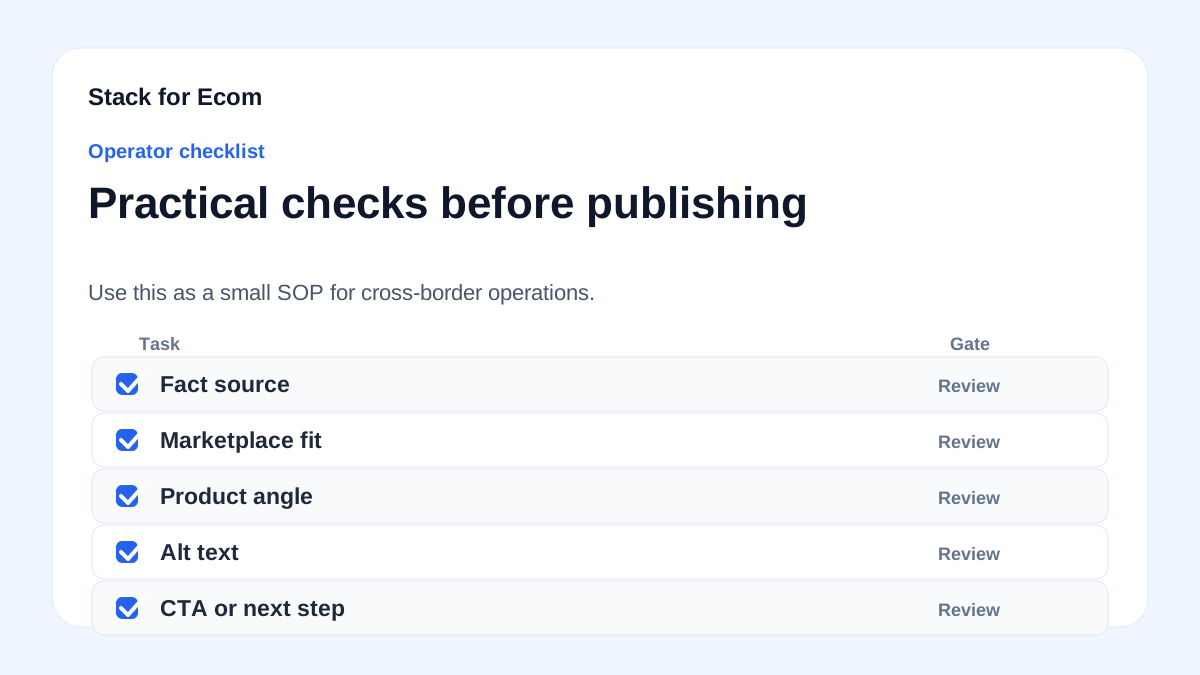
- [ ] Inventory all SKUs and identify which ones cross borders. Tag them in your PIM or order system.
- [ ] For each SKU, collect structured attributes: material, function, dimensions, weight, power source, packaging form, and intended use.
- [ ] Generate a precise English description using a template. Example: "[gender] [material] [product type], [size], [key feature]."
- [ ] Strip PII, packaging details, carrier disclaimers, SKU codes, and promotional language from the description field.
- [ ] Map each description to a suggested HS code using a rules engine or internal mapping table.
- [ ] Route new or ambiguous SKUs to a customs specialist for review and approval.
- [ ] Validate that the description is clear, concise, in plain language, and detailed enough to identify size, shape, and characteristics.
- [ ] Ensure a U.S. Customs and Border Protection Declaration form with a full and accurate description is securely attached to the outside of the shipment.
- [ ] Confirm an invoice accompanies the shipment to avoid seizure, forfeiture, or return to sender.
- [ ] For shipments under $2,500 not subject to quota and not restricted or prohibited, confirm whether a CBP official will prepare the paperwork.
- [ ] Review the ITA Global Business Navigator chatbot outputs against Trade.gov references; do not use as legal advice.
- [ ] For EU-bound goods, check the European Commission customs procedures page for Union Customs Code, rules of origin, and AEO requirements.
- [ ] Log all classification decisions and reviews for audit purposes.
- [ ] Re-review classification quarterly or when product attributes change.
Potential pitfalls
- Vague product descriptions. Descriptions like "accessories" or "gift" fail CBP's precision requirement. Prevention: enforce a description template with required attributes.
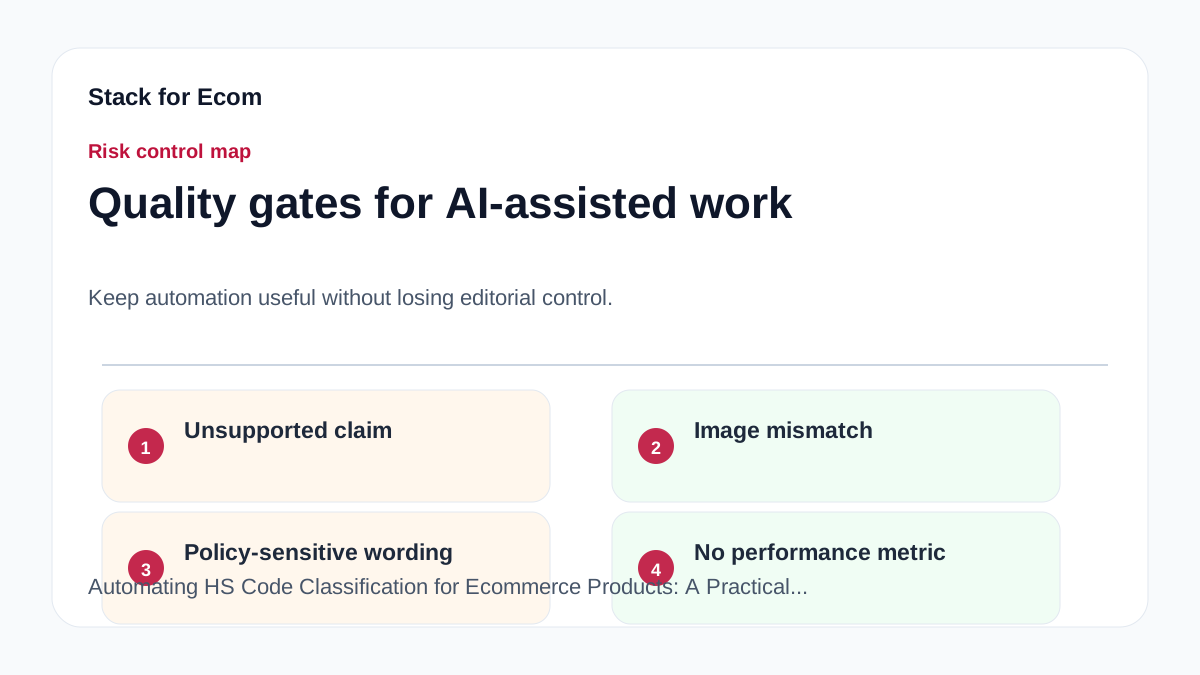
- Including PII or superfluous information in the commodity description field. CBP states only the cargo description should be transmitted. Prevention: strip order numbers, customer names, and carrier disclaimers before transmission.
- Over-relying on a beta chatbot for classification. The ITA chatbot may be inaccurate or incomplete and cannot provide product-specific responses. Prevention: use it for orientation only and verify with official references.
- Assuming a tool exists for EU HS code automation. The European Commission page does not mention any such tool. Prevention: build a manual or semi-automated process for EU-bound goods and check references.
- Missing declaration form or invoice. Foreign shipments without these may be subject to seizure, forfeiture, or return to sender. Prevention: add a pre-shipment checklist that verifies both documents.
- Ignoring importer responsibility. The importer is responsible for compliance with state and federal import regulations. Prevention: assign a compliance owner and document responsibilities.
- Failing to update classifications when products change. A material change can change the HS code. Prevention: trigger re-review when attributes change.
Suggested visuals
- A flowchart showing the classification workflow: SKU data extraction → description templating → code suggestion → human review → declaration form.
- A screenshot of a product data form with required attributes highlighted (material, function, dimensions, intended use).
- A table comparing weak vs. precise cargo descriptions, with examples like "water bottle" vs. "18/8 stainless steel vacuum-insulated water bottle, 750 ml."
- A chart showing FY2024 De Minimis shipment volume (1.36 billion) and declared value ($64.6 billion) to illustrate scale.
- A diagram of the U.S. import process for international postal shipments forwarded to CBP International Mail Branches for clearance.
- A checklist template for pre-shipment document verification (declaration form, invoice, description field).
Who this helps / Who should avoid
This article helps ecommerce sellers, exporters, and small operations teams who ship products across borders and need a repeatable way to classify goods. It is useful for operations managers, customs compliance staff, and developers building internal classification workflows. It also helps teams that want to understand what official resources exist and where automation can realistically fit.
This article is not for teams looking for a fully automated, guaranteed HS code classification tool. No such tool is described in the provided sources. It is also not a substitute for legal or professional advice. If you need product-specific or market-specific guidance, consult a customs broker or legal expert. Details may vary; check references.
Conclusion
Automating HS code classification for ecommerce products is less about finding a magic tool and more about building a disciplined data and review process. Start with precise, plain-language English descriptions. Strip PII and superfluous information. Map descriptions to codes with a rules engine, and route ambiguous SKUs to a human reviewer. Use official resources such as CBP guidance, the ITA Global Business Navigator beta chatbot, and the European Commission customs pages for orientation, but always verify outputs.
The scale of cross-border ecommerce means errors are costly. In Fiscal Year 2024, total De Minimis shipments reached 1.36 billion with a declared value of $64.6 billion. Fines, penalties, detention, or destruction can result from non-compliant goods. A semi-automated workflow with clear checkpoints reduces risk and saves time. Use the checklist above as your SOP, and revisit it as regulations and product lines change.
References
- https://www.cbp.gov/trade/basic-import-export/internet-purchases
- https://www.cbp.gov/trade/basic-import-export/e-commerce
- https://www.trade.gov/ecommerce
- https://taxation-customs.ec.europa.eu/customs-4/customs-procedures-import-and-export_en
- https://ads.tiktok.com/help/article/get-started-tiktok-ads-manager