TL;DR
- The provided sources do not contain a head-to-head comparison of cross-border ecommerce insurance products, so this article gives you a comparison framework, not a product ranking. Details may vary; check references.
- Customs compliance is a core risk driver: the importer is responsible for ensuring goods comply with state and federal import regulations, and unsafe goods, health code failures, or quota violations can lead to fines, penalties, detention, or destruction by CBP. Source: https://www.cbp.gov/trade/basic-import-export/internet-purchases
- De minimis volumes rose from 636.7 million shipments in FY2020 to 1.36 billion in FY2024, then declined to 942.5 million in FY2025, which shows how quickly cross-border parcel flows shift. Source: https://www.cbp.gov/trade/basic-import-export/e-commerce
- Use the checklist in this article as a repeatable SOP, then confirm every coverage-specific detail with the insurer, broker, or customs advisor. Details may vary; check references.
Introduction
Small exporters often treat cross-border ecommerce insurance as a single line item to buy at the last minute. In practice, the risk profile is a bundle: cargo loss and damage, customs delays, regulatory non-compliance, returns, and data handling. The provided sources do not include a direct comparison of insurance products for small exporters, so the practical problem is not "which policy is cheapest" but "which risks am I actually carrying, and what evidence do I need to compare quotes fairly?" Details may vary; check references.
The business impact shows up in cash flow and customer trust. If a shipment is detained or destroyed because goods are unsafe, fail health code requirements, or violate quota restrictions, the loss is not only the product value, it is also the freight, the marketplace penalty, and the customer relationship. Source: https://www.cbp.gov/trade/basic-import-export/internet-purchases. Meanwhile, parcel volumes are volatile: total de minimis shipment volume rose from 636.7 million in FY2020 to 1.36 billion in FY2024, then declined to 942.5 million in FY2025. Source: https://www.cbp.gov/trade/basic-import-export/e-commerce. Volatility makes under-insurance and over-insurance equally expensive.
Use this article as a decision aid. First, map your shipment and compliance exposure using the CBP and ITA facts cited here. Second, run the step-by-step checklist to build a quote-ready risk profile. Third, compare insurer responses against that profile, and treat any missing detail as a question to verify rather than an assumption. The ITA's Global Business Navigator chatbot is a general information tool in beta testing; it cannot provide responses specific to a company's product or a specific foreign market, and users are advised to double-check responses and not use them as legal or professional advice. Source: https://www.trade.gov/ecommerce.
Main Content
Start with the customs and compliance exposure, not the premium
Insurance comparison for small exporters should begin with the regulatory exposure that creates insurable and uninsurable losses. When goods move from a foreign country to the United States, they are being imported and must clear U.S. Customs and Border Protection (CBP). Source: https://www.cbp.gov/trade/basic-import-export/internet-purchases. The importer, which is the buyer when purchasing from foreign sources, is responsible for ensuring goods comply with state and federal import regulations. Source: https://www.cbp.gov/trade/basic-import-export/internet-purchases. If you are the seller shipping into the U.S., your buyer may be the importer of record, but your commercial terms and your reputation are still on the line.
Concrete example: a small exporter of consumer electronics ships 500 units to a U.S. buyer. If the goods are found to be unsafe or fail health code requirements, CBP can impose fines, penalties, detention, or destruction. Source: https://www.cbp.gov/trade/basic-import-export/internet-purchases. A cargo policy may respond to physical loss, but it will not automatically respond to a regulatory seizure. That gap is exactly what a comparison should surface, and it is why you should ask each insurer or broker how they treat customs-related losses. Details may vary; check references.
Another concrete example: merchandise imported into the United States, whether new or used, may be subject to duty payment and applicable import regulations. Source: https://www.cbp.gov/trade/basic-import-export/internet-purchases. If your landed-cost model assumes a duty rate that later changes, your margin and your insured value may both be wrong. Build the comparison around declared value accuracy, because misrepresenting the value of an item on the Customs declaration is illegal, and the importer could face legal action and fines. Source: https://www.cbp.gov/trade/basic-import-export/internet-purchases.
Build a quote-ready risk profile from declaration data
Insurers price risk from data. For small exporters, the most reliable data set is the customs declaration itself. A U.S. Customs and Border Protection Declaration form should include a full and accurate description of the merchandise in English and be securely attached to the outside of the shipment. Source: https://www.cbp.gov/trade/basic-import-export/internet-purchases. The declaration should include seller's name and address, detailed item description, quantity, purchase price in U.S. dollars (unit and total), weight, and country of origin of the product itself. Source: https://www.cbp.gov/trade/basic-import-export/internet-purchases.
Concrete example: an exporter of handmade home goods can pull unit price, total price, weight, and country of origin directly from the declaration template and use those fields as the basis for insured value and premium calculation. If the declaration is incomplete, the quote request is incomplete, and the comparison becomes apples-to-oranges. This is also where a short software angle helps: a simple spreadsheet or export-compliance tool that stores declaration fields consistently makes it easier to produce the same risk profile for every insurer you approach. Details may vary; check references.
A second concrete example: for merchandise shipped through the international postal service valued under $2,500 and not subject to quota or restriction, a CBP official usually prepares the paperwork, assesses duty, and releases it for delivery. Source: https://www.cbp.gov/trade/basic-import-export/internet-purchases. That does not remove your need to describe goods accurately, because under 19 CFR § 4.7a, 122.48a, 123.91, 123.92, and 128.21, a precise cargo description is required regardless of value, and personally identifiable information (PII), packaging type, and carrier disclaimers must not be included in the commodity description field. Source: https://www.cbp.gov/trade/basic-import-export/e-commerce. Use this rule when you compare insurers: ask whether their claims process requires the same commodity description standard.
Compare coverage against de minimis and entry-type realities
Cross-border ecommerce insurance comparison must account for how shipments actually enter the country. CBP publishes de minimis shipment statistics based on the number of Bills of Lading (BOLs) and their declared value at the time of import. Source: https://www.cbp.gov/trade/basic-import-export/e-commerce. Total de minimis shipment volume rose from 636.7 million in fiscal year 2020 to 1.36 billion in fiscal year 2024, then declined to 942.5 million in fiscal year 2025. Source: https://www.cbp.gov/trade/basic-import-export/e-commerce. Total de minimis declared value ranged from $43.5 billion (FY2021) to $67 billion (FY2020), with FY2025 at $48.1 billion. Source: https://www.cbp.gov/trade/basic-import-export/e-commerce.
Concrete example: an exporter using air freight should note that air BOLs accounted for the largest share of de minimis volume, reaching 1.1 billion in FY2024 and 794.8 million in FY2025. Source: https://www.cbp.gov/trade/basic-import-export/e-commerce. If your insurer asks for shipment counts by mode, you can supply air BOL volumes directly. Another concrete example: Entry Type 86 BOLs grew from 122.1 million in FY2020 to 948 million in FY2024, then fell to 635.3 million in FY2025. Source: https://www.cbp.gov/trade/basic-import-export/e-commerce. If your broker or insurer uses Entry Type 86 assumptions, the FY2025 decline is a reason to re-check current volumes rather than rely on FY2024 peak figures. Details may vary; check references.
CBP's E-Commerce Strategy focuses on four primary goals and identifies private industry and foreign governments as key resources in assessing the e-commerce environment. Source: https://www.cbp.gov/trade/basic-import-export/e-commerce. The strategy includes educating the public and trade community about importer compliance responsibilities and streamlining enforcement processes affected by increasing e-commerce volumes. Source: https://www.cbp.gov/trade/basic-import-export/e-commerce. For comparison purposes, ask each insurer how they align claims and compliance guidance with these enforcement priorities, and document the answer.
Use the ITA chatbot as a scoping tool, then verify
The ITA's Global Business Navigator is an AI chatbot from the International Trade Administration (ITA), currently in beta testing, designed to provide general information on the exporting process and resources for U.S. exporters. Source: https://www.trade.gov/ecommerce. It was developed using Microsoft's Azure AI services and is trained on ITA's export-related content. Source: https://www.trade.gov/ecommerce. As a beta product, the chatbot's responses may occasionally produce inaccurate or incomplete information, and its knowledge is limited to public information on the Export Solutions web pages of Trade.gov. Source: https://www.trade.gov/ecommerce.
Concrete example: a small exporter can use the chatbot to scope general questions about exporting resources, then verify the answer on the Export Solutions pages before using it in an insurance quote request. The chatbot cannot provide responses specific to a company's product or a specific foreign market, but its reference pages guide users to other relevant government resources and market research. Source: https://www.trade.gov/ecommerce. Users are advised to always double-check the chatbot's responses using the provided references or by visiting the Export Solutions web pages on Trade.gov, and not to use its responses as legal or professional advice. Source: https://www.trade.gov/ecommerce.
Data handling matters when you use any AI tool during a comparison. The chatbot does not collect user information, does not use chat history to learn new information, and all feedback is anonymous; users should not enter personally identifiable information (PII), sensitive, or proprietary information. Source: https://www.trade.gov/ecommerce. Conversations with the chatbot may be reviewed to help ITA improve the tool and address harmful, illegal, or otherwise inappropriate questions. Source: https://www.trade.gov/ecommerce. The chatbot supports a wide range of languages, but because it is trained in English and responses are translated, users should verify the translation, as it may have difficulty with acronyms, abbreviations, and nuances in other languages. Source: https://www.trade.gov/ecommerce. Practical takeaway: keep policy numbers, customer names, and proprietary pricing out of any chatbot prompt, and verify translated answers with the original English source.
Turn the comparison into a repeatable decision record
A comparison is only useful if it produces a decision record you can revisit. For each insurer or broker, record the risk profile inputs, the coverage response, the exclusions, the claims documentation requirements, and the open questions. Because the provided sources do not include a product-level insurance comparison, treat every coverage-specific answer as unverified until you confirm it in writing. Details may vary; check references.
Concrete example: an exporter of small appliances can build a one-page decision record per quote, listing declared value, country of origin, weight, and commodity description standard, then attach the corresponding declaration template. This makes renewals faster and makes audits less painful, because the same fields are used every time. A lightweight compliance or document tool can store these records, but the discipline matters more than the software.
Concrete example: an exporter shipping through the international postal service can note the under-$2,500 postal handling path, where a CBP official usually prepares the paperwork, assesses duty, and releases it for delivery. Source: https://www.cbp.gov/trade/basic-import-export/internet-purchases. Then ask the insurer whether their claims process changes for postal versus air BOL shipments, and record the answer. This is the kind of detail that separates a real comparison from a premium-only spreadsheet.
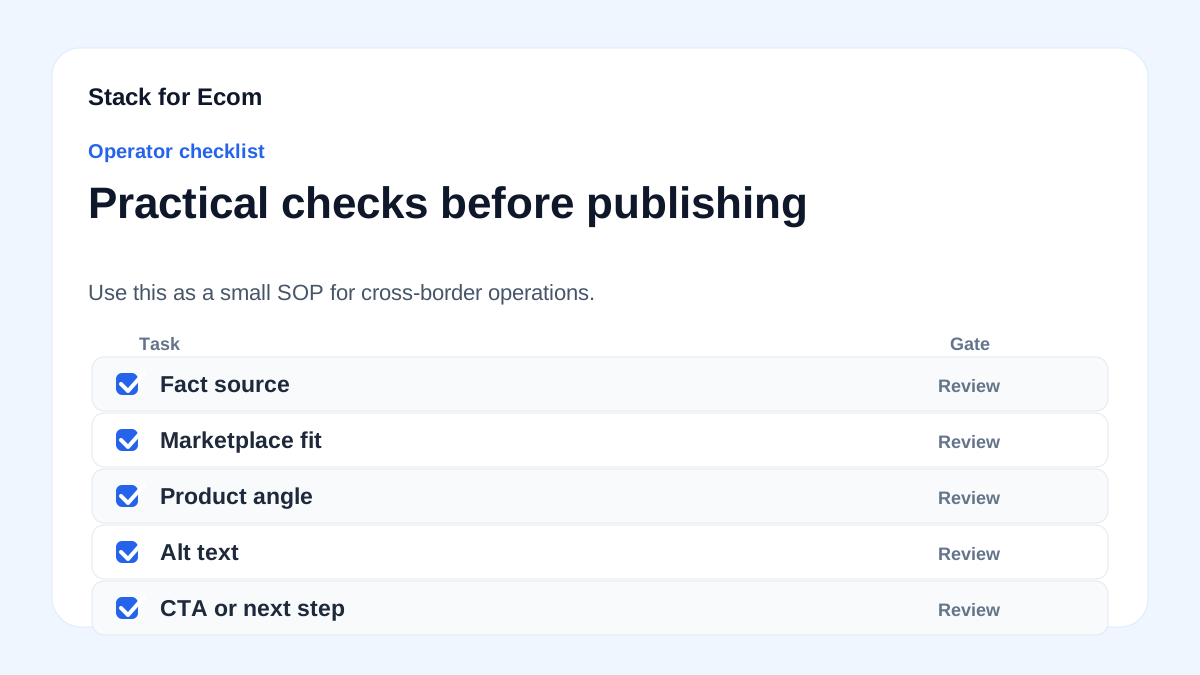
Step-by-step checklist
- Confirm who the importer of record is for each shipment lane, because the importer is responsible for ensuring goods comply with state and federal import regulations. Source: https://www.cbp.gov/trade/basic-import-export/internet-purchases
- Verify that every customs declaration includes a full and accurate description of the merchandise in English and is securely attached to the outside of the shipment. Source: https://www.cbp.gov/trade/basic-import-export/internet-purchases
- Capture seller's name and address, detailed item description, quantity, purchase price in U.S. dollars (unit and total), weight, and country of origin of the product itself for each SKU. Source: https://www.cbp.gov/trade/basic-import-export/internet-purchases
- Check that the commodity description field excludes PII, packaging type, and carrier disclaimers, per 19 CFR § 4.7a, 122.48a, 123.91, 123.92, and 128.21. Source: https://www.cbp.gov/trade/basic-import-export/e-commerce
- Do not misrepresent value on the Customs declaration, because it is illegal and the importer could face legal action and fines. Source: https://www.cbp.gov/trade/basic-import-export/internet-purchases
- Segment your lanes by mode and entry type, and pull current volumes such as air BOL and Entry Type 86 figures rather than relying on prior-year peaks. Source: https://www.cbp.gov/trade/basic-import-export/e-commerce
- For postal shipments under $2,500 that are not subject to quota or restriction, note that a CBP official usually prepares the paperwork, assesses duty, and releases it for delivery. Source: https://www.cbp.gov/trade/basic-import-export/internet-purchases
- Ask each insurer or broker how they treat fines, penalties, detention, or destruction tied to unsafe goods, health code failures, or quota violations. Source: https://www.cbp.gov/trade/basic-import-export/internet-purchases
- Use the ITA chatbot only for general scoping, then double-check responses against the provided references or the Export Solutions pages, and never as legal or professional advice. Source: https://www.trade.gov/ecommerce
- Keep PII, sensitive, and proprietary information out of chatbot prompts, and verify translated responses because the tool is trained in English. Source: https://www.trade.gov/ecommerce
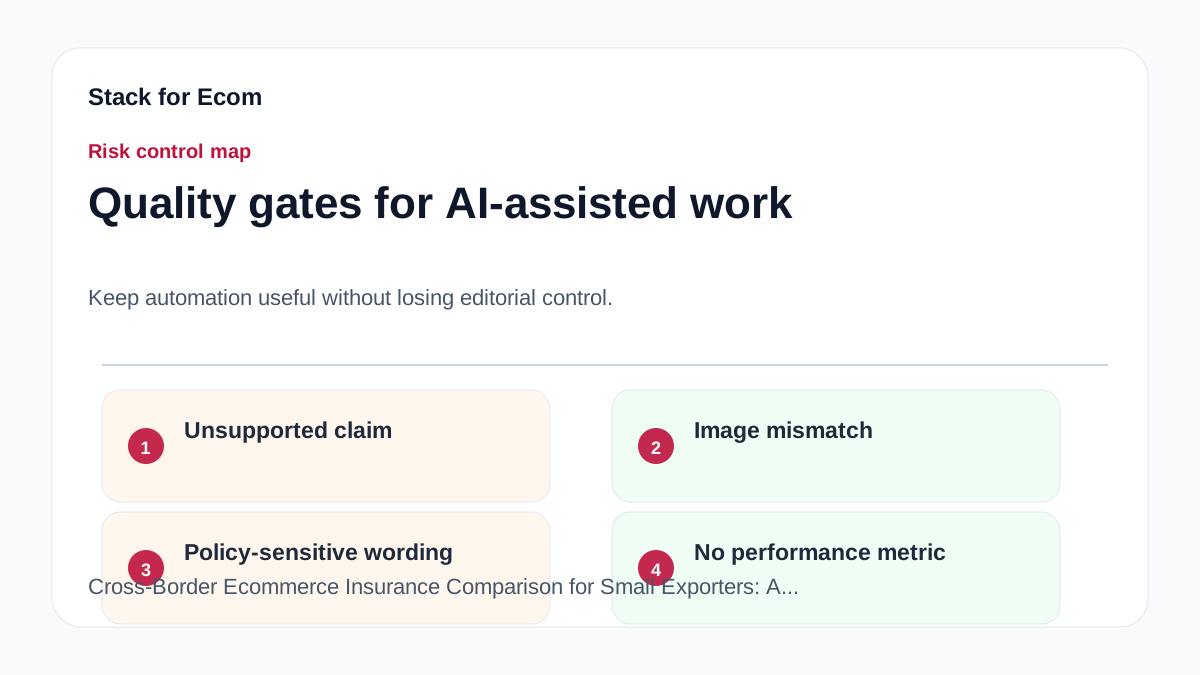
Potential pitfalls
- Assuming a cargo policy covers customs fines, penalties, detention, or destruction. Prevention: ask directly and get the answer in writing, because these outcomes are tied to unsafe goods, health code failures, or quota violations. Source: https://www.cbp.gov/trade/basic-import-export/internet-purchases
- Using an inaccurate declared value to lower duty or premium. Prevention: treat declared value as a compliance control, because misrepresentation is illegal and can lead to legal action and fines. Source: https://www.cbp.gov/trade/basic-import-export/internet-purchases
- Leaving PII, packaging type, or carrier disclaimers in the commodity description field. Prevention: apply the 19 CFR description rules on every shipment, regardless of value. Source: https://www.cbp.gov/trade/basic-import-export/e-commerce
- Relying on peak-year de minimis or Entry Type 86 volumes when building a risk profile. Prevention: use the most recent figures, such as FY2025 at 942.5 million shipments and 635.3 million Entry Type 86 BOLs, and note the decline from FY2024. Source: https://www.cbp.gov/trade/basic-import-export/e-commerce
- Treating an AI chatbot's answer as final. Prevention: remember the ITA tool is in beta, may produce inaccurate or incomplete information, cannot address your specific product or foreign market, and should be double-checked. Source: https://www.trade.gov/ecommerce
- Entering sensitive or proprietary information into a chatbot. Prevention: keep PII and confidential data out of prompts, and remember conversations may be reviewed to improve the tool and address harmful or illegal questions. Source: https://www.trade.gov/ecommerce
- Assuming translated chatbot responses are exact. Prevention: verify translation, especially for acronyms, abbreviations, and nuances, because the tool is trained in English. Source: https://www.trade.gov/ecommerce
Suggested visuals
- A one-page risk profile template showing declaration fields: seller name and address, item description, quantity, unit and total price in USD, weight, and country of origin. Source: https://www.cbp.gov/trade/basic-import-export/internet-purchases
- A bar chart of total de minimis shipment volume from FY2020 to FY2025, highlighting the rise from 636.7 million to 1.36 billion and the decline to 942.5 million. Source: https://www.cbp.gov/trade/basic-import-export/e-commerce
- A line chart of total de minimis declared value from FY2020 to FY2025, showing the range from $43.5 billion to $67 billion and FY2025 at $48.1 billion. Source: https://www.cbp.gov/trade/basic-import-export/e-commerce
- A mode-split chart comparing air BOL volume (1.1 billion in FY2024; 794.8 million in FY2025) against Entry Type 86 BOL volume (948 million in FY2024; 635.3 million in FY2025). Source: https://www.cbp.gov/trade/basic-import-export/e-commerce
- A workflow diagram of the postal path for merchandise under $2,500 not subject to quota or restriction, showing CBP official paperwork, duty assessment, and release for delivery. Source: https://www.cbp.gov/trade/basic-import-export/internet-purchases
- A screenshot-style mockup of a chatbot scoping session with a warning banner: beta tool, general information only, do not enter PII, verify responses. Source: https://www.trade.gov/ecommerce
Who this helps / Who should avoid
This helps small exporters, export operations staff, and ecommerce sellers who ship into the United States and need a structured way to compare insurance options without inventing product-level claims. It also helps teams that want a repeatable SOP for declaration data, de minimis context, and AI-tool hygiene.
This is not for readers looking for a ranked list of insurance products or a legal opinion. The provided sources do not contain a cross-border ecommerce insurance comparison for small exporters, and the TikTok Ads Help Center article could not be loaded because it no longer exists or failed to load, with no content related to this topic. Source: https://ads.tiktok.com/help/article/get-started-tiktok-ads-manager. If you need coverage-specific or legal advice, consult a qualified professional. Details may vary; check references.
Conclusion
Cross-border ecommerce insurance comparison for small exporters is a discipline, not a single purchase. Start with customs and compliance exposure, build a quote-ready risk profile from declaration data, compare coverage against de minimis and entry-type realities, and use the ITA chatbot only for general scoping with verification. The CBP facts in this article give you the compliance backbone; the checklist gives you the repeatable process.
Because the provided sources do not include product-level insurance comparisons, treat every coverage-specific answer as something to confirm with the insurer, broker, or customs advisor. Keep your decision record current, re-check volumes and rules as they change, and never let a beta AI response stand in for verified guidance. Details may vary; check references.
References
- https://www.trade.gov/ecommerce
- https://www.cbp.gov/trade/basic-import-export/internet-purchases
- https://www.cbp.gov/trade/basic-import-export/e-commerce
- https://ads.tiktok.com/help/article/get-started-tiktok-ads-manager