TL;DR
- For U.S.-bound shipments, the importer (often the buyer) is responsible for compliance with state and federal import regulations, and a full, accurate CBP declaration should be securely attached to the outside of the shipment. Source: https://www.cbp.gov/trade/basic-import-export/internet-purchases
- A complete declaration should include the seller's name and address, an English description of items, quantity of each item type, purchase price in U.S. dollars, weight, and country of origin. Source: https://www.cbp.gov/trade/basic-import-export/internet-purchases
- Missing declaration and invoice documents can lead to seizure, forfeiture, or return to sender. Source: https://www.cbp.gov/trade/basic-import-export/internet-purchases
- Precise cargo descriptions are required regardless of value under 19 CFR §§ 4.7a, 122.48a, 123.91, 123.92, and 128.21. Source: https://www.cbp.gov/trade/basic-import-export/e-commerce
- For EU-bound goods, the framework includes the Union Customs Code, customs controls, rules of origin, AEO status, prohibitions and restrictions, electronic customs systems, and the EU Customs Reform initiative. Source: https://taxation-customs.ec.europa.eu/customs-4/customs-procedures-import-and-export_en
- Details may vary; check references.
Introduction
Small cross-border ecommerce shipments fail at the border for predictable, document-level reasons: a vague item description, a missing declaration, an invoice that does not match the parcel, or a value that looks inconsistent with the product. When goods move from any foreign country to the United States, they are being imported and are subject to specific rules and regulations. The importer, which is the buyer when purchasing from foreign sources, is responsible for assuring that goods comply with state and federal government import regulations. That means the seller's paperwork quality directly affects the buyer's ability to clear goods, and it affects the seller's reputation, refund rate, and repeat-purchase rate. Source: https://www.cbp.gov/trade/basic-import-export/internet-purchases
The business impact is not limited to a single delayed parcel. Importing goods that are unsafe, fail to meet health code requirements, or violate quota restrictions could result in fines, penalties, detention, or destruction by CBP. Foreign shipments not accompanied by a U.S. Customs and Border Protection declaration form and an invoice may be subject to seizure, forfeiture, or return to sender. Misrepresenting the value or nature of an item on the Customs declaration is illegal and the importer could face legal action and fines. For a small operation, one seizure or one penalty notice can consume the margin from dozens of orders. Source: https://www.cbp.gov/trade/basic-import-export/internet-purchases
Use this article as a working template and SOP. It gives you the fields to include, the wording standards to follow, and a repeatable checklist you can hand to a packer, a 3PL, or a virtual assistant. It also flags where U.S. and EU rules differ, and where you should verify current requirements instead of assuming. The goal is not legal advice; it is a practical document system that reduces holds, delays, and avoidable penalties. Source: https://www.cbp.gov/trade/basic-import-export/internet-purchases
Main Content
What a customs clearance document template must contain for U.S.-bound parcels
A U.S. Customs and Border Protection Declaration form should include a full and accurate description of the merchandise and be securely attached to the outside of the shipment. This is the core physical requirement. If the declaration is inside the box, or if it is attached loosely and falls off in transit, the shipment can be treated as unaccompanied by the required form. Source: https://www.cbp.gov/trade/basic-import-export/internet-purchases
The declaration should include the seller's name and address, description of items in English, quantity of each item type, purchase price in U.S. dollars, weight, and country of origin. Build your template around these six fields first. For example, a seller shipping 12 silicone phone cases from Vietnam should not write "accessories" or "gift." The template should force: seller name and address; "silicone phone cases, 12 pieces"; unit price and total purchase price in USD; shipment weight; and country of origin. Source: https://www.cbp.gov/trade/basic-import-export/internet-purchases
A practical template also separates the commercial invoice from the customs declaration. The invoice supports the declared value and the buyer-seller relationship; the declaration supports the border description. Keep both documents aligned. If the invoice says "sample" but the declaration says "retail goods," you have created an inconsistency that can trigger questions. Details may vary; check references. Source: https://www.cbp.gov/trade/basic-import-export/internet-purchases
Precise cargo descriptions: the field that causes most holds
19 CFR §§ 4.7a, 122.48a, 123.91, 123.92, and 128.21 require a precise cargo description of merchandise regardless of value. This is important for small ecommerce sellers because the common belief is that low-value parcels do not need detailed descriptions. The regulation does not support that belief. A precise cargo description must be clear, concise, in plain language, and detailed enough for U.S. Customs to identify the size, shape, and characteristics of the commodity; only the cargo description should be transmitted in the commodity description field. Source: https://www.cbp.gov/trade/basic-import-export/e-commerce
In practice, this means your template should reject generic terms such as "goods," "sample," "gift," "accessories," or "parts" when used alone. A better description for a textile shipment is "men's cotton knit T-shirts, short sleeve, 100% cotton, 24 pieces." A better description for a hardware shipment is "stainless steel hex bolts, M8 x 40 mm, 500 pieces." The description should let an officer identify what the item is without opening the parcel. Source: https://www.cbp.gov/trade/basic-import-export/e-commerce
This matters at scale. In fiscal year 2024, total de minimis shipments reached 1.36 billion with a declared value of $64.6 billion. Entry Type 86 BOLs increased from 122.1 million in fiscal year 2020 to 948 million in fiscal year 2024. With that volume, generic descriptions create friction for everyone. A Bill of Lading is a document issued by a carrier to a shipper that serves as evidence of receipt of goods, the contract of carriage, and the commitment to deliver the goods, and de minimis volume and value statistics are calculated from the number of Bills of Lading and their declared value at the time of import. Your description quality feeds directly into that data. Source: https://www.cbp.gov/trade/basic-import-export/e-commerce
U.S. postal and low-value shipment handling
For merchandise shipped through international postal service valued under $2,500 and not subject to quota or restriction, a CBP official will usually prepare import paperwork, assess duty, and release it for delivery. This is a useful baseline for small sellers using postal channels, but it does not remove the seller's obligation to provide accurate declarations and invoices. The official can only prepare paperwork from the information provided. Source: https://www.cbp.gov/trade/basic-import-export/internet-purchases
If the parcel is not accompanied by a declaration form and an invoice, it may be subject to seizure, forfeiture, or return to sender. That is a direct operational cost: return shipping, lost inventory, refunded buyer, and possible platform penalty. For a small seller, the cheapest insurance is a template that makes the declaration and invoice impossible to forget. Source: https://www.cbp.gov/trade/basic-import-export/internet-purchases
CBP's E-Commerce Strategy focuses on four primary goals and identifies private industry and foreign governments as key resources for assessing the e-commerce environment. The strategy includes efforts to educate the public and trade community about importer responsibilities for customs compliance and to streamline enforcement processes affected by increasing e-commerce volumes. That means education and enforcement are moving together. Sellers who build clean documentation now are better positioned than sellers who rely on vague declarations. Source: https://www.cbp.gov/trade/basic-import-export/e-commerce
EU-bound shipments: what changes in your template
The European Commission's Directorate-General for Taxation and Customs Union publishes information on EU customs procedures for importing and exporting goods. The EU customs framework includes the Union Customs Code, customs controls, rules of origin, and Authorised Economic Operator (AEO) status. If you ship to the EU, your template should not be a copy of the U.S. form. It should include the commercial invoice data, origin information, and any restriction flags required for the specific goods. Source: https://taxation-customs.ec.europa.eu/customs-4/customs-procedures-import-and-export_en
The EU maintains prohibitions and restrictions applicable to certain goods in cross-border trade. Your template should therefore include a screening step before packing: does this product category face prohibitions or restrictions in the destination country? The European Commission provides online services and databases for customs procedures, and the EU operates an electronic customs system as part of its customs procedures. Use those official services to verify current requirements rather than relying on a template alone. Source: https://taxation-customs.ec.europa.eu/customs-4/customs-procedures-import-and-export_en
The EU Customs Reform is listed as an active initiative within the customs procedures framework. That means procedures and systems may change. Build your template with version control: date the template, note the source, and review it when you expand to a new market. Details may vary; check references. Source: https://taxation-customs.ec.europa.eu/customs-4/customs-procedures-import-and-export_en
Tools and reference workflows for small teams
You do not need enterprise customs software to run a clean process, but a small amount of tooling helps. The Global Business Navigator is an AI chatbot from the International Trade Administration (ITA), currently in beta testing, designed to provide general information on the exporting process and resources for U.S. exporters. It was developed using Microsoft's Azure AI services and is trained on ITA's export-related content. As a beta product, the chatbot's responses may occasionally be inaccurate or incomplete, and its knowledge is limited to public information on the Export Solutions web pages of Trade.gov. Source: https://www.trade.gov/ecommerce
The chatbot cannot provide responses specific to a company's product or a specific foreign market, but its reference pages guide users to other government resources and market research. Users should always double-check the chatbot's responses using provided references or by visiting the Export Solutions web pages on Trade.gov, and should not use its responses as legal or professional advice. The chatbot does not collect user information, does not use chat history to learn new information, and all feedback is anonymous; users should not enter personally identifiable information (PII), sensitive, or proprietary information. Conversations with the chatbot may be reviewed to help ITA improve the tool and address harmful, illegal, or otherwise inappropriate questions. The chatbot supports a wide range of languages, but because it is trained in English and responses are translated, users should verify translations as it may have difficulty with acronyms, abbreviations, and nuances in other languages. Source: https://www.trade.gov/ecommerce
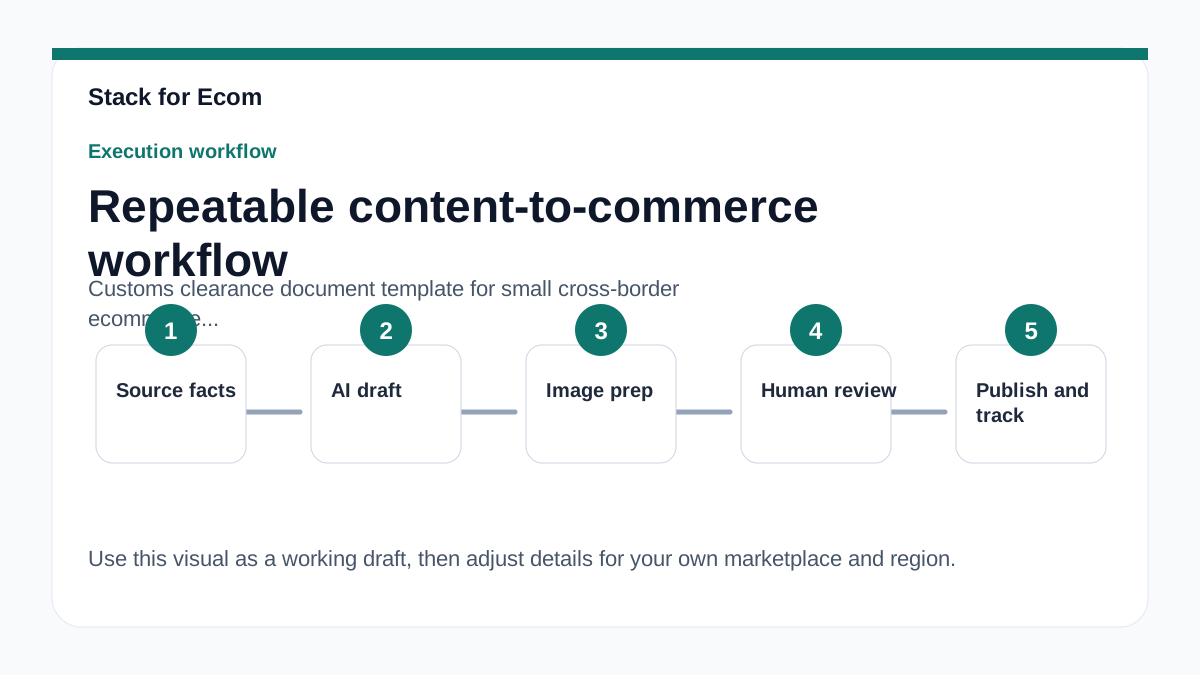
Use such tools for orientation, not as a replacement for your own document review. A practical workflow is: (1) product and destination screening; (2) template population; (3) second-person review of description, value, weight, and origin; (4) attachment to the outside of the shipment; (5) archive a copy with the tracking number. This workflow can live in a spreadsheet, a shared drive, or a lightweight order-management tool. The tool matters less than the repeatable review step. Source: https://www.trade.gov/ecommerce
One note on unrelated sources: the requested article on the TikTok Ads Help Center is no longer available or failed to load, and the page displays a 'Back to home page' link with a 5-second countdown. No customs clearance document template content for small cross-border ecommerce shipments is present in that source. Do not rely on it for customs guidance. Source: https://ads.tiktok.com/help/article/get-started-tiktok-ads-manager
Step-by-step checklist
- Confirm the destination country and whether the shipment is U.S.-bound, EU-bound, or both. Source: https://www.cbp.gov/trade/basic-import-export/internet-purchases
- Screen the product against prohibitions, restrictions, health code requirements, and quota restrictions before packing. Source: https://www.cbp.gov/trade/basic-import-export/internet-purchases
- Populate the seller's name and address exactly as it should appear on the declaration. Source: https://www.cbp.gov/trade/basic-import-export/internet-purchases
- Write the item description in English, in plain language, detailed enough to identify size, shape, and characteristics. Source: https://www.cbp.gov/trade/basic-import-export/e-commerce
- Enter the quantity of each item type separately; do not combine different products into one generic line. Source: https://www.cbp.gov/trade/basic-import-export/internet-purchases
- Enter the purchase price in U.S. dollars and ensure it matches the commercial invoice. Source: https://www.cbp.gov/trade/basic-import-export/internet-purchases
- Record the shipment weight and country of origin for each item line. Source: https://www.cbp.gov/trade/basic-import-export/internet-purchases
- Attach the declaration securely to the outside of the shipment and include the invoice. Source: https://www.cbp.gov/trade/basic-import-export/internet-purchases
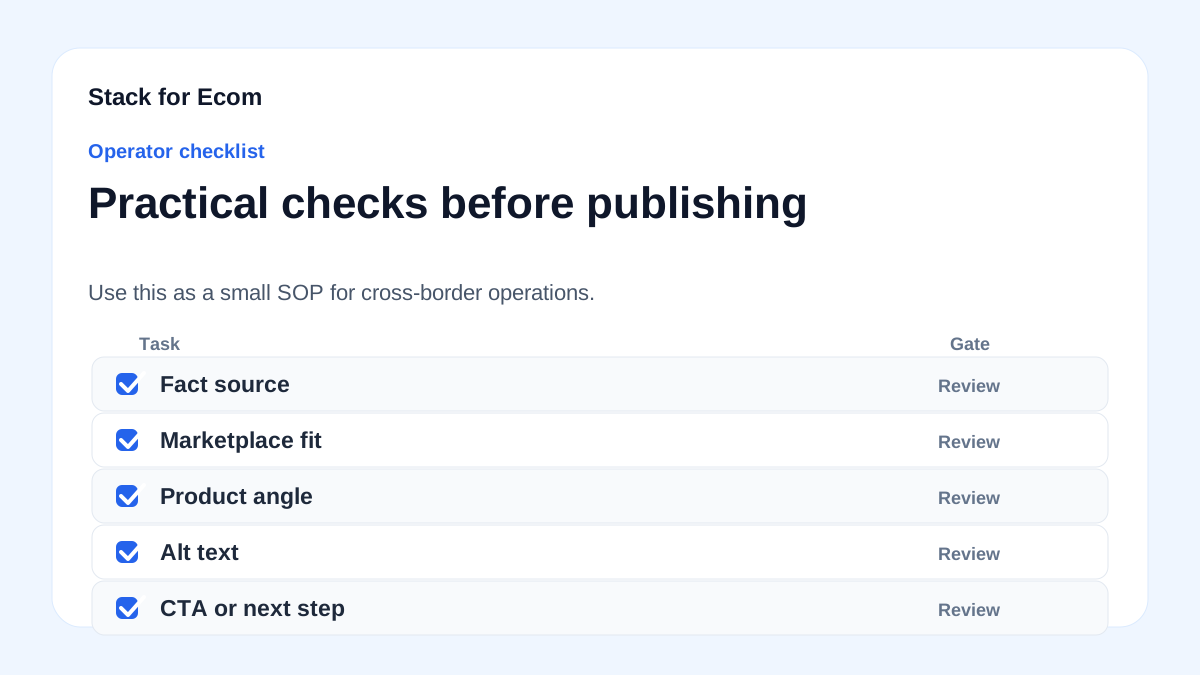
- Have a second person review the description, value, weight, and origin before the parcel is sealed. Source: https://www.cbp.gov/trade/basic-import-export/e-commerce
- Archive a copy of the declaration, invoice, and tracking number for at least the period required by your marketplace or internal policy. Source: https://www.cbp.gov/trade/basic-import-export/internet-purchases
- For EU-bound goods, verify current procedures using official European Commission services and databases. Source: https://taxation-customs.ec.europa.eu/customs-4/customs-procedures-import-and-export_en
- Review and version-control the template whenever you add a new product category or destination market. Source: https://taxation-customs.ec.europa.eu/customs-4/customs-procedures-import-and-export_en
Potential pitfalls
- Using generic descriptions such as "gift," "sample," or "accessories." Prevention: require a plain-language description with material, size, shape, and use. Source: https://www.cbp.gov/trade/basic-import-export/e-commerce
- Understating value or misdescribing the item to reduce duty. Prevention: treat the declared value as a compliance field, not a pricing field; misrepresentation is illegal and can lead to legal action and fines. Source: https://www.cbp.gov/trade/basic-import-export/internet-purchases
- Attaching the declaration inside the parcel or loosely on the outside. Prevention: make "securely attached to the outside" a packing-station requirement. Source: https://www.cbp.gov/trade/basic-import-export/internet-purchases
- Assuming low-value postal shipments do not need documentation. Prevention: include the declaration and invoice even when a CBP official will usually prepare import paperwork for postal items under $2,500. Source: https://www.cbp.gov/trade/basic-import-export/internet-purchases
- Copying a U.S. template for EU shipments. Prevention: check EU-specific requirements, including the Union Customs Code, rules of origin, AEO status, and prohibitions and restrictions. Source: https://taxation-customs.ec.europa.eu/customs-4/customs-procedures-import-and-export_en
- Relying on an AI chatbot's answer as final customs advice. Prevention: double-check responses using provided references and do not use them as legal or professional advice. Source: https://www.trade.gov/ecommerce
- Entering PII or proprietary information into a public beta chatbot. Prevention: keep customer names, addresses, and supplier data out of the chat. Source: https://www.trade.gov/ecommerce
Suggested visuals
- A one-page "Customs Declaration Field Map" showing the six required fields: seller name and address, English description, quantity, purchase price in USD, weight, and country of origin. Source: https://www.cbp.gov/trade/basic-import-export/internet-purchases
- A side-by-side comparison table of a bad description versus a precise cargo description, using textile and hardware examples. Source: https://www.cbp.gov/trade/basic-import-export/e-commerce
- A workflow diagram of the packing-station SOP: screen, populate, review, attach, archive. Source: https://www.cbp.gov/trade/basic-import-export/internet-purchases
- A screenshot-style mockup of a commercial invoice aligned with the customs declaration, highlighting matching value, weight, and origin fields. Source: https://www.cbp.gov/trade/basic-import-export/internet-purchases
- A chart showing the growth of Entry Type 86 BOLs from 122.1 million in fiscal year 2020 to 948 million in fiscal year 2024. Source: https://www.cbp.gov/trade/basic-import-export/e-commerce
- A simple EU-versus-U.S. checklist graphic listing Union Customs Code, rules of origin, AEO status, and prohibitions and restrictions as EU-specific considerations. Source: https://taxation-customs.ec.europa.eu/customs-4/customs-procedures-import-and-export_en
Who this helps / Who should avoid
This helps small cross-border ecommerce sellers, exporters, marketplace operators, 3PL packers, and virtual assistants who prepare customs paperwork for parcels. It is also useful for teams shipping low-value goods through postal or express channels who need a repeatable document SOP. If you ship to the United States or the European Union and you currently rely on informal descriptions, this template will reduce avoidable holds. Source: https://www.cbp.gov/trade/basic-import-export/internet-purchases
This is not a substitute for legal or professional customs advice. Teams shipping restricted goods, regulated health products, high-value cargo, or goods subject to quota should work with a licensed customs broker and verify current requirements directly with the relevant authority. If your product category is unclear, do not guess. Details may vary; check references. Source: https://taxation-customs.ec.europa.eu/customs-4/customs-procedures-import-and-export_en
Teams looking for a marketing or advertising template should avoid using this article. The TikTok Ads Help Center source referenced in the facts does not contain customs clearance document template content, and the page was unavailable or failed to load. Source: https://ads.tiktok.com/help/article/get-started-tiktok-ads-manager
Conclusion
A customs clearance document template for small cross-border ecommerce shipments is less about a single form and more about a controlled process. The declaration must be full and accurate, attached securely to the outside of the shipment, and supported by an invoice. The importer carries responsibility for compliance, and the seller's paperwork determines whether the buyer can clear the goods smoothly. Source: https://www.cbp.gov/trade/basic-import-export/internet-purchases
Start with the six required fields, enforce precise cargo descriptions regardless of value, and add a second-person review before sealing. For EU-bound goods, verify current procedures through official European Commission services and databases. For general orientation, tools such as the ITA's beta chatbot can help, but always double-check responses and never treat them as legal or professional advice. Source: https://www.trade.gov/ecommerce
Finally, version-control your template. As ecommerce volumes grow and customs frameworks evolve, including the EU Customs Reform initiative, your template should be reviewed when you add products or markets. A dated, source-linked template is a small operational asset that prevents large border problems. Source: https://taxation-customs.ec.europa.eu/customs-4/customs-procedures-import-and-export_en
References
- https://www.cbp.gov/trade/basic-import-export/internet-purchases
- https://www.cbp.gov/trade/basic-import-export/e-commerce
- https://taxation-customs.ec.europa.eu/customs-4/customs-procedures-import-and-export_en
- https://www.trade.gov/ecommerce
- https://ads.tiktok.com/help/article/get-started-tiktok-ads-manager