TL;DR
- When goods move from any foreign country to the United States, they are being imported and are subject to specific rules and regulations. Source: https://www.cbp.gov/trade/basic-import-export/internet-purchases
- The importer, which is the buyer when purchasing from foreign sources, is responsible for assuring that the goods comply with state and federal government import regulations. Source: https://www.cbp.gov/trade/basic-import-export/internet-purchases
- Merchandise imported into the United States, whether new or used, must clear CBP and may be subject to duty payment and applicable import regulations. Source: https://www.cbp.gov/trade/basic-import-export/internet-purchases
- A U.S. Customs and Border Protection Declaration form should include a full and accurate description of the merchandise and be securely attached to the outside of the shipment. Source: https://www.cbp.gov/trade/basic-import-export/internet-purchases
- Foreign shipments not accompanied by a U.S. Customs and Border Protection declaration form and an invoice may be subject to seizure, forfeiture, or return to sender. Source: https://www.cbp.gov/trade/basic-import-export/internet-purchases
- 19 CFR §§ 4.7a, 122.48a, 123.91, 123.92, and 128.21 require a precise cargo description regardless of merchandise value. Source: https://www.cbp.gov/trade/basic-import-export/e-commerce
- In fiscal year 2024, total de minimis shipments reached 1.36 billion with a declared value of $64.6 billion. Source: https://www.cbp.gov/trade/basic-import-export/e-commerce
- The EU customs framework includes the Union Customs Code, customs controls, rules of origin, and prohibitions and restrictions. Source: https://taxation-customs.ec.europa.eu/customs-4/customs-procedures-import-and-export_en
Introduction
Cross-border ecommerce operators often treat customs valuation as a back-office formality until a shipment is delayed, seized, or returned. In practice, valuation and documentation are the front line of import compliance. When goods move from any foreign country to the United States, they are being imported and are subject to specific rules and regulations. Source: https://www.cbp.gov/trade/basic-import-export/internet-purchases. The importer, which is the buyer when purchasing from foreign sources, is responsible for assuring that the goods comply with state and federal government import regulations. Source: https://www.cbp.gov/trade/basic-import-export/internet-purchases. That means the seller's commercial invoice, declaration form, and product description must be accurate enough for customs to classify the goods and assess duty.
The business impact is direct. Merchandise imported into the United States, whether new or used, must clear CBP and may be subject to duty payment and applicable import regulations. Source: https://www.cbp.gov/trade/basic-import-export/internet-purchases. Importing goods that are unsafe, fail to meet health code requirements, or violate quota restrictions could result in fines, penalties, detention, or destruction by CBP. Source: https://www.cbp.gov/trade/basic-import-export/internet-purchases. For a growing ecommerce operation, one mis-declared SKU can trigger a hold across an entire inbound batch, disrupt marketplace delivery promises, and create refund and reshipment costs that erase thin margins.
This guide translates the available customs facts into an operator-ready workflow. It focuses on what you can control before handoff: declaration forms, English-language descriptions, invoice attachment, cargo description quality, and awareness of EU customs procedures. Where a specific threshold, rate, or platform rule is not provided in the sources, we flag it as something to verify. Use the checklist as a repeatable SOP and the pitfalls section as a pre-shipment audit.
Main Content
1. Who is the importer, and why does that determine your valuation paperwork?
The importer is the party legally responsible for compliance. The importer, which is the buyer when purchasing from foreign sources, is responsible for assuring that the goods comply with state and federal government import regulations. Source: https://www.cbp.gov/trade/basic-import-export/internet-purchases. In a direct-to-consumer ecommerce model, the buyer is often the end customer, but in wholesale, marketplace, or fulfillment-center models, the importer may be your company, a subsidiary, or a third-party importer of record. This distinction matters because the importer's identity drives who signs declarations, who receives CBP inquiries, and who bears duty liability.
For practical purposes, treat every outbound international parcel as an import file. Merchandise imported into the United States, whether new or used, must clear CBP and may be subject to duty payment and applicable import regulations. Source: https://www.cbp.gov/trade/basic-import-export/internet-purchases. Even used or sample goods are not exempt from clearance. Build a file that includes the commercial invoice, the declaration form, and a product description detailed enough to determine the classification number and duty rate assigned by Customs. Source: https://www.cbp.gov/trade/basic-import-export/internet-purchases.
Example: A U.S. ecommerce seller buys 500 units of a phone accessory from a supplier in Asia and ships them to a third-party logistics warehouse. The seller is the buyer and therefore the importer for that transaction. If the invoice says "accessories" without material, function, or model, customs cannot reliably classify the goods. The seller should prepare a full and accurate description and ensure the declaration is securely attached to the outside of the shipment. Source: https://www.cbp.gov/trade/basic-import-export/internet-purchases. Details may vary; check references.
2. The declaration form and invoice: the two documents that prevent seizure
A U.S. Customs and Border Protection Declaration form should include a full and accurate description of the merchandise and be securely attached to the outside of the shipment. Source: https://www.cbp.gov/trade/basic-import-export/internet-purchases. The form is not a formality; it is the document that allows customs to understand what is inside the package before it is opened. If the form is missing, incomplete, or attached loosely, the shipment can be delayed or rejected.
The invoice is equally important. Foreign shipments not accompanied by a U.S. Customs and Border Protection declaration form and an invoice may be subject to seizure, forfeiture, or return to sender. Source: https://www.cbp.gov/trade/basic-import-export/internet-purchases. For ecommerce operators, the invoice should match the order, the packing list, and the declaration. Discrepancies between the invoice value and the declared value are a common trigger for customs questions, even when the seller believes the value is low.
Example: A small exporter sends 20 parcels of handmade jewelry to U.S. customers. The supplier writes "gift" on the invoice and omits the declaration form. Because foreign shipments not accompanied by a declaration form and an invoice may be subject to seizure, forfeiture, or return to sender, the entire batch is at risk. Source: https://www.cbp.gov/trade/basic-import-export/internet-purchases. The fix is procedural: attach the declaration to the outside, include an English-language invoice, and keep a digital copy for the importer.
3. Precise cargo descriptions: the rule that applies regardless of value
Many sellers assume that low-value shipments do not need detailed descriptions. The available facts contradict that assumption. 19 CFR §§ 4.7a, 122.48a, 123.91, 123.92, and 128.21 require a precise cargo description regardless of merchandise value. Source: https://www.cbp.gov/trade/basic-import-export/e-commerce. A precise cargo description must be clear, concise, in plain language, and detailed enough for U.S. Customs to identify the commodity's size, shape, and characteristics. Source: https://www.cbp.gov/trade/basic-import-export/e-commerce.
What does that look like in practice? Instead of "electronics" or "gifts," write "wireless Bluetooth earbuds, plastic housing, 5 cm x 3 cm, model XR-200." Only the cargo description should be transmitted in the commodity description field; personally identifiable information, packaging type, and carrier disclaimers should not be included. Source: https://www.cbp.gov/trade/basic-import-export/e-commerce. This means you should not put customer names, phone numbers, or "fragile" notes in the commodity field. Keep the field clean and factual.
Example: A cross-border seller ships 1,000 units of a silicone kitchen utensil set. The cargo description field says "kitchen items." Customs cannot determine size, shape, or characteristics, so the shipment may be held for more information. A better description is "silicone kitchen utensil set, 12 pieces, heat-resistant to 230°C, item SKU-KU-12." This level of detail supports classification and duty assessment without adding marketing language. The same principle applies to EU-bound shipments, where the EU customs framework includes the Union Customs Code, customs controls, rules of origin, and prohibitions and restrictions. Source: https://taxation-customs.ec.europa.eu/customs-4/customs-procedures-import-and-export_en.
4. De minimis data and what it tells operators about volume risk
De minimis volume and value statistics are calculated from the number of Bills of Lading (BOLs) and their declared value at the time of import. Source: https://www.cbp.gov/trade/basic-import-export/e-commerce. In fiscal year 2024, total de minimis shipments reached 1.36 billion with a declared value of $64.6 billion. Source: https://www.cbp.gov/trade/basic-import-export/e-commerce. These figures show that low-value shipments are a massive and visible category, not an invisible one. Customs authorities have data on volume and declared value, which means systematic under-declaration or vague descriptions are easier to spot than sellers may think.
For operators, the takeaway is not a specific threshold to exploit. It is that declared value and BOL data are the basis for statistics and risk analysis. If your invoices consistently show a lower value than comparable goods, or if your cargo descriptions are generic, your shipments may attract additional scrutiny. CBP's E-Commerce Strategy focuses on four primary goals and identifies private industry and foreign governments as key resources. Source: https://www.cbp.gov/trade/basic-import-export/e-commerce. The strategy includes efforts to educate the public and trade community about importer responsibilities for customs compliance. Source: https://www.cbp.gov/trade/basic-import-export/e-commerce.
Example: A seller ships 10,000 low-value parcels per month and uses "accessories" as the description for every parcel. Even if each parcel is below any de minimis threshold, the BOL and declared value data create a pattern. A more defensible approach is to use precise descriptions per SKU, keep invoices consistent, and train fulfillment staff on the commodity description field rules. For merchandise shipped through the international postal service valued at less than $2,500 and not subject to quota or restriction, a CBP official will usually prepare import paperwork, assess duty, and release it for delivery. Source: https://www.cbp.gov/trade/basic-import-export/internet-purchases. That convenience does not remove the need for accurate declarations.
5. EU customs procedures and the compliance mindset for multi-region sellers
If you sell into both the United States and the European Union, you need to understand that customs frameworks differ. The European Commission's Directorate-General for Taxation and Customs Union provides information on EU customs procedures for importing and exporting goods. Source: https://taxation-customs.ec.europa.eu/customs-4/customs-procedures-import-and-export_en. The EU customs framework includes the Union Customs Code, customs controls, rules of origin, and prohibitions and restrictions. Source: https://taxation-customs.ec.europa.eu/customs-4/customs-procedures-import-and-export_en.
Authorised Economic Operator (AEO) status is a recognized customs procedure within the EU. Source: https://taxation-customs.ec.europa.eu/customs-4/customs-procedures-import-and-export_en. The EU maintains electronic customs systems and online services and databases for customs procedures. Source: https://taxation-customs.ec.europa.eu/customs-4/customs-procedures-import-and-export_en. National customs administrations of EU member states are referenced as part of the customs framework. Source: https://taxation-customs.ec.europa.eu/customs-4/customs-procedures-import-and-export_en. The EU Customs Reform is listed as an ongoing initiative under the customs section. Source: https://taxation-customs.ec.europa.eu/customs-4/customs-procedures-import-and-export_en. Because reform is ongoing, specific procedural changes and dates may vary; check references.
Example: A U.S. exporter ships apparel to Germany and the United States. For the U.S. leg, the declaration form must include a full and accurate description and be attached to the outside of the shipment. Source: https://www.cbp.gov/trade/basic-import-export/internet-purchases. For the EU leg, the seller should check the Union Customs Code, rules of origin, and any prohibitions or restrictions that apply to textiles. The same SKU may require different documentation and may face different duty treatment. A multi-region compliance matrix, reviewed quarterly, is a practical tool to keep both lanes aligned.
6. Using available tools without outsourcing responsibility
The International Trade Administration (ITA) offers a beta AI chatbot called the Global Business Navigator, built with Microsoft Azure AI services, to provide general information on the exporting process and resources for U.S. exporters. Source: https://www.trade.gov/ecommerce. This can be useful for orientation, but it is not a customs ruling. The chatbot's knowledge is limited to public information on the Export Solutions web pages of Trade.gov and cannot provide responses specific to a company's product or a specific foreign market. Source: https://www.trade.gov/ecommerce.
As a beta product, the chatbot may occasionally produce inaccurate or incomplete information, and users are advised to double-check responses using provided references or by visiting the Export Solutions web pages on Trade.gov. Source: https://www.trade.gov/ecommerce. The chatbot does not collect user information, does not use chat history to learn new information, and all feedback is anonymous; users should not enter personally identifiable information (PII), sensitive, or proprietary information. Source: https://www.trade.gov/ecommerce. Conversations with the chatbot may be reviewed to help ITA improve the tool and address harmful, illegal, or otherwise inappropriate questions. Source: https://www.trade.gov/ecommerce. The chatbot supports a wide range of languages, but because it is trained in English and responses are translated, users should verify translations as it may have difficulty with acronyms, abbreviations, and nuances in other languages. Source: https://www.trade.gov/ecommerce. The chatbot is trained to decline out of scope or inappropriate requests, and its responses should not be used as legal or professional advice; inaccurate advice would not be a defense to violating any export rules or regulations. Source: https://www.trade.gov/ecommerce.
Example: A seller asks a general AI tool about duty rates for a specific product. The tool may give a plausible but non-binding answer. The responsible operator uses that answer only to identify questions for a customs broker or official source. The importer remains responsible for assuring that the goods comply with state and federal government import regulations. Source: https://www.cbp.gov/trade/basic-import-export/internet-purchases. Software can speed up invoice generation and description validation, but it does not transfer liability.
Note: One source in the allowlist, the TikTok Ads Manager help article, could not be found or failed to load. Source: https://ads.tiktok.com/help/article/get-started-tiktok-ads-manager. The page displays a 'Back to home page' link with a 5-second countdown. Source: https://ads.tiktok.com/help/article/get-started-tiktok-ads-manager. No customs valuation content, dates, thresholds, policy requirements, or actionable steps are present in the provided content. Source: https://ads.tiktok.com/help/article/get-started-tiktok-ads-manager. We therefore do not use it for customs guidance.
Step-by-step checklist
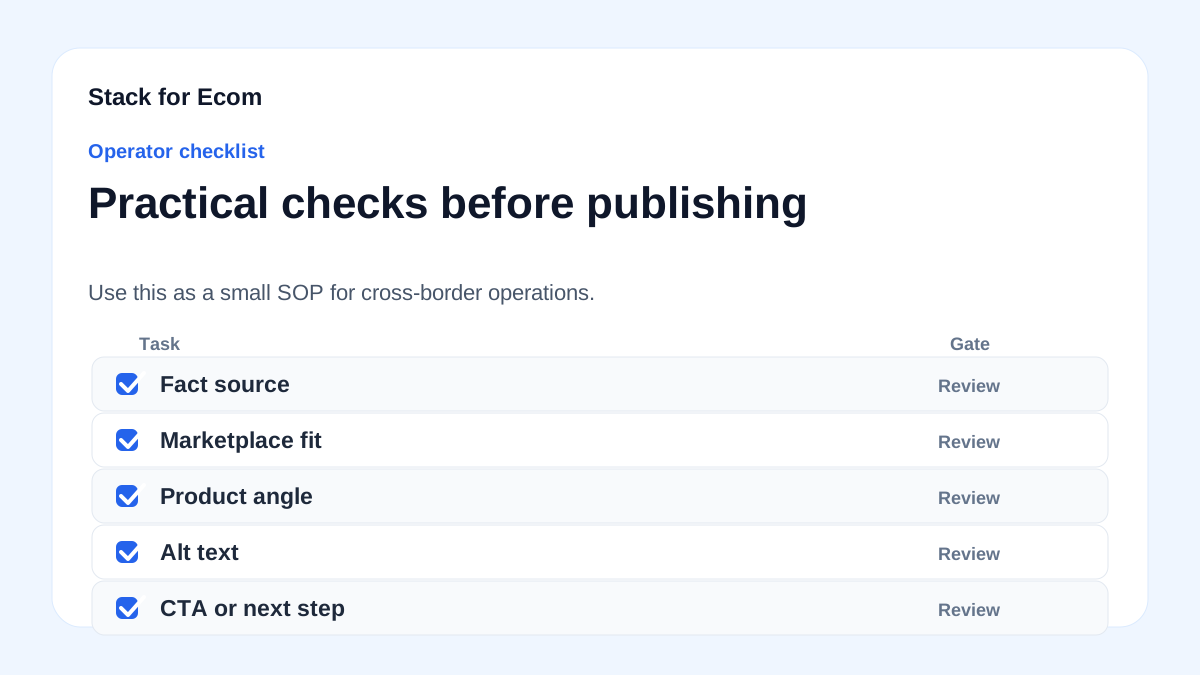
Use this as a pre-shipment SOP for every cross-border ecommerce order or bulk inbound shipment.
- Confirm the importer of record. Identify whether the buyer, your company, or a third party is the importer, because the importer is responsible for assuring that the goods comply with state and federal government import regulations. Source: https://www.cbp.gov/trade/basic-import-export/internet-purchases.
- Verify that the goods are not unsafe, do not fail health code requirements, and do not violate quota restrictions, since importing such goods could result in fines, penalties, detention, or destruction by CBP. Source: https://www.cbp.gov/trade/basic-import-export/internet-purchases.
- Prepare a U.S. Customs and Border Protection Declaration form with a full and accurate description of the merchandise, and attach it securely to the outside of the shipment. Source: https://www.cbp.gov/trade/basic-import-export/internet-purchases.
- Include a commercial invoice with every foreign shipment, because shipments not accompanied by a declaration form and an invoice may be subject to seizure, forfeiture, or return to sender. Source: https://www.cbp.gov/trade/basic-import-export/internet-purchases.
- Write the item description in English and make it detailed enough to determine the classification number and duty rate assigned by Customs. Source: https://www.cbp.gov/trade/basic-import-export/internet-purchases.
- Apply the precise cargo description rule regardless of merchandise value, per 19 CFR §§ 4.7a, 122.48a, 123.91, 123.92, and 128.21. Source: https://www.cbp.gov/trade/basic-import-export/e-commerce.
- Make the cargo description clear, concise, in plain language, and detailed enough for U.S. Customs to identify the commodity's size, shape, and characteristics. Source: https://www.cbp.gov/trade/basic-import-export/e-commerce.
- Transmit only the cargo description in the commodity description field; exclude personally identifiable information, packaging type, and carrier disclaimers. Source: https://www.cbp.gov/trade/basic-import-export/e-commerce.
- For postal shipments valued at less than $2,500 and not subject to quota or restriction, note that a CBP official will usually prepare import paperwork, assess duty, and release it for delivery, but still provide accurate declarations. Source: https://www.cbp.gov/trade/basic-import-export/internet-purchases.
- For EU-bound goods, review the Union Customs Code, customs controls, rules of origin, and prohibitions and restrictions before shipping. Source: https://taxation-customs.ec.europa.eu/customs-4/customs-procedures-import-and-export_en.
- Check whether AEO status or electronic customs systems apply to your EU operations and whether the EU Customs Reform initiative changes your procedures. Source: https://taxation-customs.ec.europa.eu/customs-4/customs-procedures-import-and-export_en.
- Keep a digital file of every declaration, invoice, and cargo description, and review de minimis volume and value trends using BOL and declared value data. Source: https://www.cbp.gov/trade/basic-import-export/e-commerce.
Potential pitfalls
- Vague descriptions such as "gifts," "accessories," or "electronics." Prevention: rewrite every description to include material, function, size, shape, and model, following the precise cargo description rule. Source: https://www.cbp.gov/trade/basic-import-export/e-commerce.
- Missing declaration form or invoice. Prevention: attach the declaration securely to the outside of the shipment and include an invoice, because foreign shipments without both may be subject to seizure, forfeiture, or return to sender. Source: https://www.cbp.gov/trade/basic-import-export/internet-purchases.
- Putting PII or packaging notes in the commodity description field. Prevention: transmit only the cargo description; exclude personally identifiable information, packaging type, and carrier disclaimers. Source: https://www.cbp.gov/trade/basic-import-export/e-commerce.
- Assuming low value means no scrutiny. Prevention: remember that de minimis volume and value statistics are calculated from BOLs and declared value, and that 19 CFR provisions require precise descriptions regardless of value. Source: https://www.cbp.gov/trade/basic-import-export/e-commerce.
- Ignoring quota, health, or safety restrictions. Prevention: screen products against applicable rules before shipping, because unsafe goods, health code failures, or quota violations could result in fines, penalties, detention, or destruction by CBP. Source: https://www.cbp.gov/trade/basic-import-export/internet-purchases.
- Treating AI chatbot answers as legal advice. Prevention: use the Global Business Navigator only for general orientation, double-check responses, and do not enter PII or proprietary information. Source: https://www.trade.gov/ecommerce.
- Applying U.S. procedures to EU shipments without checking EU rules. Prevention: review the Union Customs Code, rules of origin, and prohibitions and restrictions, and note that EU Customs Reform is ongoing. Source: https://taxation-customs.ec.europa.eu/customs-4/customs-procedures-import-and-export_en.
Suggested visuals
- A one-page flowchart titled "From order to clearance" showing order capture, invoice generation, declaration form attachment, cargo description validation, carrier handoff, and customs release.
- A side-by-side table comparing a bad cargo description ("accessories") with a precise cargo description ("wireless Bluetooth earbuds, plastic housing, 5 cm x 3 cm, model XR-200") based on the precise cargo description rule. Source: https://www.cbp.gov/trade/basic-import-export/e-commerce.
- A screenshot-style mockup of a U.S. Customs and Border Protection Declaration form with callouts for full and accurate description, English language, and secure attachment to the outside of the shipment. Source: https://www.cbp.gov/trade/basic-import-export/internet-purchases.
- A bar chart or infographic showing fiscal year 2024 de minimis shipments of 1.36 billion and declared value of $64.6 billion, with a note that statistics are calculated from BOLs and declared value. Source: https://www.cbp.gov/trade/basic-import-export/e-commerce.
- A compliance matrix for U.S. vs. EU shipments, listing declaration form, invoice, cargo description, Union Customs Code, rules of origin, and AEO status. Sources: https://www.cbp.gov/trade/basic-import-export/internet-purchases and https://taxation-customs.ec.europa.eu/customs-4/customs-procedures-import-and-export_en.
- A pre-shipment audit checklist graphic with eight checkboxes matching the step-by-step checklist, designed for warehouse wall posting or a fulfillment SOP binder.
Who this helps / Who should avoid
This guide helps cross-border ecommerce sellers, exporters, marketplace operators, fulfillment teams, and small operations teams that ship physical goods from a foreign country to the United States or the European Union. It is especially useful for sellers who prepare their own invoices and declarations, who ship low-value parcels at volume, or who are building a repeatable customs SOP. It also helps teams that need a plain-language explanation of importer responsibility and cargo description rules to share with suppliers and 3PL partners.
This guide is not a substitute for legal, tax, or customs brokerage advice. It should not be used by operators looking for a specific duty rate, a guaranteed de minimis threshold, or a definitive classification number, because those details are not provided in the source facts and may vary; check references. Teams with complex quota, health, or safety restrictions should work with a licensed customs broker. Anyone seeking to minimize declared value or obscure product details should avoid this guide, because the facts emphasize accurate descriptions and importer responsibility, and non-compliance could result in fines, penalties, detention, or destruction by CBP. Source: https://www.cbp.gov/trade/basic-import-export/internet-purchases.
Conclusion
Customs valuation and compliance for cross-border ecommerce is not a single number on an invoice. It is a documentation discipline: identify the importer, attach the declaration form, include the invoice, and write a precise cargo description in English that allows customs to classify the goods. When goods move from any foreign country to the United States, they are being imported and are subject to specific rules and regulations. Source: https://www.cbp.gov/trade/basic-import-export/internet-purchases. The importer is responsible for compliance, and that responsibility cannot be delegated to a carrier, a chatbot, or a marketplace. Source: https://www.cbp.gov/trade/basic-import-export/internet-purchases.
The operational takeaway is to build a repeatable SOP around the checklist in this article. Train fulfillment staff on the commodity description field, audit invoices against declarations, and keep records of BOL and declared value data. For EU-bound shipments, review the Union Customs Code, rules of origin, and prohibitions and restrictions, and monitor the ongoing EU Customs Reform initiative. Source: https://taxation-customs.ec.europa.eu/customs-4/customs-procedures-import-and-export_en. For U.S. exporters seeking general orientation, tools like the Global Business Navigator can help frame questions, but responses should be double-checked and are not legal advice. Source: https://www.trade.gov/ecommerce.
Finally, treat every shipment as an import file. A full and accurate description, securely attached to the outside of the shipment, is the simplest and most effective risk control. Source: https://www.cbp.gov/trade/basic-import-export/internet-purchases. Where specific thresholds, rates, or platform rules are not covered by the sources, details may vary; check references.
References
- https://www.cbp.gov/trade/basic-import-export/internet-purchases
- https://www.cbp.gov/trade/basic-import-export/e-commerce
- https://taxation-customs.ec.europa.eu/customs-4/customs-procedures-import-and-export_en
- https://www.trade.gov/ecommerce
- https://ads.tiktok.com/help/article/get-started-tiktok-ads-manager