TL;DR
- Every international shipment must be accompanied by a commercial invoice or customs declaration that accurately describes the goods. Missing or inaccurate paperwork can lead to seizure, fines, or return of the shipment.
- For U.S. imports, the buyer is the importer of record and must ensure compliance with CBP rules. The declaration must include seller name/address, detailed English descriptions, quantity, value in USD, weight, and country of origin.
- Misrepresenting value or description is illegal and can result in penalties or wrong duty rates. CBP randomly inspects packages.
- De Minimis volumes are rising sharply (from 636.7M in FY2020 to 1.36B in FY2024), increasing the need for accurate, machine-readable data.
- AI tools like the ITA's Global Business Navigator can help with general export process questions but cannot provide product-specific or market-specific advice and may give inaccurate responses.
- EU customs procedures are governed by the Union Customs Code, and electronic systems are increasingly used. Always verify current requirements with official sources.
Introduction
When you sell cross-border, every parcel you ship is a customs event. The commercial invoice is the primary document that customs officials use to assess duties, enforce regulations, and decide whether to release or inspect your package. Yet many small ecommerce sellers treat invoices as afterthoughts, filling in vague descriptions like “gift” or “parts” to save time. That approach is risky. Customs agencies like U.S. CBP can detain, seize, or even destroy shipments that lack proper documentation or contain misdescribed goods. For a growing exporter, one seized shipment can mean lost inventory, angry customers, and a damaged reputation.
The business impact is real and growing. De Minimis shipments (those under the duty-free threshold) have exploded in volume—from 636.7 million in FY2020 to 1.36 billion in FY2024—according to CBP data. That surge means customs systems are processing more entries than ever, and they are relying on accurate data to target risky shipments. A single typo in a product description or an undervalued item can trigger an audit or a penalty. For sellers, the cost of non-compliance is not just the fine; it is the time spent resolving holds, the lost sales, and the potential for your shipping privileges to be revoked.
This article is your practical guide to generating commercial invoices that meet U.S. and EU customs requirements. We will break down the exact data fields required, show you how to avoid common pitfalls, and give you a repeatable checklist you can use for every shipment. Whether you are a solo seller on marketplaces or a small operations team, you will learn how to turn invoice generation from a chore into a compliance advantage.
Main Content
Why the Commercial Invoice Matters More Than Ever
Customs authorities worldwide are tightening their grip on ecommerce imports. In the United States, CBP has an E-Commerce Strategy with four primary goals, including educating the public and trade community on importer compliance responsibilities and streamlining enforcement processes affected by increasing ecommerce volumes. This means more inspections, more data analytics, and more scrutiny of low-value shipments. The days when a simple “gift” label could slide through are over.
For sellers, the commercial invoice is the primary document that tells customs what you are shipping, its value, and where it came from. If that information is incomplete or inaccurate, you are not just risking a delay—you are risking legal consequences. Under 19 CFR § 4.7a, 122.48a, 123.91, 123.92, and 128.21, a precise cargo description is required regardless of value. It must be clear, concise, in plain language, and detailed enough for U.S. Customs to identify the commodity's size, shape, and characteristics. That means “plastic toy” is not enough; you need “plastic action figure, 6 inches tall, blue and red.”
Key Data Fields for U.S. Customs Declarations
When you ship to the United States, you must attach a U.S. Customs and Border Protection Declaration form to the outside of the package. This form is available at most foreign post offices, but many carriers now generate it electronically. The declaration must include:
- Seller's name and address
- Detailed description of items in English (legal requirement)
- Quantity of each item type
- Purchase price in U.S. dollars (unit and total)
- Weight
- Country of origin of the product (which may differ from the country of purchase)
That last point is critical. If you buy a product from a supplier in China but the product was manufactured in Vietnam, the country of origin is Vietnam, not China. Misstating origin can lead to penalties and incorrect duty rates.
Also, remember that the buyer of goods from foreign sources becomes the importer and is responsible for ensuring compliance with state and federal import regulations. Non-compliance can result in fines, penalties, detention, or destruction of goods by CBP. So your invoice is not just a shipping document—it is a legal declaration that your customer relies on.
How De Minimis and E-Commerce Volumes Affect Your Invoices
De Minimis refers to shipments valued below a certain threshold (currently $800 for U.S. imports) that are generally free of duty and formal entry. However, even these shipments must have accurate documentation. CBP uses Bills of Lading (BOLs) and their declared value to compile De Minimis statistics. A BOL is a carrier-issued document providing evidence of goods receipt, transport conditions, and delivery engagement. Entry Type 86 BOLs—a special type for low-value ecommerce shipments—have skyrocketed from 122.1 million in FY2020 to 948 million in FY2024. That is a 677% increase.
What does this mean for you? Customs systems are being flooded with data, and they are using that data to spot anomalies. If your declared value is consistently below $10 for items that retail for $50, you will raise red flags. Even if you are shipping under the De Minimis threshold, your invoice must still be accurate. Misrepresenting the value or description of items on the Customs declaration is illegal. CBP randomly inspects packages, and inaccurate or deliberately misleading information can lead to seizure, fines, or assessment of the wrong duty rate.
In practice, this means your invoice generation process must be disciplined. Use a tool that auto-populates product data from your catalog, calculates totals in USD, and flags missing fields. Avoid manual entry whenever possible—human error is the most common cause of non-compliance.
EU Customs Procedures and the Union Customs Code
If you ship to the European Union, you face a different but equally strict regime. The EU Customs Union operates under the Union Customs Code (UCC), which applies to all member states for import and export procedures. The European Commission's Taxation and Customs Union pages provide official information on procedures, including rules of origin, customs controls, authorised economic operator status, prohibitions and restrictions, and customs security.
For ecommerce sellers, the key takeaway is that the EU is moving toward full digitalisation. The UCC mandates electronic customs systems, and the EU is rolling out a digital customs infrastructure. This means your commercial invoice data must be structured to feed into these systems. If you use a manual process, you will struggle to keep up with the required data formats.
One practical tip: for EU shipments, always include the Importer Reference Number (EORI) if you have one, and ensure your product descriptions are in the language of the destination country or at least in English, which is widely accepted. The EU also requires a clear indication of the country of origin, as rules of origin can affect duty rates under trade agreements.
Leveraging AI Tools Responsibly
Given the complexity of customs rules, many sellers are tempted to use AI chatbots for quick answers. The International Trade Administration (ITA) has launched a beta AI chatbot called Global Business Navigator, built on Microsoft Azure AI services, to provide general exporting process information for U.S. exporters. It is trained on public content from the Export Solutions web pages of Trade.gov and can understand non-expert language, idiomatic expressions, and foreign languages.
However, the chatbot has limitations. It cannot answer product-specific or foreign-market-specific questions. As a beta product, it may produce inaccurate or incomplete responses. ITA explicitly states that inaccurate advice from it is not a defense against violating export rules or regulations. Also, the chatbot does not collect user information or use chat history for learning, and all feedback is anonymous. But you should never enter personally identifiable information (PII), sensitive, or proprietary data into the chatbot, as conversations may be reviewed by ITA for improvement and to address harmful or illegal questions.
For commercial invoice generation, AI tools can help you draft descriptions or check for common errors, but they are not a substitute for a robust internal process. Always double-check AI-generated content against official sources like CBP or the EU Taxation and Customs Union portal. And remember, the chatbot supports multiple languages, but because responses are translated from English, you should verify translations, especially for acronyms, abbreviations, and non-English nuances.
Step-by-step checklist
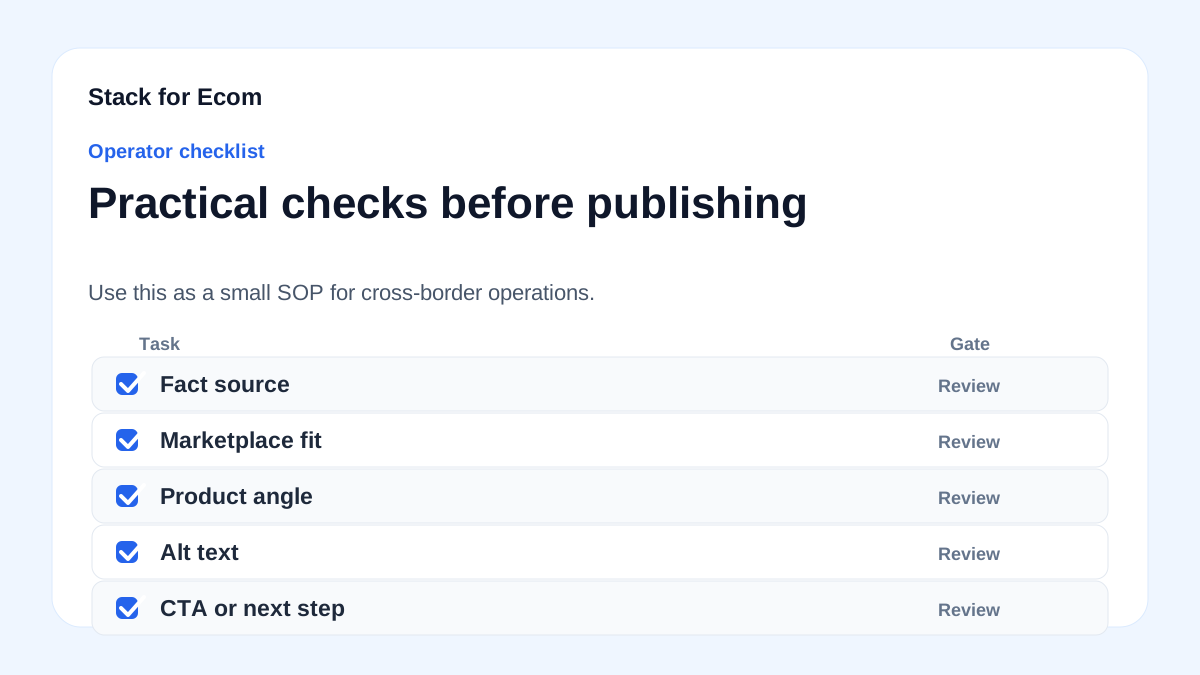
- Verify the destination country's customs requirements – For U.S., check CBP.gov; for EU, check the European Commission's customs pages.
- Collect all necessary product data – Include SKU, product name, detailed description in plain English, quantity, unit price in USD, total value, weight, and country of origin.
- Ensure the description is precise – Avoid vague terms like “gift” or “miscellaneous.” Describe size, shape, material, and intended use.
- Calculate total value correctly – Use the actual transaction value, not a discounted or arbitrary amount. Include shipping costs if required by the carrier.
- Indicate the country of origin correctly – This may differ from the country of purchase. Verify with your supplier.
- Attach the customs declaration form – For postal shipments, use the CBP Declaration form; for courier shipments, use the carrier's commercial invoice template.
- Include seller and buyer details – Full legal names, addresses, and contact information.
- Double-check for prohibited or restricted items – Refer to CBP's restricted items list or EU prohibitions and restrictions.
- Use a commercial invoice generator tool – Automate data entry to reduce errors and ensure consistency.
- Keep a copy of every invoice – Store digital copies for at least five years for audit purposes.
- Review AI-generated content carefully – If using an AI tool, verify all facts with official sources.
- Test your process with a small shipment – Before scaling, send a test package to confirm your documentation is accepted.
Potential pitfalls
- Vague product descriptions – Customs needs clear, concise, plain language descriptions. “Parts” or “accessories” are not enough. Prevention: Use a standardised product description template that includes material, dimensions, and function.
- Undervaluing goods to avoid duties – This is illegal and can lead to seizure, fines, or wrong duty rates. Prevention: Always declare the actual transaction value. If you offer discounts, use the discounted price as the declared value.
- Incorrect country of origin – Misstating origin can lead to penalties and incorrect duty assessment. Prevention: Ask your supplier for a certificate of origin and verify the manufacturing location.
- Missing or incomplete declaration forms – Shipments without a declaration and invoice may be seized, forfeited, or returned to sender. Prevention: Use a checklist and have a second person review each shipment before dispatch.
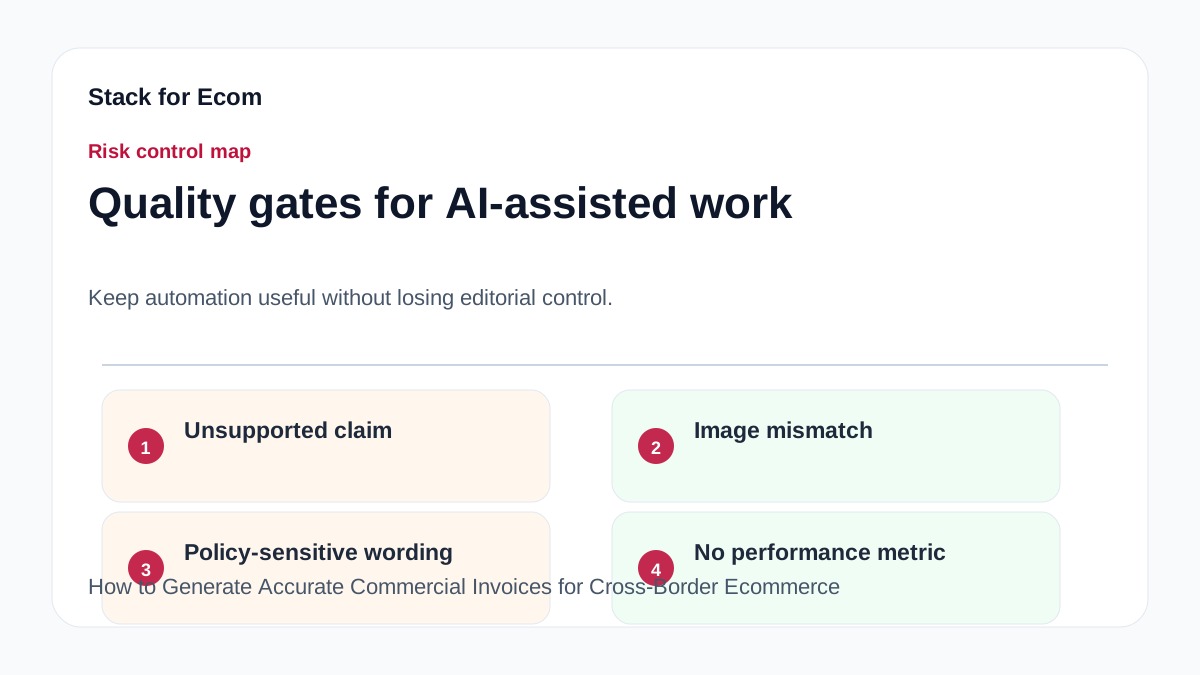
- Relying solely on AI tools – AI chatbots may give inaccurate or incomplete responses, and inaccurate advice is not a defense. Prevention: Use AI for general guidance only, and cross-check with official sources.
- Ignoring EU-specific requirements – The EU has its own customs procedures under the Union Customs Code. Prevention: Familiarise yourself with the EU's digital customs systems and ensure your invoices meet their data format.
Suggested visuals
- Infographic: Anatomy of a Commercial Invoice – A labelled diagram showing where to place each required field (seller, buyer, description, HS code, value, origin).
- Chart: De Minimis Volume Growth – A bar chart showing the increase from 636.7M to 1.36B BOLs from FY2020 to FY2024, sourced from CBP data.
- Screenshot: CBP Declaration Form – A sample of the U.S. Customs Declaration form with annotations highlighting required fields.
- Flowchart: Customs Clearance Process – A step-by-step visual showing how a shipment moves from seller to CBP International Mail Branch and what happens if documentation is incomplete.
- Table: Common Product Description Do's and Don'ts – Examples of vague vs. compliant descriptions, e.g., “plastic toy” vs. “plastic action figure, 6 inches, blue and red.”
- Screenshot: ITA's Global Business Navigator Chatbot – A mock conversation showing a general export question and the bot's response, with a note that product-specific questions are declined.
Who this helps / Who should avoid
This helps:
- Small and medium ecommerce sellers who ship internationally and want to avoid customs delays and penalties.
- Export operations teams that need a repeatable SOP for invoice generation.
- Freelance consultants and logistics coordinators who manage cross-border shipments for clients.
- Sellers using marketplaces like Amazon or eBay who are responsible for their own customs documentation.
Who should avoid:
- Sellers who only ship domestically and have no international exposure.
- Businesses that rely on a freight forwarder to handle all customs documentation and have no direct responsibility for invoice accuracy.
- Companies that need product-specific or market-specific customs advice—this article only provides general guidance; consult a customs broker for complex cases.
Conclusion
Generating accurate commercial invoices is not just a bureaucratic task—it is a critical compliance function that protects your business from costly delays, fines, and lost shipments. With the explosive growth of De Minimis volumes and the increasing sophistication of customs enforcement, sellers who invest in disciplined invoice processes will have a competitive edge. Use the checklist above to standardise your workflow, avoid the common pitfalls, and leverage AI tools responsibly. Remember, the invoice is your promise to customs that your shipment is what you say it is. Make that promise accurate every time.
References
- https://www.cbp.gov/trade/basic-import-export/internet-purchases
- https://www.cbp.gov/trade/basic-import-export/e-commerce
- https://www.trade.gov/ecommerce
- https://www.trade.gov/export-solutions
- https://taxation-customs.ec.europa.eu/customs-4/customs-procedures-import-and-export_en