TL;DR
- Customs inspection delays are usually caused by incomplete or inaccurate declarations, unclear cargo descriptions, or missing invoices and declarations.
- U.S.-bound goods must clear U.S. Customs and Border Protection (CBP); the importer is responsible for compliance with state and federal import regulations.
- In Fiscal Year 2024, total De Minimis volume reached 1.36 billion BOLs with a total declared value of $64.6 billion, so even small documentation errors can create large delays.
- Use precise, plain-language cargo descriptions and avoid putting PII, packaging details, or carrier disclaimers in the commodity description field.
- For EU shipments, follow the Union Customs Code and check national customs administration guidance.
- Build a repeatable SOP: verify declarations, keep invoices ready, track exceptions, and escalate to a customs broker when needed.
Introduction
Customs inspection delays are one of the most common and frustrating operational problems for ecommerce sellers, exporters, and small logistics teams. When a shipment is held, the immediate impact is a missed delivery promise, but the downstream effects are often worse: customer complaints, refund requests, marketplace penalties, and cash tied up in inventory that cannot be sold. For cross-border sellers, a single delayed container or postal batch can disrupt an entire sales cycle.
The root cause is rarely a single mistake. In the United States, goods moving from a foreign country to the United States are being imported and must clear U.S. Customs and Border Protection (CBP). The importer, which is the buyer when purchasing from foreign sources, is responsible for ensuring goods comply with state and federal import regulations. If goods are unsafe, fail health code requirements, or violate quota restrictions, CBP can impose fines, penalties, detention, or destruction. Foreign shipments not accompanied by a CBP declaration form and an invoice may be subject to seizure, forfeiture, or return to sender.
This article gives you a practical operating framework for preventing and managing customs inspection delays. It focuses on what you can control: documentation quality, cargo descriptions, communication workflows, and escalation paths. It also covers when to use a customs broker, how to handle postal versus commercial shipments, and what to verify for EU-bound goods. Use the checklist and pitfalls sections as a repeatable SOP for your team.
Main Content
Understand why customs inspections happen and what CBP expects
Customs inspections are not random punishment; they are a control mechanism. CBP reviews declarations, invoices, and cargo descriptions to assess duty, enforce prohibitions and restrictions, and protect health and safety. For international postal shipments valued under $2,500 that are not subject to quota or restricted/prohibited, a CBP official usually prepares the paperwork, assesses duty, and releases the item for delivery. This process is known as mail entry. However, if the shipment is not accompanied by a proper CBP declaration form and an invoice, it may be seized, forfeited, or returned to sender.
The CBP declaration should include the seller's name and address, a detailed description of items in English, quantity of each item type, purchase price in U.S. dollars (unit and total), weight, and country of origin of the product itself. Missing any of these fields increases the chance of a hold. Misrepresenting the value or nature of an item on the Customs declaration is illegal, and the importer may face legal action and fines. That means under-declaring to save duty is not a shortcut; it is a compliance risk that can stop your shipment and create long-term penalties.
For ecommerce operators, the practical takeaway is to treat the declaration as a data-quality problem. Build a template that captures every required field at the point of order or fulfillment. If your seller does not arrange postal or door-to-door delivery, the importer must either hire a customs broker to clear the goods or go to the port of entry and clear them personally. Knowing which model applies to each lane prevents confusion when a delay occurs.
Write precise cargo descriptions that clear inspection faster
A precise cargo description is one of the highest-leverage fixes for customs delays. U.S. regulations, including 19 CFR § 4.7a, 122.48a, 123.91, 123.92, and 128.21, require a precise or specific description of merchandise regardless of value. A precise cargo description must be clear, concise, in plain language, and detailed enough for U.S. Customs to identify the size, shape, and characteristics of the commodity. Vague terms like "gift," "sample," or "accessories" invite scrutiny.
Only the cargo description should be included in the field of transmission. Superfluous information such as personally identifiable information (PII), type of packaging, and carrier disclaimers should not be transmitted in the commodity description field. This is a common mistake in ecommerce because order management systems often merge customer notes, marketing names, and packaging instructions into one field. Clean that data before it reaches the carrier or broker.
Concrete example: instead of "phone case," write "silicone protective case for smartphone, model X, black, 50 units, unit value $2.10, total value $105.00, country of origin China." Instead of "apparel," write "women's cotton T-shirt, short sleeve, size M, 120 units, unit value $4.50, total value $540.00, country of origin Vietnam." These descriptions help CBP identify the commodity, assess duty, and release the shipment without unnecessary back-and-forth.
Manage postal, commercial, and broker-assisted shipments differently
The clearance path depends on how the goods move. For international postal shipments under $2,500 that are not restricted, CBP may handle the paperwork and release the item through mail entry. This is often the fastest path for small parcels, but it still depends on a complete declaration and invoice. If the seller does not arrange postal or door-to-door delivery, the importer must either hire a customs broker or clear the goods personally at the port of entry. Ecommerce teams should map each shipping lane to its clearance model before peak season.
For commercial shipments, a customs broker is often the most reliable option because they manage entry filing, duty assessment, and communication with CBP. The broker also becomes your escalation point when a shipment is detained. For postal shipments, the importer may have less visibility, so tracking and proactive communication with the carrier and CBP are critical. In both cases, the importer remains responsible for compliance with state and federal import regulations.
The scale of ecommerce makes this operational discipline essential. CBP publishes De Minimis volume and value statistics based on the number of Bills of Lading (BOLs) and their declared value at the time of import. In Fiscal Year 2024, total De Minimis volume reached 1.36 billion BOLs with a total declared value of $64.6 billion. With that volume, CBP has developed an E-Commerce Strategy with four primary goals, identifying private industry and foreign governments as key resources. The strategy includes enforcement initiatives such as streamlining enforcement processes affected by increasing ecommerce volumes and leveraging enforcement partnerships with partner government agencies and foreign governments. Your best defense is clean data and fast response.
Apply EU customs procedures and use official tools carefully
If you ship to the European Union, the framework is different but the principle is the same: accurate declarations and compliance with prohibitions and restrictions. The European Commission's Taxation and Customs Union provides official information on EU customs procedures for importing and exporting goods. The EU customs framework includes Authorised Economic Operator (AEO) status, customs controls, prohibitions and restrictions, and rules of origin for goods. The Union Customs Code governs customs procedures within the EU Customs Union. National customs administrations in EU member states are listed as a resource within the EU customs framework, and the European Commission maintains online services and databases for customs procedures.
For operators, AEO status can reduce friction, but it is not a substitute for correct documentation. Rules of origin affect duty rates and preferential treatment, so verify the origin of the product itself, not just the shipping origin. If your product is subject to prohibitions or restrictions, check the specific EU and member-state requirements before shipping. When in doubt, consult a customs broker or the relevant national customs administration.
Software and AI tools can help, but they are not authoritative. The Global Business Navigator is an AI chatbot from the International Trade Administration (ITA), currently in beta testing, designed to provide general information on the exporting process and resources for U.S. exporters. It is developed using Microsoft's Azure AI services and is trained on ITA's export-related content from the Export Solutions web pages on Trade.gov. As a beta product, the chatbot's responses may occasionally produce inaccurate or incomplete information, and its knowledge is limited to public information on Export Solutions web pages. It cannot provide responses specific to a company's product or a specific foreign market, but its reference pages guide users to other government resources and market research. Users should always double-check the chatbot's responses using provided references or by visiting the Export Solutions web pages on Trade.gov, and should not use its responses as legal or professional advice. The chatbot does not collect user information, does not use chat history to learn new information, and all feedback is anonymous; users should not enter personally identifiable information (PII), sensitive, or proprietary information. Conversations with the chatbot may be reviewed to help ITA improve the tool and address harmful, illegal, or otherwise inappropriate questions. It supports a wide range of languages, but because it is trained in English and responses are translated, users should verify translations as it may have difficulty with acronyms, abbreviations, and nuances in other languages. Use such tools for orientation, not for final compliance decisions.
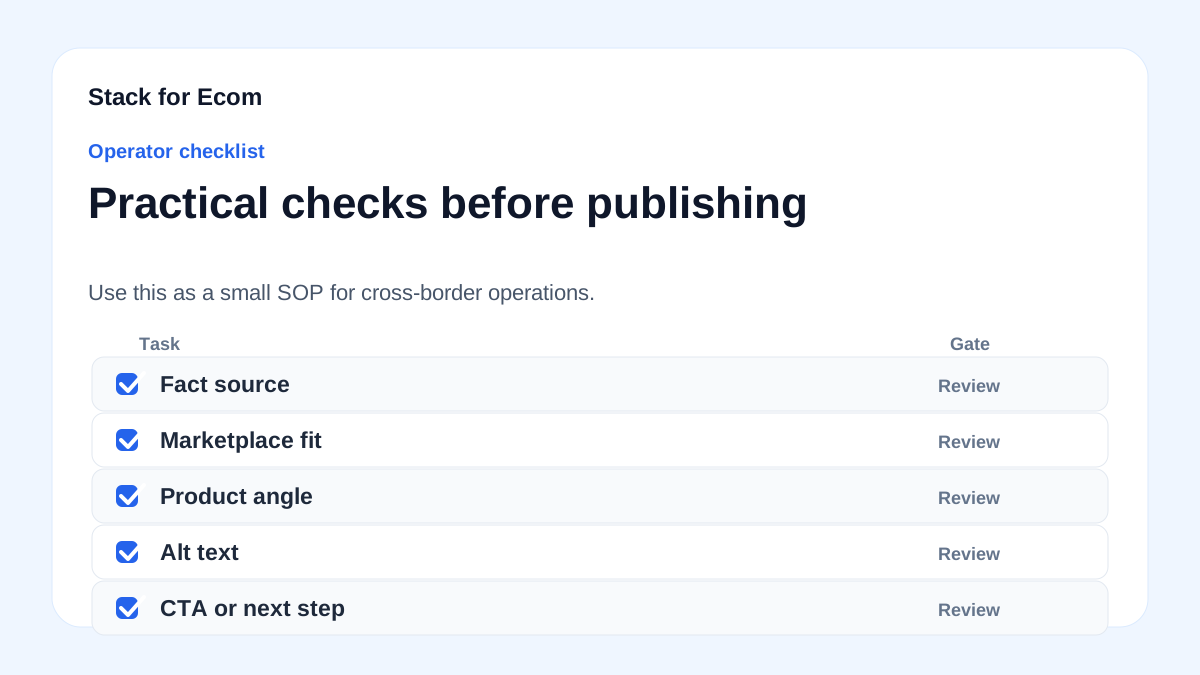
Step-by-step checklist
- Confirm the importer of record and who is responsible for compliance in each lane.
- Verify that every shipment has a CBP declaration form and a commercial invoice before it leaves origin.
- Check that the declaration includes seller name and address, detailed English description, quantity, unit and total price in USD, weight, and country of origin of the product.
- Write a precise cargo description that is clear, concise, plain language, and detailed enough to identify size, shape, and characteristics.
- Remove PII, packaging details, and carrier disclaimers from the commodity description field.
- Validate that the declared value matches the invoice and purchase price; never misrepresent value or nature.
- Confirm whether the shipment qualifies for mail entry under $2,500 and is not subject to quota or restrictions.
- Decide whether to use postal delivery, door-to-door delivery, a customs broker, or personal clearance at the port of entry.
- For EU shipments, check Union Customs Code procedures, AEO status, prohibitions and restrictions, and rules of origin.
- Set up a tracking and exception workflow so holds are flagged within 24 hours.
- Prepare a broker escalation template with shipment IDs, invoices, and declaration copies.
- Review De Minimis volume and value trends to anticipate peak inspection periods.
- Train fulfillment staff on the difference between marketing names and customs descriptions.
- Audit a sample of declarations monthly and correct recurring data errors.
Potential pitfalls
- Vague descriptions such as "gift," "sample," or "accessories" trigger holds. Prevention: enforce a description template with material, function, model, size, and quantity.
- Missing invoice or declaration leads to seizure, forfeiture, or return to sender. Prevention: make both documents mandatory at label generation.
- Misrepresenting value or nature is illegal and can lead to fines and legal action. Prevention: reconcile declared value with the actual purchase price and keep evidence.
- Mixing PII or carrier disclaimers into the commodity description field causes transmission errors. Prevention: separate customer data from customs data in your order system.
- Assuming postal shipments always clear automatically under $2,500. Prevention: verify quota, restricted/prohibited status, and mail entry eligibility before shipping.
- Ignoring EU rules of origin and prohibitions. Prevention: check the Union Customs Code and national customs administration guidance for each destination.
- Relying on beta AI tools for final compliance decisions. Prevention: double-check chatbot responses with official references and never treat them as legal advice.
Suggested visuals
- A flowchart showing the decision path: postal mail entry vs. commercial entry vs. customs broker vs. personal clearance at the port of entry.
- A sample CBP declaration and invoice with required fields highlighted: seller name and address, English description, quantity, unit and total USD price, weight, and country of origin.
- A before-and-after table of vague vs. precise cargo descriptions for common ecommerce products.
- A screenshot-style mockup of an order management field showing where PII and packaging notes should be excluded from the commodity description field.
- A bar chart or table of FY2024 De Minimis volume and value statistics: 1.36 billion BOLs and $64.6 billion declared value.
- A simple EU customs procedure map showing the Union Customs Code, AEO status, customs controls, prohibitions and restrictions, and rules of origin.
Who this helps / Who should avoid
This guide helps ecommerce sellers, exporters, marketplace operators, and small logistics teams that ship physical goods across borders and want fewer customs holds. It is especially useful for teams handling U.S.-bound postal and commercial shipments, and for those shipping into the EU who need a practical starting point on customs procedures.
This guide is not legal or professional advice, and it does not replace a customs broker, trade lawyer, or official customs administration guidance. If your goods are highly regulated, subject to quota, or involve restricted or prohibited items, work directly with a qualified professional. If you need company-specific or market-specific advice, use official resources and verify every detail. Details may vary; check references.
Conclusion
Customs inspection delays are preventable when you treat declarations as operational data, not paperwork. The importer is responsible for compliance, and CBP can impose fines, penalties, detention, or destruction for unsafe goods, health code failures, or quota violations. Missing declarations and invoices can lead to seizure, forfeiture, or return to sender. Precise cargo descriptions, accurate values, and complete documentation are your fastest path through inspection.
Build a repeatable SOP around the checklist above, train your team on precise descriptions, and keep escalation paths ready for postal, commercial, and broker-assisted shipments. For EU-bound goods, follow the Union Customs Code and check national customs administration guidance. Use AI and software tools for orientation, but verify everything against official sources. With the right process, customs delays become exceptions you manage, not crises that manage you.
References
- https://www.cbp.gov/trade/basic-import-export/internet-purchases
- https://www.cbp.gov/trade/basic-import-export/e-commerce
- https://taxation-customs.ec.europa.eu/customs-4/customs-procedures-import-and-export_en
- https://www.trade.gov/ecommerce
- https://ads.tiktok.com/help/article/get-started-tiktok-ads-manager