TL;DR
- When a supplier requests a price increase, do not accept or reject immediately. First, request a detailed breakdown of the cost drivers (materials, labor, freight, tariffs).
- Use the U.S. Customs and Border Protection (CBP) rules on cargo descriptions and import compliance to ensure you are not paying for unnecessary logistics or documentation errors.
- If you are an ecommerce seller, factor the new cost into your Amazon Sponsored Products budget or ad bids, as margin changes may require a new advertising strategy.
- Always verify any new information using official resources like the International Trade Administration (ITA) chatbot or the Export Solutions pages, but do not rely on them for legal advice.
- Negotiate for a phased increase, a volume discount, or a longer-term contract to mitigate the impact on your landed cost.
Introduction
When a long-time supplier sends an email announcing a 10% price increase on your core product line, your first instinct might be to push back or accept to keep the relationship. Both reactions can hurt your business. Accepting without analysis erodes your margin, while a flat rejection may strain a relationship that took years to build. The real problem is not the increase itself, but the lack of a structured process to evaluate it.
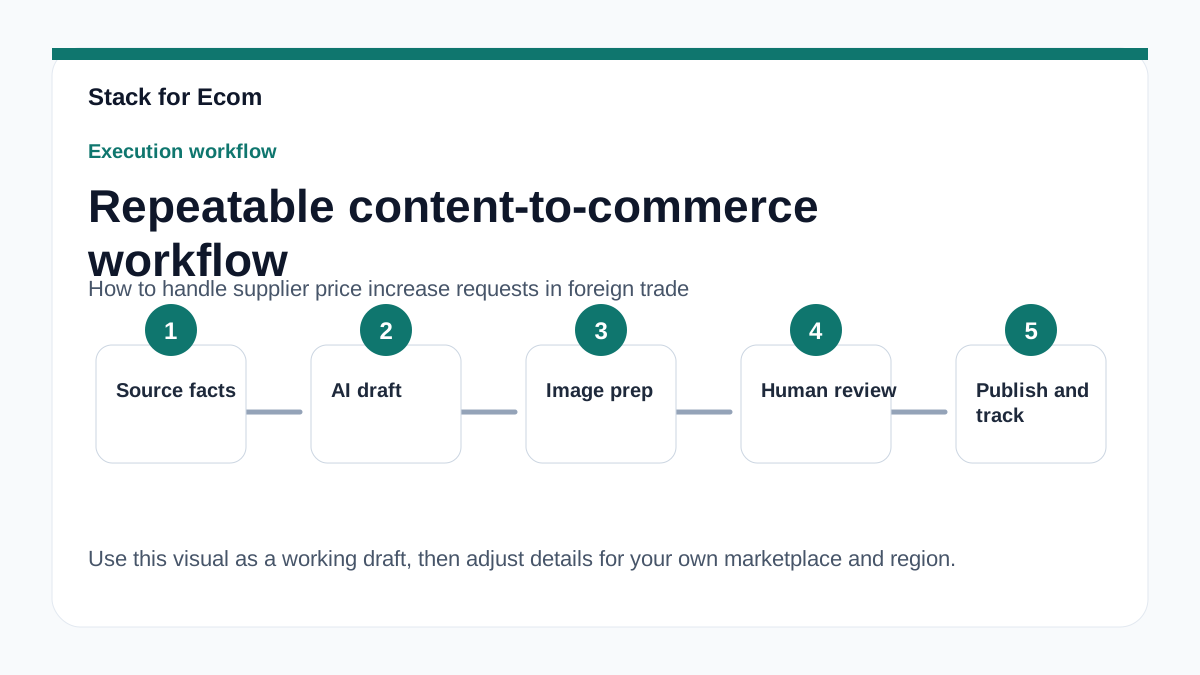
The business impact is direct: a 10% supplier increase can reduce your net margin by 3-5% if you do not adjust your selling price or find efficiency elsewhere. For an ecommerce seller running Amazon ads, this also means your return on ad spend (ROAS) shifts, because your cost of goods sold (COGS) just went up. You need a repeatable workflow to assess the request, verify the facts, and negotiate from a position of strength.
This article gives you a step-by-step playbook for handling supplier price increase requests. You will learn how to audit the cost breakdown, check import compliance implications, adjust your ecommerce advertising budget, and negotiate a fair outcome. Use the checklist in this guide as a standard operating procedure (SOP) for every price change request you receive.
Main Content
1. Request a Transparent Cost Breakdown Before Agreeing
Your first response to a price increase request should not be a counteroffer. It should be a request for data. Ask the supplier for a line-item breakdown of the new cost structure: raw material costs, labor, energy, freight, and any new tariffs or compliance costs. A legitimate supplier will share this data. A supplier who cannot or will not provide a breakdown may be testing your willingness to pay more.
For example, if you import electronics components from a factory in Vietnam, the supplier might cite a rise in copper prices. You can verify that claim against global commodity indices. If copper prices are flat, you have a negotiating point. If they are up 15%, you can accept a smaller increase or ask for a temporary surcharge that is reviewed quarterly.
Once you receive the breakdown, compare it against your own records. Your purchase history, freight invoices, and previous price lists are your evidence base. If the supplier claims a 20% freight increase, check your recent shipping bills. If your logistics provider shows a 5% increase, the supplier's number is inflated.
2. Check Import Compliance and Landed Cost Implications
A price increase is not just about the unit cost. It also affects your landed cost, which includes freight, insurance, duties, and customs brokerage fees. When goods move from any foreign country to the United States, they are being imported and are subject to specific U.S. Customs and Border Protection (CBP) rules and regulations. As the buyer, you become the importer and are responsible for ensuring compliance with state and federal import regulations, including safety, health, and quota restrictions.
If the supplier's price increase is due to a change in the product's composition or origin, you must verify that the new product still meets CBP requirements. Importing goods that are unsafe, fail health code requirements, or violate quota restrictions can result in fines, penalties, detention, or destruction by CBP. A price increase that comes with a change in material sourcing may also change the product's country of origin, which affects duty rates.
For example, if your supplier switches from a Chinese component to a Taiwanese one to avoid tariffs, the final product's origin may change. This could alter your duty rate or require new documentation. Under 19 CFR § 4.7a, 122.48a, 123.91, 123.92, and 128.21, a precise cargo description is required regardless of value, and must be clear, concise, and detailed enough for U.S. Customs to identify the commodity's size, shape, and characteristics. If the product changes, your customs broker may need to update the entry filing.
3. Recalculate Your Ecommerce Advertising Budget and Margins
If you sell on Amazon or other ecommerce marketplaces, a supplier price increase has a ripple effect on your advertising. Your cost of goods sold (COGS) goes up, which reduces your profit per unit. If you are using Amazon Ads Sponsored Products, your target return on ad spend (ROAS) must be recalculated. For example, if your product sells for $50, your COGS was $20, and your ad cost per sale is $10, your profit is $20. If the supplier raises the price to $22, your profit drops to $18 unless you adjust your ad bids or your selling price.
Amazon recommends new advertisers start with Sponsored Products using automatic targeting, where Amazon matches ads to shopping queries based on product information. But when your margin shrinks, you should switch to manual targeting to control costs. Launch a manual keyword targeting campaign with at least 30 keywords, start with broad match, and use the search term report to identify top performers for phrase or exact match. This helps you cut wasted spend and protect your reduced margin.
Also, consider your daily budget. For Sponsored Products campaigns, Amazon recommends a minimum daily budget of $10 in the United States, £10 in the United Kingdom, 10 € in Germany, and 1,000円 in Japan. If your margin per unit drops, you may need to lower your daily budget or pause low-performing keywords. Use the available advertising reports, including search term, targeting, and performance over time, to track the impact of the cost increase on your profitability.
4. Negotiate Terms, Not Just Prices
A price increase is often negotiable, but not always on the unit price. You can negotiate other terms that reduce your total cost. Ask for extended payment terms, such as moving from 30 days to 60 days. This improves your cash flow and offsets the higher unit cost. You can also ask for a volume discount if you commit to a larger order quantity. Suppliers often prefer certainty over higher margins.
Another option is to negotiate a phased increase. Instead of a 10% jump effective immediately, ask for a 5% increase now and another 5% in six months. This gives you time to adjust your selling price or find a new supplier. You can also propose a price review clause that ties future increases to a specific commodity index, such as the London Metal Exchange for raw materials. This makes the relationship more transparent and reduces the chance of surprise increases.
For example, a U.S. furniture importer received a 12% increase request from a Malaysian supplier due to rising rubberwood costs. The importer asked for a breakdown, found that rubberwood was only 30% of the product cost, and negotiated a 6% increase with a quarterly review tied to the rubberwood index. This saved the importer $18,000 annually on a $300,000 order.
5. Use Official Resources to Verify Export and Import Rules
Before you accept any price increase, verify that the supplier's claims about tariffs, regulations, or compliance costs are accurate. The International Trade Administration (ITA) has launched a beta AI chatbot called Global Business Navigator, built on Microsoft Azure AI, to provide general exporting process information for U.S. exporters. The chatbot is trained on ITA's export-related content and uses Microsoft Azure AI services, but its knowledge is limited to public information on the Export Solutions web pages of Trade.gov.
This tool can help you understand general export rules, but it has limitations. As a beta product, the chatbot may produce inaccurate or incomplete responses, and users should not rely on its answers as legal or professional advice. The chatbot cannot provide responses specific to a company's product or a specific foreign market, but its reference pages guide users to other relevant government resources and market research. Always double-check the chatbot's responses using provided references or by visiting the Export Solutions web pages on Trade.gov.
Also, be careful about what you share. The chatbot does not collect user information or use chat history for learning, and all feedback is anonymous; users should avoid entering personally identifiable information (PII), sensitive, or proprietary information. If you ask the chatbot about a specific tariff, it may give you a general answer, but you must verify it against the official CBP or ITA pages before making a business decision.
Step-by-step checklist
- [ ] Acknowledge the supplier's request in writing within 24 hours, stating that you will review the details.
- [ ] Request a line-item cost breakdown showing material, labor, freight, and overhead changes.
- [ ] Compare the breakdown against your own purchase history and market commodity prices.
- [ ] Calculate the new landed cost, including freight, insurance, duties, and brokerage fees.
- [ ] Verify that the product's composition or origin has not changed, and if it has, check CBP compliance requirements.
- [ ] Review your current Amazon Sponsored Products campaigns and recalculate your target ROAS based on the new COGS.
- [ ] Adjust your daily ad budget or keyword bids if your margin per unit has dropped.
- [ ] Prepare a counteroffer, such as a phased increase, extended payment terms, or a volume discount.
- [ ] Use the ITA Global Business Navigator chatbot or Export Solutions pages to verify any regulatory claims, but do not rely on them for legal advice.
- [ ] Get the final agreement in writing, including the effective date, new price, and any review clauses.
Potential pitfalls
- Accepting the first increase without data: If you agree immediately, you signal that you are willing to pay more without question. Always ask for a breakdown first. Prevention: make a cost breakdown request a standard part of your procurement process.
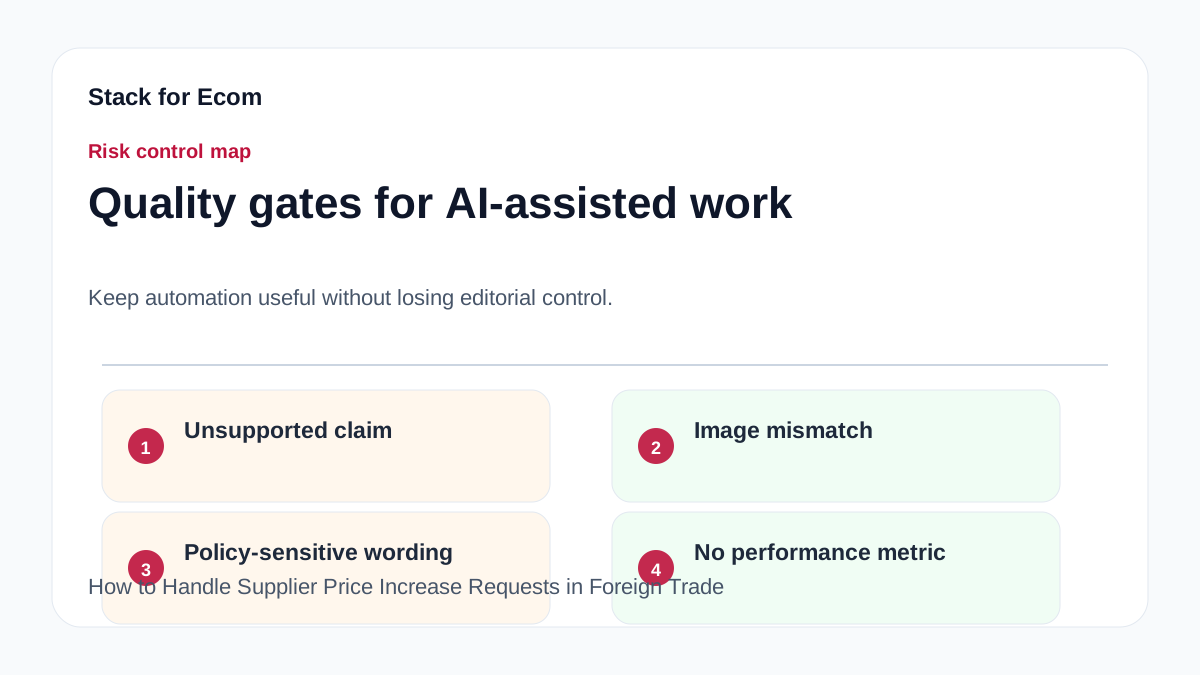
- Ignoring import compliance changes: A price increase may come with a change in materials or origin, which can affect duty rates or trigger new regulations. Prevention: check with your customs broker and review CBP rules before accepting.
- Failing to adjust your ad budget: If you sell on Amazon and your COGS rises, your ad spend may eat into your profit. Prevention: recalculate your ROAS and lower bids or budgets before the new cost hits.
- Entering sensitive data into AI chatbots: The ITA chatbot does not collect user information, but conversations may be reviewed. Prevention: never share PII, proprietary formulas, or pricing details with any AI tool.
- Assuming the supplier's tariff claim is accurate: Suppliers may inflate tariff or compliance costs to justify an increase. Prevention: verify tariff rates on official CBP or ITA pages before negotiating.
Suggested visuals
- A flowchart showing the decision process: price increase request → cost breakdown → landed cost calculation → negotiation → final agreement.
- A comparison table of old vs. new landed cost, including unit price, freight, duties, and ad spend per unit.
- A screenshot of an Amazon Sponsored Products campaign manager showing how to adjust daily budget and keyword bids.
- A line chart of commodity prices (e.g., copper or lumber) over the last 12 months to verify supplier claims.
- A checklist infographic summarizing the 10-step SOP for handling price increase requests.
- A diagram of the CBP cargo description requirements, showing examples of good vs. poor descriptions.
Who this helps / Who should avoid
This guide is for U.S. importers, ecommerce sellers, and small operations teams that buy finished goods or components from overseas suppliers. It is especially useful for Amazon sellers who need to manage both procurement and advertising costs. If you are a large enterprise with a dedicated procurement team, you likely already have a formal process, but the checklist can still serve as a reference.
Avoid using this guide if you are a brand-new importer who has not yet established a supplier relationship. In that case, focus first on finding reliable suppliers and understanding basic import rules. Also, if you are importing goods for personal use only, the CBP rules are simpler, and this guide's advertising and negotiation sections are not relevant.
Conclusion
Handling a supplier price increase request is a negotiation, not a demand. By requesting a cost breakdown, verifying import compliance, recalculating your ecommerce margins, and negotiating terms beyond the unit price, you can protect your profitability without damaging the relationship. Use the official resources from ITA and CBP to verify claims, but always confirm with primary sources. Finally, treat every price increase request as a trigger to review your entire cost structure, not just the line item in question.
References
- https://www.trade.gov/export-solutions
- https://www.trade.gov/ecommerce
- https://www.cbp.gov/trade/basic-import-export/internet-purchases
- https://www.cbp.gov/trade/basic-import-export/e-commerce
- https://advertising.amazon.com/library/guides/getting-started-with-sponsored-ads