TL;DR
- The provided sources do not contain confirmed Amazon or eBay marketplace product image carousel requirements. The TikTok Ads Help Center page about catalogs could not be retrieved, and no Amazon or eBay carousel specifics were present. Details may vary; check references. Source
- Amazon advertising guidance covers Sponsored Products, Sponsored Brands, budgets, targeting, and reporting, but not image carousel specifications. Source
- Amazon Global Selling covers account structure, fees, compliance, and listing requirements by country, but does not provide image carousel rules. Source
- Google Merchant Center product data rules are available and useful for feed-based image quality and product data hygiene, but they are not Amazon or eBay carousel requirements. Source
- Use this article as a verification and workflow guide, not as a definitive Amazon vs eBay policy comparison. Always confirm current requirements in Seller Central, eBay Seller Center, and official help pages before publishing listings.
Introduction
If you sell on Amazon and eBay, product images are not just creative assets. They are listing infrastructure. They affect click-through rate, conversion rate, return rate, and how your product appears in shopping results, detail pages, and mobile feeds. When teams ask for a marketplace product image carousel requirements comparison for Amazon and eBay, they usually want a simple answer: how many images, what aspect ratio, what background, what order, and what happens if an image fails. That is a reasonable operational question, but it requires verified platform documentation.
The problem is that the sources provided for this article do not contain confirmed Amazon or eBay carousel image requirements. The TikTok Ads Help Center article about catalogs could not be retrieved because the page no longer exists or failed to load, and the source content contained no factual information about Amazon or eBay marketplace product image carousel requirements. It also did not provide effective dates, regions, platform policies, thresholds, or affected seller groups. Details may vary; check references. Source
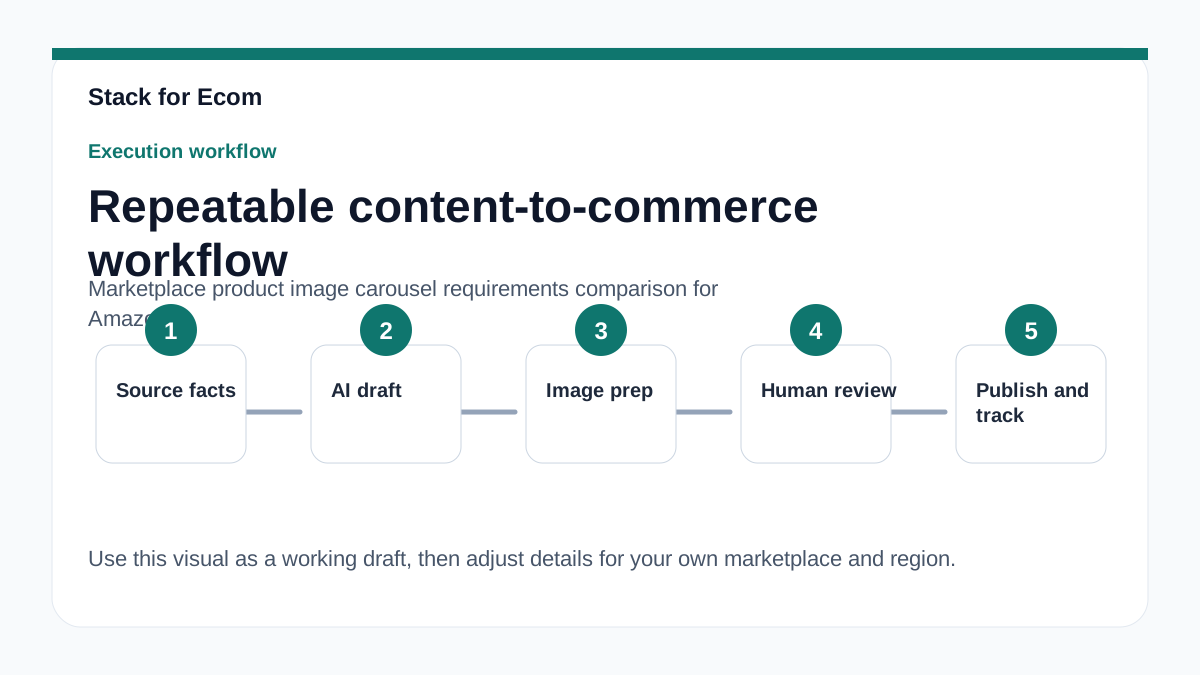
This article therefore does two things. First, it clearly separates what is confirmed from what still needs checking. Second, it gives you a repeatable operating procedure for verifying image carousel requirements on Amazon and eBay, documenting them, and applying them across listings. It also uses adjacent, verified facts from Amazon advertising, Amazon Global Selling, Google Merchant Center, and the International Trade Administration to show how image and product data quality fits into a broader cross-border listing workflow. Where a specific Amazon or eBay carousel rule is not in the provided facts, this article says so rather than inventing one.
Main Content
What the provided sources confirm about Amazon and eBay image carousels
The short answer is: they do not confirm Amazon or eBay image carousel requirements. The TikTok Ads Help Center page about catalogs returned only an error message and a 'Back to home page' link, with no substantive content on catalogs. The source content explicitly states that no factual information about Amazon or eBay marketplace product image carousel requirements was present, and no effective dates, regions, platform policies, thresholds, or affected seller groups were provided. Details may vary; check references. Source
What the provided sources do confirm is adjacent but not equivalent. Amazon Sponsored Products are self-service, cost-per-click ads for individual product listings that appear in shopping results and on product detail pages. Amazon Sponsored Brands are self-service, cost-per-click ads for brands that appear in shopping results and feature a custom headline, brand logo, and multiple products. Source These formats may use product images, but the source does not define carousel image requirements for Amazon listings or eBay listings.
Amazon Global Selling also does not provide carousel image rules. It confirms that selling globally involves selecting products per country, completing tax, regulatory, compliance, safety, and listing requirements, listing products, shipping inventory, and managing the business with Amazon tools. Source Product requirements, taxes, regulations, compliance, safety, and listing requirements vary by country, and Amazon provides Manage Your Compliance and Compliance Reference tools. Source That means image requirements may vary by marketplace, category, and country, but the provided facts do not specify them.
Amazon advertising and listing context that affects image planning
Even though the sources do not define carousel image requirements, they do give useful Amazon advertising context. Amazon recommends a minimum daily budget of $10 for Sponsored Products campaigns in the United States and Canada. It also recommends £10 for the United Kingdom, 10 € for Germany, France, Italy, Spain, Belgium, Ireland, and the Netherlands, and ₹500 for India. Source These budget thresholds matter because image quality directly affects whether paid traffic converts. If your carousel images are weak, you may still pay for clicks but lose the sale.
Amazon advises new advertisers to start with Sponsored Products using automatic targeting, or manual keyword or product targeting. For manual keyword targeting campaigns, Amazon recommends targeting at least 30 keywords and starting with broad match. Source This is relevant to image planning because different keywords and placements can surface different product images. A seller promoting a kitchen organizer may appear in broad-match results for "kitchen storage," "pantry organizer," and "cabinet shelf." If the main image does not clearly show the product in those contexts, the click may not convert.
Amazon Sponsored Products reports include search term report, targeting report, advertising product report, placement report, performance over time report, and purchased product report. Source These reports can help you diagnose whether image changes correlate with performance changes, but they do not replace official image policy documentation. Use them as feedback loops, not as a source of carousel rules.
eBay and Amazon carousel requirements: what still needs checking
For eBay, the provided sources contain no eBay-specific image carousel requirements at all. There is no confirmed information about eBay image counts, aspect ratios, background rules, zoom requirements, or carousel behavior. Details may vary; check references. Any article that claims to compare Amazon and eBay carousel requirements without citing official platform documentation should be treated as incomplete.
For Amazon, the same limitation applies. The provided sources mention Sponsored Products, Sponsored Brands, budgets, targeting, reporting, Global Selling account structures, referral fees, and compliance tools, but they do not state Amazon product image carousel requirements. Source Source That means you should not rely on this article for exact Amazon image counts or technical specifications.
What you can do is build a verification workflow. Check Amazon Seller Central help pages for image requirements by category and marketplace. Check eBay Seller Center for listing image requirements and any carousel or gallery behavior. Record the date you checked, the region, the category, and the exact requirement. Because product requirements, taxes, regulations, compliance, safety, and listing requirements vary by country, and Amazon provides Manage Your Compliance and Compliance Reference tools, treat image requirements as part of a broader country-specific compliance review. Source
Using Google Merchant Center rules as a data-quality proxy, not a marketplace carousel substitute
Google Merchant Center requirements are not Amazon or eBay carousel requirements, but they are useful for understanding product data hygiene. Google Merchant Center requires the ID [id] attribute, with a maximum of 50 characters, and recommends using the product's SKU as a unique value. Source The title [title] attribute is required and limited to 150 characters of plain text; promotional text, all capital letters, and gimmicky foreign characters are prohibited. Source
Google also states that for titles created using generative AI, advertisers must use the structured title [structured_title] attribute instead of the title [title] attribute. The structured title attribute has two sub-attributes: digital source type [digital_source_type], which is optional and accepts default or trained_algorithmic_media, and content [content], which is required and limited to 150 characters. Source AI regulations in the European Union, India, and New York require ads with certain AI-generated or edited assets to include disclosures and/or labels informing consumers the ads were made with AI. Source
Incorrect, inaccurate, or missing product information can cause disapprovals, limited eligibility, incorrect displays, or other issues in Merchant Center. Common product data problems include incorrect google product category [google_product_category] or gtin [gtin] values, missing or incorrect variant attributes, low-quality images, or conflicting data between feed and website. Source Attribute names and values using supported values must be submitted in English; free-form text attributes must use the same language across all attributes in a feed. Source These principles are useful for image governance even if they are not Amazon or eBay carousel rules.
Cross-border listing workflow and where image requirements fit
Amazon Global Selling allows US-based sellers to sell internationally and non-US sellers to sell to US customers on Amazon.com. Sellers create a North America and Brazil unified selling account and any other regional or country-specific accounts as needed. Source A Europe account reaches Amazon customers in 28 countries; Asia-Pacific uses country-specific accounts for Australia, India, and Japan; Middle East and North Africa uses country-specific accounts for UAE, Saudi Arabia, and Egypt. Source
Separate Professional selling plan fees apply for Americas and Europe regional accounts and for country-specific accounts in Asia-Pacific and MENA; linking global accounts caps the monthly fee at USD 39.99 or the sum of regional fees, whichever is lower. Source Referral fees vary by product category and are a percentage of total price or a minimum amount, whichever is greater. Source These facts show why image requirements should be managed per region and per account, not as a single global standard.
For US exporters, the International Trade Administration's Global Business Navigator is an AI chatbot currently in beta testing, designed to provide general information on the exporting process and resources for U.S. exporters. It is developed using Microsoft's Azure AI services and trained on ITA's export-related content from the Export Solutions web pages on Trade.gov. Source As a beta product, its responses may occasionally be inaccurate or incomplete, and its knowledge is limited to public information on the Export Solutions web pages. It cannot provide responses specific to a company's product or a specific foreign market, but its reference pages guide users to other government resources and market research. Source Use it for general orientation, not as a substitute for platform documentation.
Step-by-step checklist
- Confirm the exact marketplace, region, category, and seller account type before checking image requirements. Amazon Global Selling notes that product requirements, taxes, regulations, compliance, safety, and listing requirements vary by country. Source
- Open official help pages for Amazon Seller Central and eBay Seller Center. Do not rely on third-party blog posts for carousel specifications.
- Record the date, region, and category for every requirement you verify. If a source does not state an effective date, mark it as unconfirmed.
- Check whether the requirement applies to listing images, advertising creatives, or both. Amazon Sponsored Products and Sponsored Brands use product listings and brand assets, but the provided sources do not define carousel image rules. Source
- Verify image count, aspect ratio, minimum resolution, background, text overlay, and zoom behavior separately. Do not assume one rule covers all image types.
- Review category-specific requirements for variations, bundles, and multi-pack products. Missing or incorrect variant attributes are a common product data problem in Google Merchant Center, and similar issues can affect marketplace listings. Source
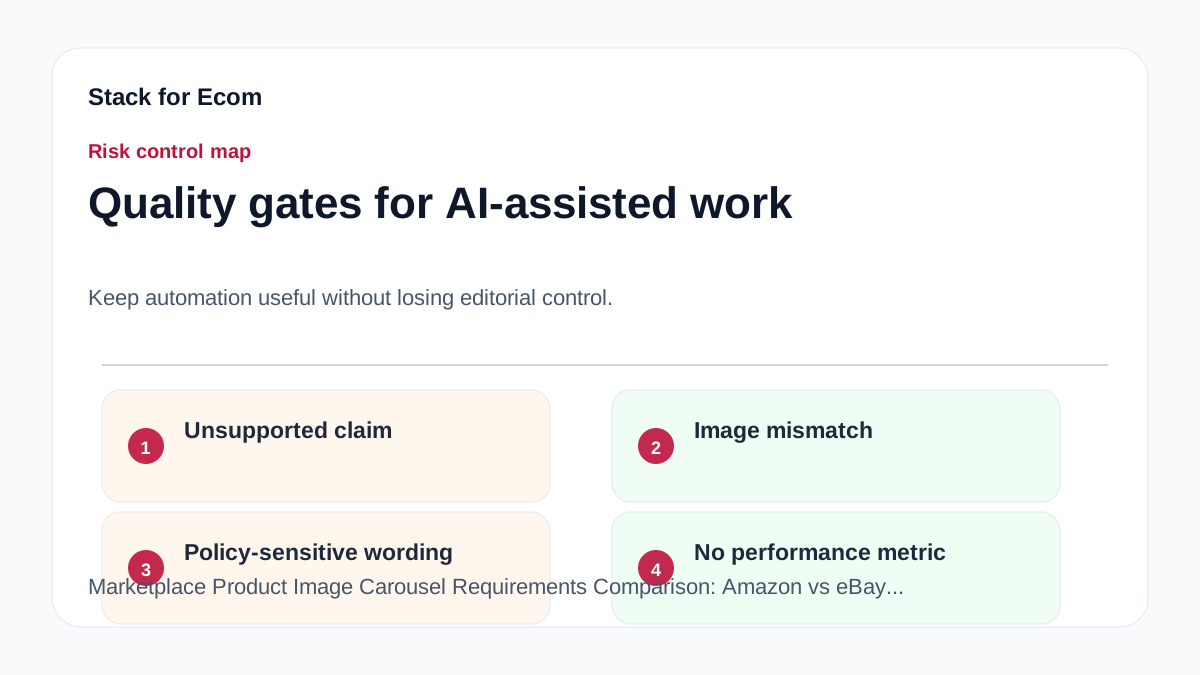
- Check AI disclosure rules if images are generated or edited with AI. AI regulations in the European Union, India, and New York require ads with certain AI-generated or edited assets to include disclosures and/or labels. Source
- Audit existing listings for low-quality images, conflicting data, and missing attributes. Google Merchant Center notes that low-quality images and conflicting data between feed and website can cause issues. Source
- Build a master image spec sheet per marketplace and region, then map each SKU to the correct spec before publishing.
- Re-check requirements quarterly or before entering a new country. Account structures and fees differ across regions. Source
- Document your verification sources and keep screenshots or PDFs of official help pages for internal audits.
- Train listing operators to escalate any requirement they cannot verify rather than guessing.
Potential pitfalls
- Assuming Amazon and eBay carousel requirements are the same. The provided sources do not confirm either platform's carousel rules, so any comparison must start with verification. Details may vary; check references.
- Using advertising guidance as image policy. Amazon Sponsored Products and Sponsored Brands guidance covers ad formats, budgets, and targeting, not carousel image specifications. Source
- Treating Google Merchant Center rules as Amazon or eBay rules. Google's product data specification is useful for feed hygiene but is not a marketplace carousel standard. Source
- Ignoring country-specific compliance. Product requirements, taxes, regulations, compliance, safety, and listing requirements vary by country, and Amazon provides Manage Your Compliance and Compliance Reference tools. Source
- Missing AI disclosure obligations. AI regulations in the European Union, India, and New York require disclosures and/or labels for certain AI-generated or edited ad assets. Source
- Relying on a beta chatbot for market-specific image rules. The Global Business Navigator cannot provide responses specific to a company's product or a specific foreign market. Source
- Failing to document verification dates. If you cannot show when and where you checked a requirement, you cannot prove compliance during an audit.
Suggested visuals
- A comparison table template with columns for marketplace, region, category, image count, aspect ratio, background rule, text overlay rule, zoom requirement, source URL, and date verified. Leave Amazon and eBay carousel cells marked "to verify" until official documentation is checked.
- A workflow diagram showing the listing image verification process: identify marketplace and region, open official help page, record requirement, map to SKU, publish, audit, re-check quarterly.
- A screenshot-style mockup of an Amazon Sponsored Products report list, including search term report, targeting report, advertising product report, placement report, performance over time report, and purchased product report. Source
- A regional account map for Amazon Global Selling showing North America and Brazil unified account, Europe account reaching 28 countries, Asia-Pacific country-specific accounts for Australia, India, and Japan, and MENA country-specific accounts for UAE, Saudi Arabia, and Egypt. Source
- A Google Merchant Center data quality checklist visual showing required ID attribute, 50-character limit, title attribute limit of 150 characters, structured title requirements for AI-generated titles, and common product data problems. Source
- A decision tree for AI-generated image assets: Is the asset AI-generated or edited? If yes, does the target region require disclosure? If yes, add label and document the source type. Source
Who this helps / Who should avoid
This helps cross-border ecommerce operators, listing managers, marketplace agencies, and small export teams who need a disciplined way to verify Amazon and eBay product image carousel requirements before publishing or scaling listings. It is especially useful for sellers managing multiple regions, because Amazon account structures and fees differ across Americas, Europe, Asia-Pacific, and MENA. Source
It also helps teams that use Google Merchant Center feeds alongside marketplace listings, because product data quality issues such as incorrect category, missing variant attributes, low-quality images, or conflicting feed and website data can cause disapprovals or limited eligibility. Source
This article is not for sellers looking for a definitive Amazon vs eBay carousel specification sheet. The provided sources do not contain those requirements. If you need exact image counts, aspect ratios, or carousel behavior, go directly to official Amazon and eBay documentation and verify by region and category. Details may vary; check references.
Conclusion
The honest conclusion is that the provided sources do not support a factual Amazon vs eBay product image carousel requirements comparison. The TikTok Ads Help Center page about catalogs could not be retrieved, and no Amazon or eBay carousel requirements were present in the source content. No effective dates, regions, platform policies, thresholds, or affected seller groups were provided. Details may vary; check references. Source
What you can do is build a verification-first workflow. Use Amazon advertising guidance for campaign structure, budgets, targeting, and reporting. Source Use Amazon Global Selling facts for account structure, regional reach, fees, and compliance. Source Use Google Merchant Center rules for product data hygiene and AI disclosure awareness. Source Use the International Trade Administration's Global Business Navigator for general export orientation, while remembering it is a beta tool with limited scope. Source
Then verify Amazon and eBay carousel requirements directly with official platform documentation, record the date and region, and update your listing SOP. That approach will not invent rules, but it will keep your image operations accurate, auditable, and ready for cross-border growth.
References
- https://advertising.amazon.com/library/guides/getting-started-with-sponsored-ads
- https://sell.amazon.com/global-selling
- https://ads.tiktok.com/help/article/about-catalogs
- https://support.google.com/google-ads/answer/6275312
- https://support.google.com/merchants/answer/7052112
- https://www.trade.gov/ecommerce