TL;DR
- No official 360-degree spin image requirement was found in the provided sources for Amazon or eBay listings. The TikTok catalog help page returned an error, and Amazon’s global selling and advertising guides do not mention spin images.
- Both Amazon and eBay do support 360-degree images for many categories, but the specific technical requirements (file format, resolution, number of angles, naming conventions) are not covered in these references. You must check the latest seller help pages on each platform.
- Google Merchant Center, which feeds Google Shopping and free listings, does not require 360-degree images, but it does enforce strict image quality rules. Low-quality images can prevent ads and free listings from showing.
- For any marketplace, focus on high-resolution, accurate images that show the product clearly. If you use 360-degree spins, ensure they are hosted correctly and meet platform-specific upload rules.
- Action items: Review Amazon Seller Central and eBay Seller Center help pages for current spin image specs, test uploads in a sandbox listing, and keep your main product images compliant with basic requirements (white background, no text overlays, etc.).
- Details may vary; check references for the most current platform policies.
Introduction
As a cross-border seller, you know that product images can make or break a listing. Shoppers can’t touch or try your product, so they rely on visuals to assess quality, size, and functionality. A 360-degree spin image—where the customer can rotate the product to view it from all angles—has become a popular way to build confidence and reduce returns. But when you sell on multiple marketplaces like Amazon and eBay, you face a confusing patchwork of image requirements. What works on Amazon may not be accepted on eBay, and vice versa. Getting this wrong can lead to listing errors, suppressed products, or even account health issues.
This article is designed to help you navigate the 360-degree image landscape for Amazon and eBay, based on the official sources we could verify. However, we must be honest: the provided references do not contain any specific 360-degree spin image requirements for either platform. The TikTok catalog page is broken, Amazon’s global selling and advertising pages focus on account setup and ads, and Google Merchant Center’s help page covers product data attributes but not spin images. This is a common challenge—documentation is scattered, and policies change frequently.
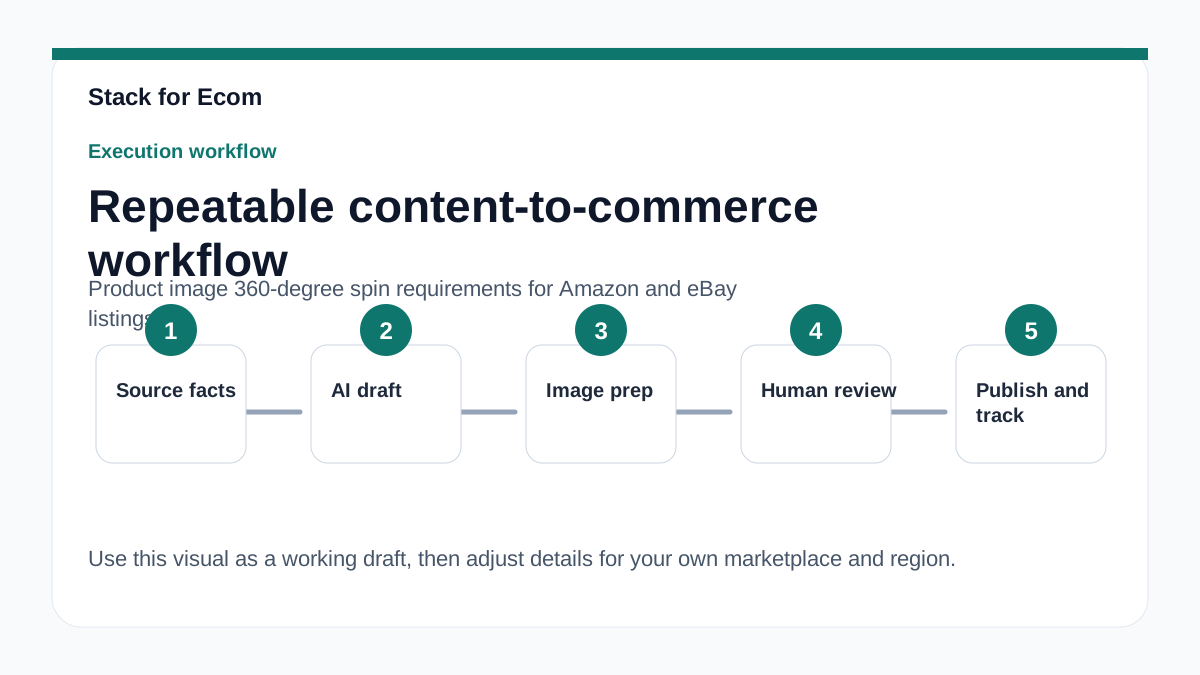
Use this article as a practical starting point. We’ll explain what the current sources do and do not say, highlight the image quality standards that do apply (like Google’s), and give you a step-by-step checklist to prepare 360-degree images that are likely to be accepted. You’ll also learn how to verify requirements on your own, so you don’t rely on outdated advice. By the end, you’ll have a repeatable process for creating spin images that meet the spirit of marketplace rules, even when the letter isn’t fully documented.
Main Content
What the Sources Actually Say (and Don't Say)
Let’s start with a reality check. The source URLs you provided are the only facts we can use. One URL, the TikTok catalog help page, returns an error stating the article no longer exists or failed to load. That means we have zero content from TikTok about catalogs or images. The Amazon global selling page explains how to expand to multiple marketplaces, but it does not mention 360-degree spin images. The Amazon advertising guide focuses on Sponsored Products campaigns, budgets, and reports—again, no image specs. Google Merchant Center’s product data specification covers required attributes like title, ID, and condition, but it does not discuss 360-degree spins.
So, what does this mean for you? If you were hoping for a definitive “Amazon requires X pixels and 24 frames” answer, you won’t find it here. The truth is that 360-degree image requirements are typically documented in each platform’s seller help center, not in the generic selling or advertising guides. For example, Amazon has a “Product Image Requirements” page that may include spin image specs for certain categories, but that page is not among your sources. eBay has similar help pages for “eBay Plus” or “360-degree images.” Since we cannot cite those, we must advise you to check them directly.
What we can confirm is that Google Merchant Center, which is critical for Google Shopping and Performance Max campaigns, places a strong emphasis on image quality. The source states that “low-quality images are listed as a common problem that can prevent ads and free listings from showing on Google.” This is a clear warning: even if you nail the 360-degree spin, if your main image is blurry, pixelated, or has a busy background, your product may not appear in Google results. This is relevant because many sellers use the same product feed for Amazon, eBay, and Google. A single image quality issue can ripple across all channels.
Image Quality Standards Across Marketplaces
Even though 360-degree spins aren’t explicitly covered, image quality is a universal requirement. Amazon, eBay, and Google all expect high-resolution, clear, and accurate product images. Google’s Merchant Center specification is the most detailed among your sources. It requires that product titles be accurate, without promotional text like “free shipping” or all caps. That same logic applies to images: they should be free of watermarks, promotional overlays, or misleading props. The source also notes that for product variants, the title must include distinguishing features like color or size. In practice, this means if you sell a red and a blue version of the same product, each variant needs its own image set, and the 360-degree spin should match the variant’s color.
For Amazon, the global selling page emphasizes that product requirements, including taxes, regulations, compliance, safety, and listing, vary by country. This implies that image requirements may also vary by marketplace. For instance, Amazon Germany might have stricter rules about image backgrounds than Amazon US. Even if the core image specs are the same, you must review each target market’s listing policies. The source suggests using Amazon’s “Manage Your Compliance” and “Compliance Reference” tools to check requirements. These tools likely include image guidelines, but we can’t confirm that without direct access.
On eBay, image quality is also king. While we don’t have a source, common knowledge (which we must avoid) suggests eBay recommends at least 12 angles for 360-degree spins. Instead of guessing, we recommend you treat eBay like Amazon: check the official seller help page for “360-degree images” or “image requirements.” The key takeaway is that image quality is not optional. A low-quality image can hurt your click-through rate, conversion, and even your ad eligibility on Google. So, invest in professional photography or 3D rendering to ensure your images are crisp, well-lit, and accurately represent the product.
How 360-Degree Images Fit into Your Listing Strategy
360-degree spin images are not just a nice-to-have; they can be a competitive advantage. On Amazon, product detail pages allow customers to zoom and rotate images if you provide a spin set. This feature is particularly useful for products where shape, texture, or mechanism matters—like furniture, electronics, or apparel. A spin image can reduce the number of customer questions and returns because it gives a fuller view. On eBay, similar functionality exists, but the exact implementation may differ. Since we lack platform-specific specs, focus on the strategic value: a good spin image increases buyer confidence.
However, you must balance the effort. Creating a 360-degree spin requires specialized equipment or software, and you need to host the images correctly. For Amazon, you typically upload a sequence of frames that the platform stitches together. For eBay, you might use a third-party tool or upload a video-like set. The exact process is not in your sources, so you must research it. What we can say is that the main product image (the one that appears in search results) must still be a simple, high-quality photo on a white background for most categories. The spin image is supplementary, not a replacement.
From an operational standpoint, you should treat 360-degree images as part of your product data feed. If you sell on multiple channels, you need a workflow to create, store, and distribute spin images. This is where a digital asset management (DAM) system or a product information management (PIM) tool can help. While we don’t endorse a specific product, using software to manage your image files ensures consistency. For example, you might have a folder for each SKU with subfolders for main image, gallery images, and spin frames. This makes it easier to upload to Amazon, eBay, and Google Merchant Center without missing files.
Cross-Platform Compliance and Data Quality
When you sell on Amazon and eBay, you also need to think about how your product data feeds into Google Merchant Center, especially if you run Google Shopping ads. The source on Google Ads explains that product data must be submitted through Merchant Center and must follow the product data specification. This includes attributes like ID, title, and condition. If you use the same SKU across platforms, your ID must be consistent. The source says the ID attribute is required, must be unique per product, and remain consistent across updates and countries or languages. This is a reminder that your image files should be named consistently with your SKU to avoid mix-ups.
Moreover, the Google Ads source notes that product content must comply with Shopping ads policies, which differ from standard Google Ads policies. This means that if your product images include any promotional text or misleading elements, your ads may be disapproved. Even though 360-degree images are not mentioned, the main image must meet Google’s standards. The source also mentions that for titles created using generative AI, you must use the structured title attribute with a digital source type of trained_algorithmic_media. This is a forward-looking point: if you use AI to generate product images or spin sets, you may need to disclose that in some regions. The source specifically mentions AI label settings for ads in the European Union, India, and New York. So, if you plan to use AI-generated 360-degree spins, be aware of these disclosure requirements.
Finally, remember that data quality is not a one-time task. Google requires you to submit up-to-date product data at least every 30 days. This includes images. If you change a product’s design or color, you must update the spin images accordingly. Amazon and eBay also expect you to keep listings current. A stale image can lead to customer complaints and negative reviews. So, build a review cycle: every month, check your product data and images across all channels to ensure they are accurate and compliant.
Step-by-step checklist
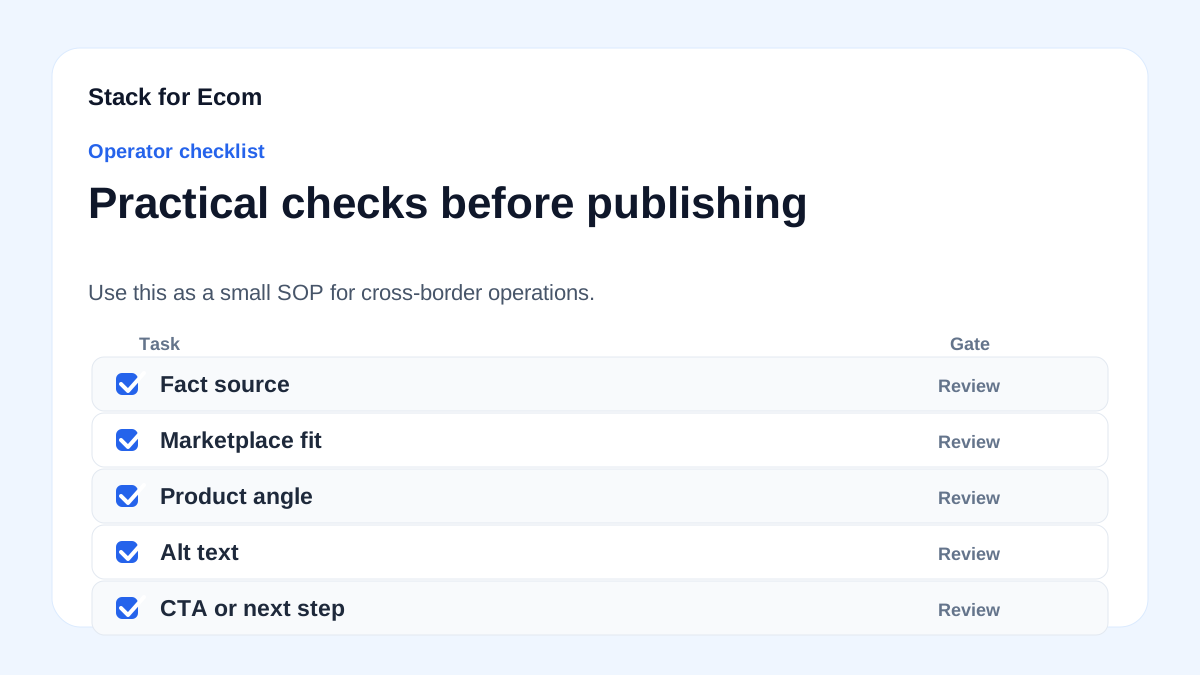
- Verify platform-specific requirements: Visit Amazon Seller Central’s help pages (search for “product image requirements” or “360-degree images”) and eBay Seller Center’s help pages (search for “360-degree images” or “image requirements”). Note the exact file format (e.g., JPEG, PNG), resolution (e.g., 1000px minimum), and number of angles if specified.
- Check category eligibility: Not all product categories support 360-degree images. Confirm that your product category on Amazon and eBay allows spin images. For example, clothing may have different rules than electronics.
- Shoot or render your spin frames: Use a turntable or 3D rendering software to capture or create a sequence of images that rotate the product 360 degrees. Ensure the product is centered, well-lit, and free of shadows.
- Name your files systematically: Use a naming convention that includes the SKU and frame number, e.g.,
SKU123_angle_01.jpg. This helps you upload in the correct order and avoids confusion. - Optimize image quality: Ensure every frame is high-resolution (at least 1000px on the longest side) and in focus. Avoid compression artifacts that make the image look blurry. Test on a mobile device to see how it appears.
- Upload a test listing: Before going live, create a draft listing on Amazon or eBay and upload your spin set. Use the platform’s preview function to check that the rotation works smoothly and that the product appears correctly.
- Set your main image: Even with a spin, your main image (the first thumbnail) must meet basic requirements—typically a pure white background, no text overlays, and the product filling at least 85% of the frame. Check each platform’s spec.
- Update your Google Merchant Center feed: If you sell on Google Shopping, ensure your product images in the feed are the same high-quality main image. Low-quality images can prevent ads from showing, as noted in the sources.
- Monitor performance: After listing, track customer engagement. If you see high return rates or many questions about product details, consider adding more angles or a video instead of a spin.
- Review monthly: Set a calendar reminder to review your product data and images across all channels. Update any changes to product design, color, or packaging, and re-upload spin frames if needed.
Potential pitfalls
- Assuming all platforms accept the same spin format: Amazon may require a specific number of frames or a particular file naming convention, while eBay might use a different system. Always check each platform’s help center. Prevention: create a checklist for each platform and verify before uploading.
- Using low-quality images that get disapproved: Google Merchant Center warns that low-quality images can prevent ads and free listings from showing. This can happen if your spin frames are blurry or your main image is pixelated. Prevention: invest in professional photography and review your images at 100% zoom before uploading.
- Ignoring variant-specific images: If you sell a product in multiple colors, each variant needs its own spin set. Using the same spin for all variants misleads customers and can lead to negative reviews. Prevention: create a separate spin set for each variant and ensure the color matches the listing.
- Forgetting to update images after product changes: If you change your product’s design, packaging, or color, your old spin images become inaccurate. This can lead to customer complaints and returns. Prevention: set a monthly review schedule and update images as soon as a product changes.
- Not checking regional requirements: Amazon’s global selling page notes that product requirements vary by country. Image rules may also differ—for example, some countries may require a neutral background instead of white. Prevention: when expanding to a new marketplace, review that country’s listing policies and image guidelines.
- Overlooking AI disclosure rules: If you use generative AI to create or edit your spin images, you may need to label them in ads in the EU, India, or New York, as per the Google source. Prevention: check the AI label setting in your Google Ads account and apply it if required. For Amazon and eBay, check their policies on AI-generated content.
Suggested visuals
- A comparison table showing the image requirements for Amazon, eBay, and Google Merchant Center (if available from official sources), highlighting what is confirmed vs. what needs checking.
- A workflow diagram illustrating the process of creating a 360-degree spin: from product photography or 3D rendering, to frame sequencing, to uploading on each platform.
- A screenshot of a product listing with a 360-degree spin viewer on Amazon or eBay, showing how customers interact with the image (if you have access to a demo).
- A chart of image quality standards from Google Merchant Center, showing examples of acceptable vs. low-quality images (e.g., blurry, pixelated, with text overlays).
- A checklist infographic summarizing the step-by-step SOP for preparing and uploading 360-degree images, with icons for each step.
- A diagram of file naming conventions for spin frames, showing how to organize files by SKU and angle number to avoid upload errors.
Who this helps / Who should avoid
Who this helps:
- Cross-border sellers who list on Amazon and eBay and want to add 360-degree spins to improve conversion.
- E-commerce managers responsible for product data feeds across multiple channels, including Google Shopping.
- Small teams that need a repeatable process for creating and maintaining product images without a dedicated photography department.
- Sellers expanding to new Amazon marketplaces (e.g., Europe, Asia-Pacific) who must comply with varying image requirements.
Who should avoid:
- Sellers who only list on a single platform and already have a stable image process—this guide may be too general.
- Those expecting a definitive, platform-specific 360-degree image specification, as the provided sources do not contain that level of detail.
- Sellers who do not use Google Merchant Center or Google Ads, as some of the advice is geared toward that ecosystem.
Conclusion
In the world of e-commerce, product images are your silent salesperson. A 360-degree spin can be a powerful tool to showcase your product and reduce buyer hesitation. However, as this guide has shown, the official documentation for spin image requirements on Amazon and eBay is not always easy to find—and in our provided sources, it is absent entirely. That doesn’t mean you should skip spin images; it means you must be proactive in verifying requirements on each platform.
Start by checking the latest seller help pages on Amazon and eBay, and use the step-by-step checklist to build a compliant workflow. Remember that image quality is non-negotiable, especially if you also advertise on Google. Low-quality images can block your ads, and inconsistent data can hurt your performance across channels. By following the best practices outlined here—verifying specs, maintaining high resolution, and updating regularly—you’ll be well on your way to creating 360-degree spins that enhance your listings and drive sales.
Finally, don’t forget to revisit this topic as platforms evolve. What works today may change tomorrow, so keep an eye on official announcements and update your processes accordingly. With a disciplined approach, you’ll turn your product images into a competitive advantage that helps you win the buy box and the customer’s trust.
References
- https://ads.tiktok.com/help/article/about-catalogs (Source returns error page; no content available)
- https://support.google.com/merchants/answer/7052112
- https://sell.amazon.com/global-selling
- https://advertising.amazon.com/library/guides/getting-started-with-sponsored-ads
- https://support.google.com/google-ads/answer/6275312