TL;DR
- The specific product image resolution requirements for Amazon, eBay, and Etsy listings are not available in the provided sources. Details may vary; check references.
- Low-quality images are a common problem that can prevent ads and free listings from showing on Google (Source: https://support.google.com/merchants/answer/7052112).
- Google Merchant Center requires accurate product data, including ID and title attributes, and has specific rules for AI-generated titles (Source: https://support.google.com/merchants/answer/7052112).
- Amazon Global Selling requires sellers to meet country-specific compliance, safety, and listing requirements (Source: https://sell.amazon.com/global-selling).
- Use this guide as a framework to audit your image workflow, but always verify platform-specific image specs directly with each marketplace.
Introduction
If you sell on Amazon, eBay, or Etsy, you already know that product images are the first thing shoppers see. But when you expand to multiple marketplaces or run ads on Google and Amazon, image quality stops being a design issue and becomes an operational one. Low-resolution or poorly formatted images can cause disapprovals, limit your ad eligibility, or keep your free listings from showing at all. The problem is that image resolution requirements are not always easy to find, and they can change. In this article, we focus on what the provided sources confirm and flag where you need to check current platform documentation.
The business impact is real. If your images are rejected or suppressed, you lose impressions, clicks, and sales. For cross-border sellers, the risk is higher because you may be managing feeds for multiple countries, each with its own compliance and listing rules. Amazon Global Selling, for example, requires sellers to complete requirements for taxes, regulations, compliance, safety, and listing for each country where they sell (Source: https://sell.amazon.com/global-selling). That means your image assets need to be ready for every market, not just your home country.
This article is structured as a practical guide. We will look at what the sources say about product data quality, how low-quality images affect ads and free listings, and how to build a repeatable checklist for your team. We will also cover AI-generated content rules, because they affect both titles and images in some regions. Where the sources do not provide specific resolution numbers for Amazon, eBay, or Etsy, we will say so clearly and point you to the right places to verify. By the end, you should have a workflow you can apply across marketplaces and a clear list of what to check before you publish.
Main Content
What the sources confirm about image quality and product data
The provided sources do not contain the exact pixel dimensions or resolution requirements for Amazon, eBay, or Etsy product images. We need to be direct about that: no information about Amazon, eBay, or Etsy product image resolution requirements was present in the retrieved content (Source: https://ads.tiktok.com/help/article/about-catalogs). The TikTok Ads Help Center articles we attempted to retrieve could not be loaded because the pages no longer exist or failed to load (Source: https://ads.tiktok.com/help/article/about-catalogs; https://ads.tiktok.com/help/article/get-started-tiktok-ads-manager). So if you are looking for a single table of pixel sizes from these sources, it is not here.
What the sources do confirm is that low-quality images are a common problem that can prevent ads and free listings from showing on Google (Source: https://support.google.com/merchants/answer/7052112). That is a critical point for any seller who also runs Google Shopping or Performance Max campaigns. It means image quality is not just a marketplace listing issue; it is a feed quality issue. Incorrect, inaccurate, or missing product information can cause disapprovals, limited eligibility, incorrect displays, or other issues in Merchant Center (Source: https://support.google.com/merchants/answer/7052112).
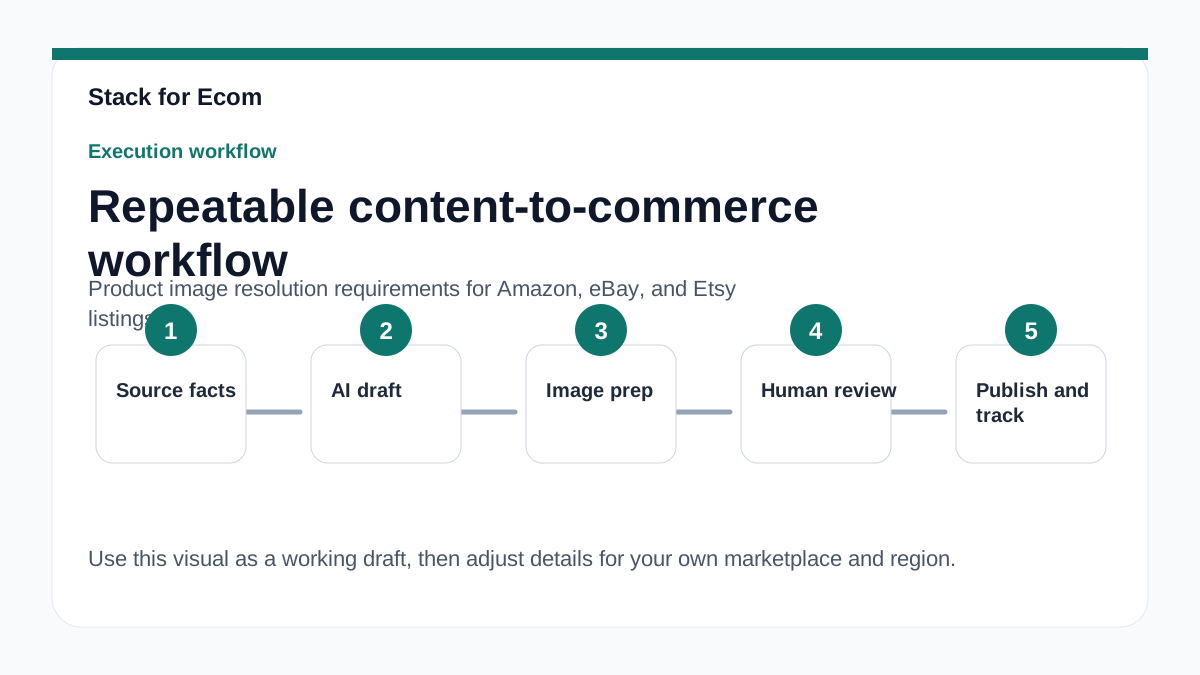
For operators, the takeaway is simple: treat image quality as part of your product data quality. Even if you do not have the exact resolution numbers from these sources, you can still build a process that prevents low-quality images from entering your feed. That process should include checks for resolution, aspect ratio, background, and file format, and it should be applied before images are uploaded to any marketplace or feed.
Google Merchant Center requirements that affect your images and feeds
Google Merchant Center requires the ID [id] attribute, with a maximum of 50 characters, and recommends using the product's SKU as a unique value (Source: https://support.google.com/merchants/answer/7052112). The title [title] attribute is required, uses plain text, and has a maximum of 150 characters (Source: https://support.google.com/merchants/answer/7052112). For titles created using generative AI, the structured title [structured_title] attribute must be used instead of the title [title] attribute (Source: https://support.google.com/merchants/answer/7052112). The structured title has two sub-attributes: digital source type [digital_source_type] (optional) and content [content] (required, max 150 characters) (Source: https://support.google.com/merchants/answer/7052112). The digital source type supports two values: Default [default] and Trained algorithmic media [trained_algorithmic_media] (Source: https://support.google.com/merchants/answer/7052112).
Why does this matter for images? Because AI regulations in the European Union, India, and New York require ads with certain AI-generated or edited assets to include disclosures and/or labels (Source: https://support.google.com/merchants/answer/7052112). If you use generative AI to create or edit product images, you may need to disclose that in your feed. The structured title attribute is one mechanism for that disclosure, but the sources do not specify how image-level disclosures work. Details may vary; check references.
For a seller, the practical step is to keep your feed data clean and consistent. Use SKUs as IDs, keep titles under 150 characters, and if you use AI-generated titles, switch to the structured title attribute. Also, make sure your product data is up to date. For Shopping campaigns and Performance Max, up-to-date product data must be sent at least every 30 days and meet data quality standards (Source: https://support.google.com/google-ads/answer/6275312). Product data submission standards are defined in the product data specification, and data is submitted regularly via Merchant Center (Source: https://support.google.com/google-ads/answer/6275312).
Amazon Global Selling and image compliance across countries
Amazon Global Selling requires sellers to complete requirements for taxes, regulations, compliance, safety, and listing for each country where they sell (Source: https://sell.amazon.com/global-selling). Product requirements, including compliance, safety, and listing, vary by country and should be reviewed for each target market (Source: https://sell.amazon.com/global-selling). This means your image assets may need to meet different standards depending on where you sell. For example, a North America and Brazil unified account lets you reach customers in the US, Canada, Mexico, and Brazil (Source: https://sell.amazon.com/global-selling). A Europe account allows sellers to reach Amazon customers in 28 countries (Source: https://sell.amazon.com/global-selling). Country-specific accounts are required for selling in the Asia-Pacific (Australia, India, Japan) and the Middle East and North Africa (UAE, Saudi Arabia, Egypt) (Source: https://sell.amazon.com/global-selling).
Amazon provides Manage Your Compliance and Compliance Reference tools to help sellers navigate product requirements (Source: https://sell.amazon.com/global-selling). These tools are useful for checking what you need for each country, but the sources do not specify whether they include image resolution requirements. Details may vary; check references. What we do know is that linked global Amazon selling accounts have a monthly fee of either USD 39.99 or the sum of selling plan fees for each region/country with active listings, whichever is lower (Source: https://sell.amazon.com/global-selling). Referral fees vary by product category and are charged as a percentage of the total price or a minimum amount, whichever is greater (Source: https://sell.amazon.com/global-selling).
If you run Amazon Ads, image quality also matters for ad performance. Amazon recommends new advertisers start with Sponsored Products, which are self-service cost-per-click ads appearing in shopping results and on product detail pages across desktop and mobile (Source: https://advertising.amazon.com/library/guides/getting-started-with-sponsored-ads). A minimum daily budget of $10 is recommended for the United States and Canada, £10 for the United Kingdom, 10 € for Germany, France, Italy, Spain, Belgium, Ireland, and the Netherlands, and 1,000円 for Japan (Source: https://advertising.amazon.com/library/guides/getting-started-with-sponsored-ads). Amazon advises running campaigns without an end date and notes that automatic targeting campaigns are automatically updated with changing shopping trends (Source: https://advertising.amazon.com/library/guides/getting-started-with-sponsored-ads). For manual keyword targeting, Amazon recommends targeting at least 30 keywords and starting with broad match before focusing on top performers with phrase or exact match (Source: https://advertising.amazon.com/library/guides/getting-started-with-sponsored-ads).
Shopping ads and Performance Max: feed and policy requirements
Setting up a Performance Max campaign with a Merchant Center feed or a Shopping campaign requires meeting specific requirements (Source: https://support.google.com/google-ads/answer/6275312). Advertisers must set up and link Google Merchant Center and Google Ads accounts (Source: https://support.google.com/google-ads/answer/6275312). Business type, products, promotions, and website must meet Shopping ads requirements before advertising begins (Source: https://support.google.com/google-ads/answer/6275312). Shopping campaign and Shopping ad content must comply with Shopping ads policies, which differ from Google Ads policies (Source: https://support.google.com/google-ads/answer/6275312). In European Economic Area (EEA) countries and Switzerland, Shopping ads participation is through Shopping Comparison Services (CSSs) of the advertiser's choice (Source: https://support.google.com/google-ads/answer/6275312).
To ensure Shopping and Performance Max campaigns run effectively, products should be added to the linked Merchant Center feed for the shopping ads destination (Source: https://support.google.com/google-ads/answer/6275312). That feed includes your product images. If your images are low quality, your ads may not show. The sources confirm that low-quality images are a common problem that can prevent ads and free listings from showing on Google (Source: https://support.google.com/merchants/answer/7052112). So even if you meet the technical requirements for campaign setup, image quality can still block your ads.
For sellers, this means image optimization is not a one-time task. You need to monitor your feed for image-related disapprovals and fix them quickly. Google Merchant Center reports can help you identify issues, but the sources do not list specific image reports. Details may vary; check references. A practical approach is to check your Merchant Center diagnostics regularly and keep a log of image-related issues. If you see a pattern, update your image workflow to prevent it from happening again.
AI-generated images and disclosure rules
AI-generated images are becoming more common in ecommerce, but they come with regulatory requirements. AI regulations in the European Union, India, and New York require ads with certain AI-generated or edited assets to include disclosures and/or labels (Source: https://support.google.com/merchants/answer/7052112). The sources do not specify exactly how image disclosures should be implemented, but they do define the structured title attribute for AI-generated titles. For titles created using generative AI, the structured title [structured_title] attribute must be used instead of the title [title] attribute (Source: https://support.google.com/merchants/answer/7052112). The structured title has two sub-attributes: digital source type [digital_source_type] (optional) and content [content] (required, max 150 characters) (Source: https://support.google.com/merchants/answer/7052112). The digital source type supports two values: Default [default] and Trained algorithmic media [trained_algorithmic_media] (Source: https://support.google.com/merchants/answer/7052112).
If you use AI to generate or edit product images, you should check whether your target markets require disclosures. The EU, India, and New York are specifically mentioned in the sources (Source: https://support.google.com/merchants/answer/7052112). If you sell in those regions, you need to understand what is required. The sources do not provide a step-by-step guide for image labeling, so you will need to consult local regulations or platform guidance. Details may vary; check references.
From an operational standpoint, the safest approach is to keep a record of which images are AI-generated or AI-edited. That way, if a platform or regulator asks for disclosure, you can provide it. You should also train your team on the difference between AI-generated and AI-edited assets, because the rules may apply differently. The sources do not clarify this distinction, so you will need to verify with legal or compliance experts.
Step-by-step checklist
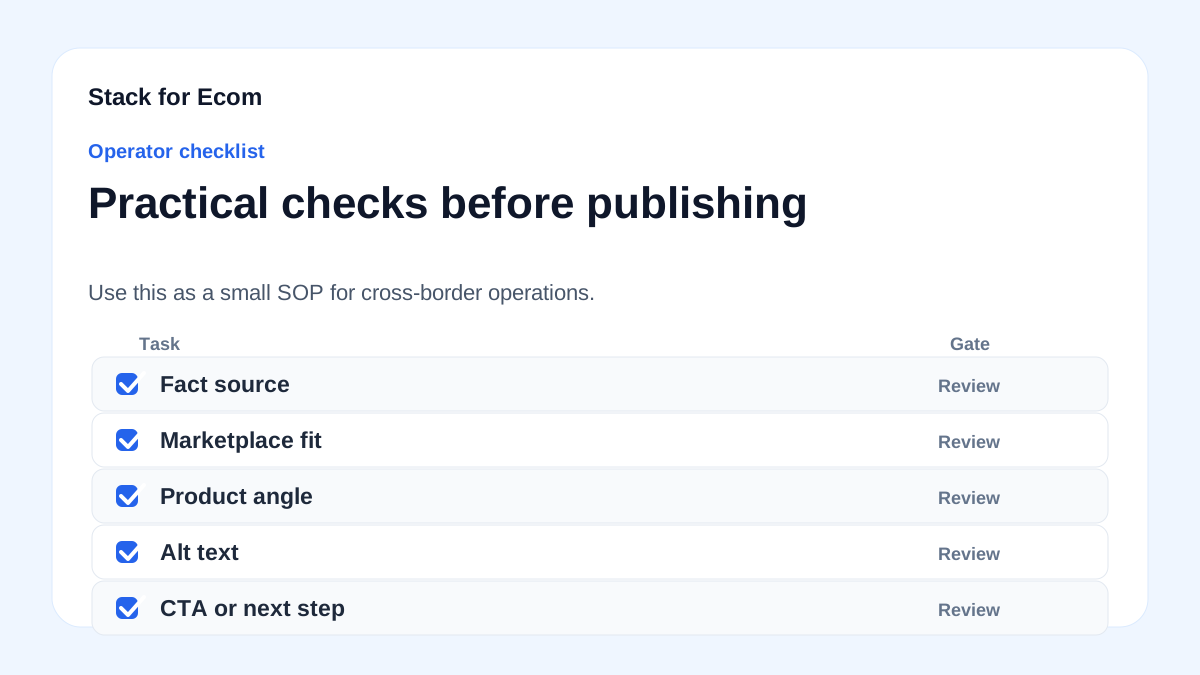
Use this checklist as a repeatable SOP for product image resolution and quality across Amazon, eBay, Etsy, and Google feeds.
- [ ] Identify every marketplace and feed where your product images appear (Amazon, eBay, Etsy, Google Merchant Center, etc.).
- [ ] For each platform, locate the current official image requirements page. Do not rely on third-party summaries.
- [ ] Check the minimum and recommended resolution, aspect ratio, file format, and file size for each platform.
- [ ] Verify whether the platform requires a pure white background, specific lighting, or no text/watermarks.
- [ ] Confirm whether the platform has different requirements for main images versus secondary images.
- [ ] For Google Merchant Center, ensure your product ID uses the SKU and is under 50 characters (Source: https://support.google.com/merchants/answer/7052112).
- [ ] For Google Merchant Center, ensure your title is plain text and under 150 characters (Source: https://support.google.com/merchants/answer/7052112).
- [ ] If you use generative AI for titles, switch to the structured title attribute and set the digital source type appropriately (Source: https://support.google.com/merchants/answer/7052112).
- [ ] If you use AI-generated or edited images, check whether your target markets (EU, India, New York) require disclosures or labels (Source: https://support.google.com/merchants/answer/7052112).
- [ ] For Amazon Global Selling, review country-specific compliance, safety, and listing requirements for each market (Source: https://sell.amazon.com/global-selling).
- [ ] Use Amazon's Manage Your Compliance and Compliance Reference tools to check product requirements (Source: https://sell.amazon.com/global-selling).
- [ ] For Shopping and Performance Max campaigns, ensure product data is sent at least every 30 days and meets data quality standards (Source: https://support.google.com/google-ads/answer/6275312).
- [ ] Add products to the linked Merchant Center feed for the shopping ads destination (Source: https://support.google.com/google-ads/answer/6275312).
- [ ] Monitor Merchant Center diagnostics for low-quality image issues and fix them promptly (Source: https://support.google.com/merchants/answer/7052112).
- [ ] Keep a log of image-related disapprovals and update your workflow to prevent repeats.
Potential pitfalls
- Assuming image requirements are the same across platforms. Amazon, eBay, Etsy, and Google each have their own rules. Prevention: Maintain a platform-by-platform checklist and verify requirements at least quarterly.
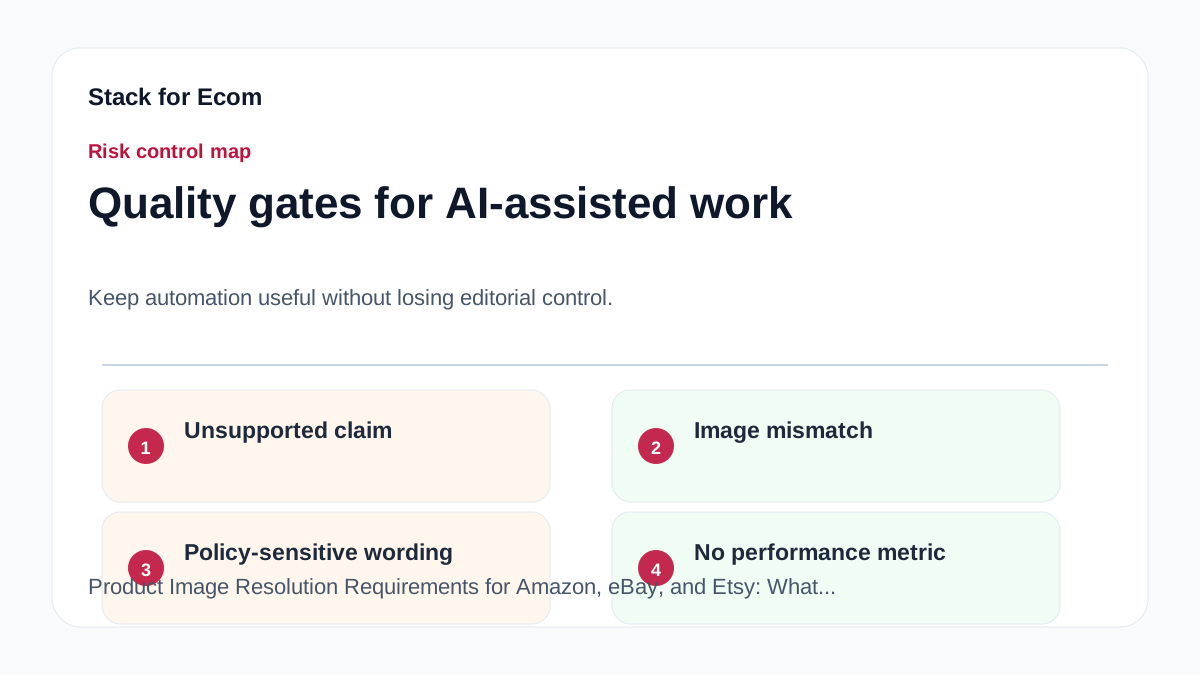
- Using low-resolution images because they look fine on your screen. Low-quality images can prevent ads and free listings from showing on Google (Source: https://support.google.com/merchants/answer/7052112). Prevention: Set a minimum resolution standard for your team and check images at 100% zoom before uploading.
- Ignoring AI disclosure rules. AI regulations in the EU, India, and New York require disclosures for certain AI-generated or edited assets (Source: https://support.google.com/merchants/answer/7052112). Prevention: Track AI-generated images and consult legal guidance for each market.
- Forgetting country-specific compliance for Amazon Global Selling. Product requirements vary by country and should be reviewed for each target market (Source: https://sell.amazon.com/global-selling). Prevention: Use Amazon's compliance tools and review requirements before listing in a new country.
- Letting product data go stale. Up-to-date product data must be sent at least every 30 days for Shopping campaigns (Source: https://support.google.com/google-ads/answer/6275312). Prevention: Set a recurring reminder to refresh your feed and check for errors.
- Missing the link between Merchant Center and Google Ads. Advertisers must set up and link Google Merchant Center and Google Ads accounts (Source: https://support.google.com/google-ads/answer/6275312). Prevention: Verify account linking before launching campaigns.
Suggested visuals
- A comparison table template with columns for Amazon, eBay, Etsy, and Google Merchant Center, and rows for minimum resolution, recommended resolution, aspect ratio, file format, and background requirements. Mark unknown cells as "Details may vary; check references."
- A screenshot of a Google Merchant Center diagnostics page highlighting a low-quality image warning (Source: https://support.google.com/merchants/answer/7052112).
- A workflow diagram showing the image approval process: capture, edit, check resolution, check compliance, upload to marketplace, upload to feed, monitor diagnostics.
- A map or table showing Amazon Global Selling regions and account types: North America and Brazil unified account, Europe account, and country-specific accounts for Asia-Pacific and MENA (Source: https://sell.amazon.com/global-selling).
- A checklist graphic for the step-by-step SOP, designed as a printable one-pager for warehouse or content teams.
- A simple chart showing the recommended minimum daily budgets for Amazon Sponsored Products by country (Source: https://advertising.amazon.com/library/guides/getting-started-with-sponsored-ads).
Who this helps / Who should avoid
This guide helps cross-border ecommerce sellers, marketplace operators, and small export teams who manage product listings on Amazon, eBay, Etsy, or Google Shopping. It is especially useful for sellers who are expanding into new countries and need to understand how image quality and product data requirements differ by market. It also helps teams that use generative AI for product content and need to stay compliant with disclosure rules.
This guide is not for sellers looking for exact pixel dimensions for Amazon, eBay, or Etsy. The provided sources do not contain those numbers. If you need precise resolution requirements, you should check each platform's official documentation directly. This guide is also not a substitute for legal advice on AI disclosure regulations. If you sell in the EU, India, or New York, consult a compliance professional.
Conclusion
Product image resolution is not just a design detail. It is a data quality issue that can affect your ads, free listings, and overall marketplace performance. The sources confirm that low-quality images can prevent ads and free listings from showing on Google (Source: https://support.google.com/merchants/answer/7052112). They also confirm that incorrect or missing product information can cause disapprovals and limited eligibility (Source: https://support.google.com/merchants/answer/7052112). For cross-border sellers, the challenge is compounded by country-specific compliance and listing requirements (Source: https://sell.amazon.com/global-selling).
The specific resolution requirements for Amazon, eBay, and Etsy are not available in the provided sources. Details may vary; check references. Your next step is to build a repeatable image quality checklist, verify current requirements on each platform, and monitor your feeds for image-related issues. If you use AI-generated content, review the disclosure rules for your target markets. By treating images as part of your product data, you can reduce disapprovals, improve ad eligibility, and protect your sales across every channel.
References
- https://ads.tiktok.com/help/article/about-catalogs
- https://ads.tiktok.com/help/article/get-started-tiktok-ads-manager
- https://support.google.com/merchants/answer/7052112
- https://sell.amazon.com/global-selling
- https://advertising.amazon.com/library/guides/getting-started-with-sponsored-ads
- https://support.google.com/google-ads/answer/6275312