TL;DR
- Use a structured supplier email template to report order discrepancies (wrong item, quantity, value, description) and request corrections before goods ship or clear U.S. Customs.
- Under U.S. import rules, the importer is responsible for ensuring goods comply with state and federal regulations; inaccurate descriptions on Customs documents can lead to fines or legal action.
- CBP requires precise, plain-language cargo descriptions for all shipments, regardless of value, and de minimis shipments reached 1.36 billion in FY2024 with a declared value of $64.6 billion.
- ITA's beta Global Business Navigator chatbot can help you find general export resources, but it may be inaccurate, cannot address your specific product or market, and must not be used for legal advice or with PII.
- This article provides a ready-to-adapt email template, a repeatable checklist, pitfalls, and visual ideas for supplier communication.
Introduction
Order discrepancies are one of the most common and costly friction points in cross-border ecommerce. A supplier ships 480 units instead of 500, substitutes a material, or lists a vague commodity description like "gift items" on the commercial invoice. For the importer, these small errors can cascade into customs delays, unexpected duty assessments, or even detention and destruction of goods. The operator problem is not just about getting the right product; it is about getting the right data, in the right language, before the shipment reaches U.S. Customs and Border Protection (CBP).
The business impact is direct. When descriptions are imprecise, CBP may not be able to classify the goods correctly, which affects the duty rate and can trigger penalties. Misrepresenting the nature or value of an item on Customs documents is illegal, and the importer may face legal action and fines. Foreign shipments without a CBP declaration form and an invoice may be subject to seizure, forfeiture, or return to sender. In FY2024 alone, de minimis shipments reached 1.36 billion with a declared value of $64.6 billion, so even small per-order errors scale quickly across a catalog.
This article gives you a practical supplier communication email template for order discrepancies, plus a step-by-step checklist you can turn into an SOP. It also explains how to use ITA's beta Global Business Navigator chatbot safely for general export research, and where its limits require you to double-check references. Use the template as a starting point, then adapt it to your product category and supplier relationship. Details may vary; check references.
Main Content
Why precise supplier communication matters for customs compliance
U.S. import rules apply the moment goods move from a foreign country to the United States. The importer, which is the buyer when purchasing from foreign sources, is responsible for ensuring goods comply with state and federal import regulations. That responsibility does not transfer to the supplier, the freight forwarder, or the marketplace. If a supplier sends a vague invoice, the importer still owns the compliance risk.
CBP regulations (19 CFR § 4.7a, 122.48a, 123.91, 123.92, and 128.21) require a precise, specific description of merchandise regardless of value. A precise cargo description must be clear, concise, in plain language, and detailed enough for U.S. Customs to identify the size, shape, and characteristics of the commodity. Only the cargo description should be in the commodity description field; superfluous information such as personally identifiable information (PII), type of packaging, and carrier disclaimers should not be transmitted.
For example, a supplier invoice that says "plastic parts" is not enough. A better description might be "injection-molded polypropylene brackets, 12 cm x 4 cm x 2 cm, for furniture assembly." That level of detail helps Customs assign the correct classification number and duty rate. Sellers should be asked to provide a detailed description of items in English, as this determines the classification number and duty rate assigned by Customs. When you build your email template around this requirement, you reduce back-and-forth and avoid last-minute corrections.
The email template: structure and exact wording
A good discrepancy email has five parts: subject line, order identification, discrepancy table, requested correction, and deadline. Keep the tone factual and collaborative. Suppliers respond better to a clear list than to a paragraph of complaints. Below is a template you can copy and adapt.
Subject: Order [PO Number] – Discrepancy Report and Correction Request
Body:
Dear [Supplier Contact],
We received your [invoice/packing list/shipment] for PO [PO Number] dated [Date]. After review, we identified the following discrepancies:
| Line | Item / SKU | Ordered | Received / Documented | Issue | Required Correction | |------|------------|---------|------------------------|-------|---------------------| | 1 | [SKU] | 500 pcs | 480 pcs | Short shipment | Confirm remaining 20 pcs ship by [Date] | | 2 | [SKU] | [Material A] | [Material B] | Material substitution | Replace with [Material A] or provide written approval | | 3 | [SKU] | [Description] | "gift items" | Vague customs description | Provide precise English description: material, size, shape, use |
Please confirm corrections in writing by [Date]. For line 3, note that U.S. Customs requires a precise, plain-language description regardless of value, and inaccurate descriptions can lead to fines or legal action. Send the corrected commercial invoice and packing list to [your email] so we can update our customs documentation.
Thank you for your prompt attention.
[Your Name] [Company]
This template works for both pre-shipment and post-shipment discrepancies. If goods have already arrived, add a line asking the supplier to issue a credit note or replacement plan. If goods are still at origin, the correction is usually faster and cheaper.
Using ITA's beta Global Business Navigator safely in your workflow
The International Trade Administration (ITA) offers a beta AI chatbot called the Global Business Navigator, built with Microsoft Azure AI services, to provide general information on the exporting process and resources for U.S. exporters. It is trained on ITA's export-related content from the Export Solutions web pages on Trade.gov and can understand non-expert language, idiomatic expressions, and foreign languages.
That makes it useful for orientation, not for order-specific decisions. The chatbot cannot provide responses specific to a company's product or a specific foreign market, but its reference pages guide users to other government resources and market research. As a beta product, it may produce inaccurate or incomplete information, and its knowledge is limited to public information on the Export Solutions web pages. Users should always double-check the chatbot's responses using provided references or by visiting the Export Solutions web pages, and should not use its responses as legal or professional advice.
Privacy matters too. The chatbot does not collect user information or use chat history to learn new information, and all feedback is anonymous. However, users are advised not to enter personally identifiable information (PII), sensitive, or proprietary information into the chatbot. Conversations may be reviewed to help ITA improve the tool and address harmful, illegal, or otherwise inappropriate questions. The chatbot supports a wide range of languages, but because it is trained in English and responses are translated, users should verify translations as it may have difficulty with acronyms, abbreviations, and nuances in other languages. Use it to find general resources, then verify with the cited pages before you act.
Handling value, duty, and de minimis discrepancies
Value discrepancies are especially sensitive. Misrepresenting or inaccurately describing the nature or value of an item on Customs documents is illegal, and the importer may face legal action and fines. If a supplier under-declares value to reduce duty, the importer carries the legal risk. Your email template should therefore include a line asking the supplier to confirm the declared value matches the commercial invoice and purchase order.
De minimis volume and value statistics are calculated from the number of Bills of Lading (BOLs) and their declared value at the time of import. In fiscal year 2024, total de minimis shipments reached 1.36 billion with a declared value of $64.6 billion. For items shipped via international postal service valued under $2,500 and not subject to quota or restriction, a CBP official usually prepares the paperwork, assesses duty, and releases the item for delivery. That does not remove the need for accurate descriptions; it simply changes who prepares the entry.
CBP's E-Commerce Strategy focuses on four primary goals and identifies private industry and foreign governments as key resources. The strategy includes educating the public and trade community about importer responsibilities for customs compliance and streamlining enforcement processes. For operators, the practical takeaway is to treat every shipment, even low-value ones, as a compliance event. Ask suppliers for a detailed English description, a consistent declared value, and a commercial invoice that matches the packing list.
Escalation, documentation, and repeatable follow-up
Not every discrepancy resolves on the first email. Build an escalation path into your SOP: first email to the supplier contact, second email to the account manager with a deadline, third step a phone or video call, and final step a formal quality report or chargeback. Keep every message in a shared thread or ticket so you have a documented history if Customs or a payment dispute arises.
Documentation should include the original PO, the supplier's invoice and packing list, photos of the received goods, and the corrected documents. If goods are detained, CBP may assess fines, penalties, detention, or destruction for unsafe goods, health code failures, or quota violations. Having a clean paper trail helps you respond quickly. Whether purchased from an established business or an individual via online auction, imported merchandise must clear CBP and may be subject to duty payments.
Finally, use the same template for every supplier and every order. Consistency is what turns a one-off email into an SOP. Review your discrepancy log monthly, identify the top three recurring issues, and add specific language to the template to prevent them. Details may vary; check references.
Step-by-step checklist
- Confirm the purchase order number, invoice number, and shipment date before writing the email.
- Compare the commercial invoice and packing list line by line against the PO.
- List each discrepancy in a table: ordered vs. received/documented, issue, and required correction.
- For every line, request a precise English description covering material, size, shape, and use.
- Ask the supplier to confirm the declared value matches the invoice and PO.
- Request corrected commercial invoice and packing list in PDF format.
- Set a written response deadline and state the next escalation step.
- Save all documents and photos in a shared order folder.
- If goods are already at a port, notify your customs broker immediately.
- Log the discrepancy type and resolution time for monthly review.
- If you use ITA's beta chatbot for general research, verify responses against the cited Export Solutions pages and never enter PII or proprietary data.
Potential pitfalls
- Vague descriptions. A supplier writes "accessories" instead of a precise description. Prevention: require material, size, shape, and use in plain English, per CBP guidance.
- Under-declared value. A supplier lowers the invoice value to reduce duty. Prevention: state in the template that misrepresenting value is illegal and the importer may face fines or legal action.
- Missing customs documents. A shipment arrives without a CBP declaration form and invoice. Prevention: require both documents before dispatch; otherwise the shipment may be seized, forfeited, or returned.
- Language and translation errors. The supplier translates descriptions poorly. Prevention: ask for English descriptions and verify translations, especially acronyms and abbreviations.
- Over-reliance on the beta chatbot. The chatbot may produce inaccurate or incomplete information and cannot address your specific product or market. Prevention: double-check responses with the cited references and never use them as legal advice.
- Privacy leaks. Someone pastes supplier contracts or customer data into a chatbot. Prevention: prohibit PII, sensitive, and proprietary information in any AI tool.
Suggested visuals
- A screenshot-style mockup of the discrepancy email template with the table filled in.
- A flowchart showing the escalation path: first email, account manager, call, formal report.
- A before-and-after table comparing a vague description ("gift items") with a precise CBP-ready description.
- A simple bar chart of FY2024 de minimis shipments (1.36 billion) and declared value ($64.6 billion).
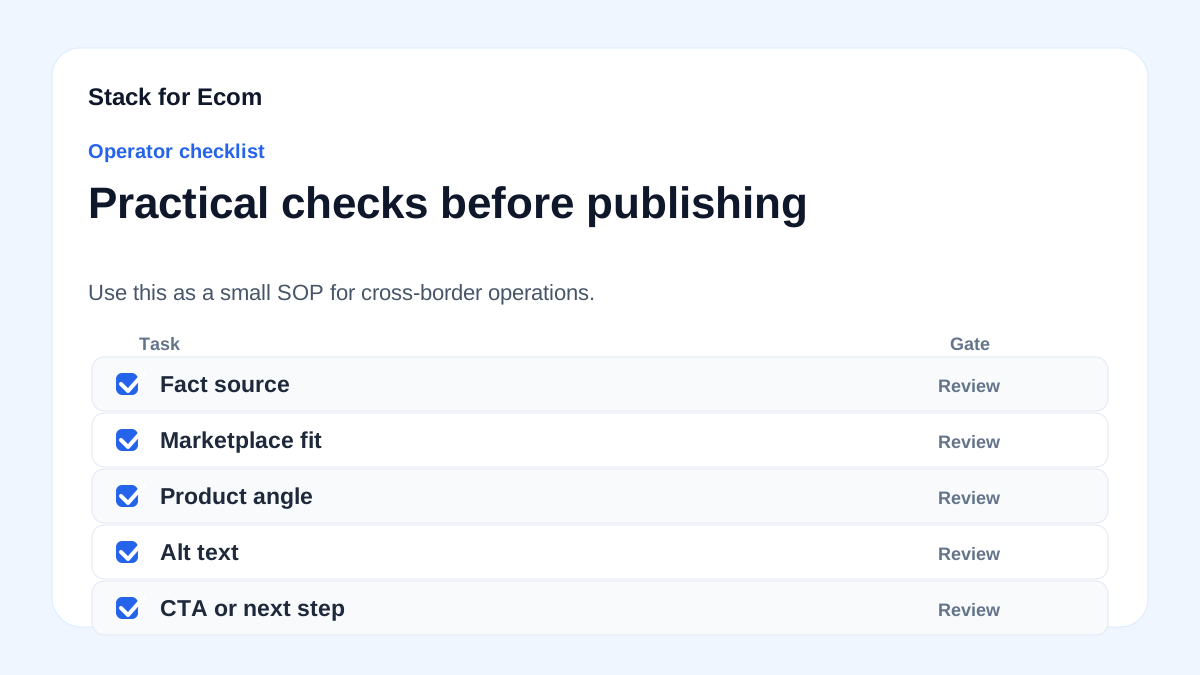
- A checklist graphic for the 11-step supplier discrepancy SOP.
- A decision tree for when to use ITA's beta chatbot versus when to consult a customs broker or legal advisor.
Who this helps / Who should avoid
This article helps ecommerce operators, importers, export coordinators, and small operations teams who manage supplier relationships and need a repeatable way to resolve order discrepancies. It is also useful for customs brokers and compliance staff who want to coach clients on better supplier communication.
It may not be suitable for teams looking for legal advice or a guaranteed classification ruling. The chatbot and this template are general resources; they do not replace a licensed customs broker, attorney, or official CBP guidance. If your goods are subject to quota, health codes, or other restrictions, seek professional advice. Details may vary; check references.
Conclusion
Order discrepancies are inevitable, but customs penalties are not. A clear supplier communication email template turns a reactive argument into a documented correction process. By requiring precise English descriptions, consistent declared values, and complete customs documents, you protect your business from fines, delays, and seizures. Use the checklist as your SOP, review your discrepancy log monthly, and keep every message in a shared record.
ITA's beta Global Business Navigator can help you find general export resources, but it cannot replace your own verification or professional advice. Treat it as a starting point, verify with the cited pages, and never enter PII or proprietary information. With the right template and discipline, supplier communication becomes a compliance advantage rather than a liability.
References
- https://www.trade.gov/export-solutions
- https://www.cbp.gov/trade/basic-import-export/internet-purchases
- https://www.cbp.gov/trade/basic-import-export/e-commerce
- https://www.trade.gov/ecommerce