TL;DR
- Quality disputes are won or lost on documentation, not emotion. Use a structured template that states the defect, the evidence, the contractual reference, and the requested remedy.
- Keep every claim tied to facts you can verify: SKU, batch, inspection report, photos, and order numbers. Avoid PII and proprietary data in third-party tools.
- Escalate in stages: friendly clarification, formal notice, corrective action request, and only then commercial remedy.
- Use a repeatable SOP with at least eight checkpoints so every dispute follows the same path.
- This article is a template and process guide. It does not provide legal advice. Details may vary; check references.
Introduction
If you sell cross-border, you already know the pattern: a container lands, the first customer reviews arrive, and the defect rate is higher than the sample you approved. The supplier says the goods left the factory in good condition. Your 3PL says the cartons were already compromised. Your marketplace account health starts to dip because of returns and negative feedback. The real problem is rarely the defect itself. The real problem is that you have no shared, written record of what was agreed, what was inspected, and what remedy you are asking for.
A supplier communication template for product quality disputes solves that. It turns a heated email thread into a structured claim: what is wrong, how many units are affected, which order and batch, what evidence supports it, what the contract or purchase order says, and what you want the supplier to do next. That structure protects your margin, your marketplace metrics, and your relationship with the factory. It also protects you if the dispute later needs a third-party inspection, a payment chargeback, or a formal legal review.
This article gives you a practical template and a repeatable SOP. It is written for sellers, exporters, and small operations teams who source from overseas suppliers and sell on channels such as Amazon or through their own storefronts. Use the template as a starting point, adapt the tone to your relationship, and keep the evidence standard consistent across every supplier. Where a specific legal or regulatory detail matters, seek professional advice; this article is operational guidance, not legal advice.
Main Content
1. Start with a shared definition of “defect” before the dispute happens
The most common failure in quality disputes is that the buyer and supplier are using different definitions. A supplier may consider a scratch acceptable if it is under a certain size, while your marketplace listing promises “like new” condition. Before you send a single complaint, check your purchase order, quality agreement, or email history for the agreed AQL (acceptable quality limit), inspection standard, and packaging requirements. If none exists, your first message should propose one for future orders, even while you resolve the current claim.
For example, a seller importing kitchenware might agree that “minor surface scratches under 2 mm are acceptable on the base, but not on the food-contact surface.” A supplier shipping electronics accessories might agree that “a 1.5% functional failure rate triggers a replacement batch.” These definitions do not need to be legalistic. They need to be specific enough that both sides can point to the same line when a dispute starts.
When you write the dispute message, restate the agreed standard in one sentence. That does two things: it shows the supplier you are organized, and it creates a written record of the standard you are enforcing. If the standard was never agreed, say so plainly and propose one going forward. Details may vary; check references.
2. Build the claim packet: evidence, quantities, and traceability
A quality dispute is only as strong as its evidence. Before contacting the supplier, assemble a claim packet. At minimum, include: the purchase order number, the SKU or model, the batch or lot code, the shipment and arrival dates, the inspection method used, the number of units inspected, the number of defective units, and the defect rate. Add photos or video that show the defect clearly, ideally with a ruler or reference object in frame. If you used a third-party inspection service, attach the report.
Traceability matters. If your supplier uses lot codes, capture them. If they do not, ask them to start. A supplier who can trace a defect to a specific production run is far more likely to accept responsibility and fix the root cause. A supplier who cannot trace anything will often default to denial. For cross-border sellers, this is also where marketplace data helps: return reasons, customer photos, and negative review themes can be summarized, but do not paste personally identifiable information (PII) into a shared document. Keep customer identities out of the supplier conversation.
Finally, separate “confirmed” from “needs checking.” For example: “Confirmed: 42 of 500 units failed the power-on test. Needs checking: whether the failure is caused by the PCB supplier or by final assembly.” This distinction keeps the conversation factual and prevents the supplier from feeling accused of something you have not proven. The U.S. International Trade Administration’s Global Business Navigator chatbot, for instance, is a beta tool that provides general export information and should be double-checked against its references; it cannot give company-specific or market-specific advice. Use the same discipline with your own data: verify before you assert.
3. Use a staged escalation path instead of a single angry email
A single email that demands a full refund rarely gets the best result. A staged path gives the supplier room to respond and creates a clean record if you need to escalate. Stage one is a “clarification and evidence” message: friendly, specific, and focused on understanding the issue. Stage two is a “formal notice” that restates the claim, the standard, and the requested corrective action with a deadline. Stage three is a “commercial remedy” request: replacement, credit, return authorization, or cost-sharing on rework. Stage four is external escalation: third-party inspection, payment dispute, or legal review.
Each stage should reference the previous one. For example: “Following our message on March 3, we have now completed inspection of the remaining cartons. The defect rate is 8.4%, above the agreed 2% limit. We request a replacement of 210 units or a credit note of the same value within 10 business days.” That structure is hard to ignore because it is specific, chronological, and tied to an agreed number.
Keep the tone professional. You can be firm without being hostile. Suppliers respond better when they see a path to resolution that protects the relationship. If you sell on Amazon, remember that account health and customer returns are business impacts, not just personal frustrations. Mentioning the operational impact—return rate, replacement cost, marketplace metrics—can help the supplier understand why the issue matters commercially.
4. Tie the dispute to the commercial and platform context
Quality disputes do not happen in a vacuum. They affect your advertising efficiency, your marketplace standing, and your cash flow. If you run Amazon Ads, for example, Sponsored Products are self-service cost-per-click ads for individual listings, and Amazon recommends new advertisers start with Sponsored Products using automatic targeting or manual keyword or product targeting, paying only when the ad is clicked. A defective batch can waste that spend because clicks convert into returns instead of repeat purchases. That is a concrete business impact you can share with a supplier when you explain why the defect rate matters.
On Google, Shopping campaigns and Performance Max campaigns require accurate product data in Merchant Center, and product data must be sent at least every 30 days. Common data problems include incorrect category or GTIN values, missing variant attributes, low-quality images, and conflicting data between the feed and the website. If a supplier changes a product without telling you, your feed can break and your ads can be disapproved. A quality dispute template can include a line asking the supplier to notify you in writing before any material change to materials, components, or packaging.
Platform rules also vary by region. In European Economic Area countries and Switzerland, Shopping ads participation is done through one or more Shopping Comparison Services of the advertiser’s choice. South Africa, according to a note in Amazon’s guide, is launching to domestic sellers and vendors only. These are not quality-dispute rules, but they show why you should not assume a single global process. Your supplier communication should reflect the specific marketplaces and regions you sell into, and you should verify current requirements before relying on them. Details may vary; check references.
5. Use a short, natural tool angle to keep records clean
You do not need expensive software to run this process. A shared spreadsheet, a document template, and a folder structure can handle most disputes. The key is consistency. Use a naming convention such as PO-12345_SupplierName_QualityClaim_2025-03-03 so anyone on your team can find the file. Keep a simple log with columns for date, stage, evidence attached, supplier response, and next action. If you use a chatbot or AI assistant to draft messages, remember that beta tools may produce inaccurate or incomplete information, and you should not enter PII, sensitive, or proprietary information. The ITA’s Global Business Navigator, for example, does not collect user information and does not use chat history to learn, but conversations may be reviewed to improve the tool.
AI can help you translate a message or tighten the tone, but it should not replace your judgment. The chatbot supports many languages, but because it is trained in English and responses are translated, you should verify translations, especially for acronyms and nuances. The same applies to any translation tool you use with a supplier. If the supplier’s first language is not English, consider sending a bilingual version of the template and asking them to confirm understanding in writing.
Finally, keep legal and regulatory questions separate from operational ones. If your ads include AI-generated or edited assets, some regions such as the European Union, India, and New York require disclosures or labels. Using a platform’s AI label setting does not guarantee compliance with specific regulations, and operators should seek legal guidance. Your supplier dispute template is not the place to resolve those questions, but your record-keeping should make it easy to hand off to a professional if needed.
Step-by-step checklist
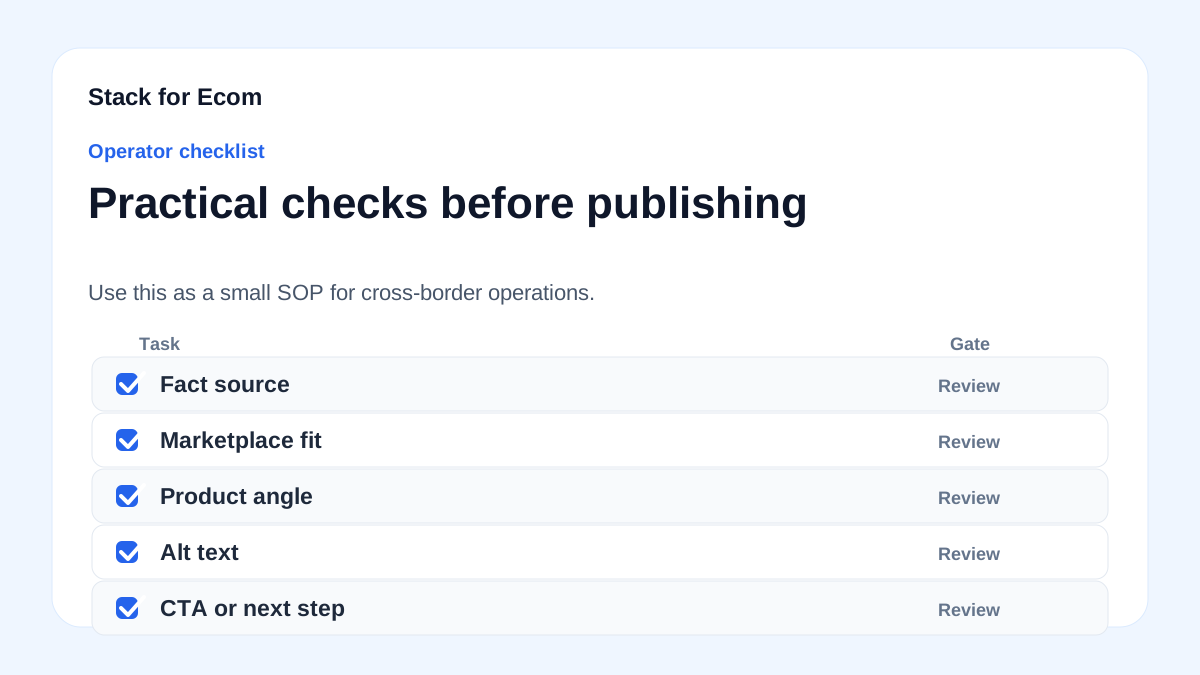
- Confirm the agreed standard. Locate the purchase order, quality agreement, or email that defines acceptable quality, AQL, packaging, and labeling. If none exists, write one and propose it for future orders.
- Pause further sales if safety is involved. If the defect could cause injury or a regulatory issue, stop shipment or listing immediately and seek professional advice.
- Assemble the claim packet. Collect PO number, SKU, batch/lot code, shipment dates, inspection method, sample size, defect count, defect rate, photos, video, and third-party reports.
- Separate confirmed facts from open questions. Write two short lists: what you have proven, and what still needs checking. Do not accuse the supplier of the unproven items.
- Choose the stage. Decide whether this is a clarification, formal notice, commercial remedy request, or external escalation. Do not skip stages unless safety or legal risk requires it.
- Draft the message using the template. State the issue, the evidence, the standard, the impact, and the requested action with a clear deadline.
- Remove PII and proprietary data. Do not include customer names, addresses, payment details, or trade secrets in shared documents or third-party tools.
- Send to the right contact. Address the message to your account manager or quality contact, and copy your internal team. Keep the thread in one place.
- Log the dispute. Record date, stage, evidence, supplier response, and next action in a shared log with a consistent file name.
- Set a follow-up reminder. If no response by the deadline, move to the next stage and reference the previous message.
- Close the loop. Once resolved, document the root cause, the corrective action, and any change to future inspection or contract terms.
Potential pitfalls
- No written standard. If you never agreed on what “acceptable” means, the supplier can argue that the goods met their own internal standard. Prevention: create a simple quality agreement or add a quality annex to your PO.
- Emotional first message. Angry emails make suppliers defensive and can damage the relationship before you have the facts. Prevention: use the staged path and lead with evidence, not blame.
- Weak evidence. Photos without scale, no batch codes, and no inspection method make it easy for the supplier to deny the claim. Prevention: build a claim packet before you send anything.
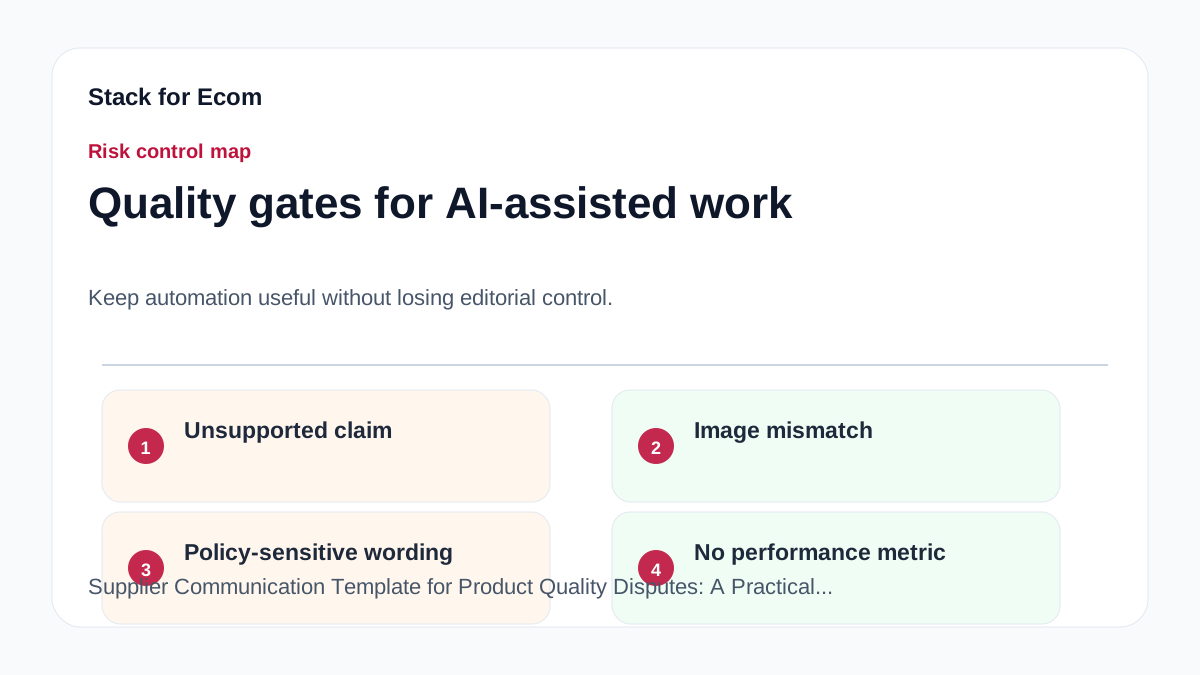
- Mixing PII into shared tools. Customer names or addresses in a supplier email or AI chatbot can create privacy and compliance risk. Prevention: anonymize all customer data and never enter PII into third-party tools.
- Assuming one global process. Marketplace rules, advertising requirements, and regional regulations differ. Prevention: verify current requirements for each market and region before relying on them. Details may vary; check references.
- Skipping the log. Without a dispute log, you cannot see patterns or hold the supplier accountable over time. Prevention: use a simple shared spreadsheet with consistent naming and stage tracking.
- Treating AI output as final. Beta tools and translation tools can be inaccurate or incomplete. Prevention: double-check responses against primary sources and verify translations before sending.
Suggested visuals
- Dispute escalation flowchart. A four-stage diagram: clarification, formal notice, commercial remedy, external escalation, with decision points and deadlines.
- Claim packet checklist table. A one-page table listing required evidence, owner, and status for each item.
- Before/after defect photo example. Two images of the same product showing an acceptable unit and a defective unit, with a ruler or reference object for scale.
- Supplier communication template screenshot. A clean, annotated view of the email template with placeholders highlighted.
- Dispute log dashboard mockup. A simple spreadsheet view with columns for date, stage, evidence, response, and next action.
- Marketplace impact chart. A bar chart showing return rate or defect rate before and after a corrective action, to illustrate business impact.
Who this helps / Who should avoid
Who this helps: cross-border ecommerce sellers, exporters, sourcing managers, and small operations teams who buy from overseas suppliers and need a repeatable way to raise quality disputes. It is especially useful if you sell on marketplaces such as Amazon or Google Shopping, where defect rates affect returns, reviews, and ad efficiency. It also helps teams that want to standardize communication across multiple suppliers and languages.
Who should avoid: businesses involved in active litigation or regulatory investigations, where a lawyer should direct all communication. Also, this article is not a substitute for legal advice on contracts, product liability, or advertising compliance. If your dispute involves safety, counterfeit goods, or regulated products, seek professional guidance before sending any template. Details may vary; check references.
Conclusion
A supplier communication template for product quality disputes is not about winning an argument. It is about creating a shared, written record that makes resolution faster and fairer for both sides. Start with a clear standard, build a claim packet, escalate in stages, and log every step. Keep PII and proprietary data out of shared tools, and verify any AI-generated or translated content before you send it. Use the checklist as your SOP, adapt the template to your product category, and review your dispute log monthly to spot recurring root causes. If you sell across multiple marketplaces, remember that platform rules and regional requirements can change, so confirm current details before you rely on them. This article is operational guidance, not legal advice; when in doubt, consult a professional.
References
- https://www.trade.gov/export-solutions
- https://advertising.amazon.com/library/guides/getting-started-with-sponsored-ads
- https://ads.tiktok.com/help/article/get-started-tiktok-ads-manager
- https://ads.tiktok.com/help/article/about-catalogs
- https://support.google.com/google-ads/answer/6275312
- https://support.google.com/merchants/answer/7052112