TL;DR
- Use a structured supplier price negotiation email template to reduce back-and-forth, protect margins, and keep a clean written record.
- Anchor every negotiation in specifics: SKU, quantity, Incoterms, target price, validity window, and required documentation.
- For U.S.-bound goods, remember that the importer (often the buyer) is responsible for assuring goods comply with state and federal import regulations, and that all merchandise imported into the United States must clear CBP and may be subject to duty payment and applicable import regulations (CBP).
- A precise cargo description is required regardless of value under 19 CFR § 4.7a, 122.48a, 123.91, 123.92 and 128.21, and it must be clear, concise, in plain language, and detailed enough for U.S. Customs to identify size, shape, and characteristics of the commodity (CBP).
- Do not enter personally identifiable information (PII), sensitive, or proprietary information into the ITA's beta Global Business Navigator chatbot; it does not collect user information and all feedback is anonymous (Trade.gov).
- Details may vary; check references.
Introduction
Supplier price negotiation in foreign trade is rarely just about the unit price. Operators are usually juggling three problems at once: margin pressure from buyers, cost volatility from suppliers, and compliance risk on the import side. A loosely written email can win a 3% discount but lose far more later through chargebacks, detention, or rework because the commercial invoice, cargo description, or declaration paperwork did not match what was actually shipped.
The business impact is direct. If your negotiation email omits Incoterms, packaging assumptions, lead time, or documentation requirements, you create ambiguity that suppliers resolve in their own favor. If you push too hard on price without offering volume, payment terms, or forecast visibility, you risk quality fade or silent substitution. And for U.S.-bound shipments, the importer, which is the buyer when purchasing from foreign sources, is responsible for assuring that goods comply with state and federal government import regulations (CBP). That responsibility does not disappear because a supplier agreed to a lower price.
Use this article as a working template. The Main Content gives you the negotiation logic and language blocks. The Step-by-step checklist turns it into a repeatable SOP. The Potential pitfalls section covers the mistakes that cost real money. Where a detail depends on your product, lane, or platform, the article says so explicitly rather than guessing. For general export-process questions, the International Trade Administration (ITA) offers a beta AI chatbot called Global Business Navigator, built with Microsoft Azure AI services, to provide general information on the exporting process and resources for U.S. exporters (Trade.gov). It can help you find reference pages, but it cannot provide responses specific to a company's product or a specific foreign market, and its responses should not be used as legal or professional advice (Trade.gov).
Main Content
1) The negotiation email structure that gets replies
A supplier price negotiation email works best when it reads like a short brief, not a complaint. Open with context: who you are, what you buy, and the volume or forecast you are bringing. Then state the specific ask: target price, quantity, Incoterms, payment terms, and the date by which you need a response. Close with the next step and the documents you need to see. This structure respects the supplier's time and makes it easy for them to say yes, counter, or decline with data.
Concrete example: a U.S. ecommerce seller sourcing 12,000 units of a silicone kitchen item from a supplier in Asia. The first email should not say "your price is too high." It should say: "We are forecasting 12,000 units per quarter for the next four quarters, shipped FOB [port]. Our target is $X.XX per unit at 12,000 units, with 30% deposit and 70% against copy of B/L. Please confirm whether you can meet this, and share your current MOQ and lead time." That single paragraph gives the supplier enough to calculate whether the deal works.
Keep the tone firm but collaborative. Suppliers respond to buyers who are clear about volume, payment reliability, and long-term intent. If you are testing a new supplier, say so. If you are comparing three quotes, do not bluff about volumes you cannot commit to. A written record of what you asked for also protects you later if the supplier claims they never agreed to a specification, packaging requirement, or documentation standard.
2) What to include so the price is comparable
Most "price negotiations" fail because the quotes are not comparable. One supplier quotes EXW, another quotes CIF, a third bundles packaging, and a fourth excludes testing. Before you negotiate, normalize the quote. Ask for unit price, MOQ, Incoterms, lead time, payment terms, packaging details, carton dimensions and weight, and any tooling or sample fees. Then compare like for like.
For U.S.-bound goods, add documentation to the comparison. The seller should provide the following information: seller's name and address, description of items in English, quantity of each item type, purchase price in U.S. dollars, weight of items, and country of origin of the product itself (CBP). If a supplier cannot or will not provide these consistently, that is a negotiation issue and a compliance issue. Foreign shipments not accompanied by a U.S. Customs and Border Protection declaration form and an invoice may be subject to seizure, forfeiture, or return to sender (CBP).
A practical email line: "To compare quotes fairly, please confirm the following in your reply: unit price at 5,000 / 10,000 / 20,000 units, Incoterms, lead time, carton dimensions and gross weight, and whether the commercial invoice will include seller name and address, description of items in English, quantity of each item type, purchase price in U.S. dollars, weight of items, and country of origin of the product itself." That one paragraph prevents weeks of confusion.
3) Compliance-safe language for U.S.-bound shipments
Price negotiation and customs compliance are connected. If you negotiate a lower price but the invoice understates value or the cargo description is vague, you create risk that no discount can offset. Under 19 CFR § 4.7a, 122.48a, 123.91, 123.92 and 128.21, a precise cargo description is required regardless of value (CBP). That description must be clear, concise, in plain language, and detailed enough for U.S. Customs to identify size, shape, and characteristics of the commodity (CBP). Superfluous information such as personally identifiable information (PII), type of packaging, and carrier disclaimers should not be transmitted in the commodity description field (CBP).
Build this into your negotiation email as a requirement, not an afterthought. For example: "All shipments must include a precise cargo description in plain language that identifies size, shape, and characteristics of the commodity. Please do not include PII, packaging type, or carrier disclaimers in the commodity description field." This is not legal advice; it is an operational instruction that keeps your supply chain aligned with published CBP guidance. Details may vary; check references.
Also clarify who is responsible for what. The importer, which is the buyer when purchasing from foreign sources, is responsible for assuring that goods comply with state and federal government import regulations (CBP). Importing goods that are unsafe, fail to meet health code requirements, or violate quota restrictions could result in fines, penalties, detention, or destruction by CBP (CBP). If your supplier is shipping consumer goods, ask early whether the product meets applicable U.S. requirements and whether test reports or certificates are available. If the answer is unclear, escalate to a qualified compliance professional.
4) Using AI and government resources without over-relying on them
The ITA's Global Business Navigator is an AI chatbot currently in beta testing, providing general information on the exporting process and resources for U.S. exporters (Trade.gov). It was developed using Microsoft's Azure AI services and is trained on ITA's export-related content (Trade.gov). It can understand non-expert language, idiomatic expressions, and foreign languages (Trade.gov). That makes it useful for orientation: finding reference pages, understanding broad export-process concepts, and pointing you to other government resources and market research (Trade.gov).
But it has hard limits. As a beta product, the chatbot may produce inaccurate or incomplete information, and its knowledge is limited to public information on the Export Solutions web pages of Trade.gov (Trade.gov). It cannot provide responses specific to a company's product or a specific foreign market (Trade.gov). Users should always double-check the chatbot's responses using provided references or by visiting the Export Solutions web pages on Trade.gov, and should not use its responses as legal or professional advice (Trade.gov). The chatbot does not collect user information or use chat history to learn new information; all feedback is anonymous, and users should not enter personally identifiable information (PII), sensitive, or proprietary information (Trade.gov). Conversations with the chatbot may be reviewed to help ITA improve the tool and address harmful, illegal, or otherwise inappropriate questions (Trade.gov).
A practical workflow: use the chatbot to find relevant Trade.gov pages, then verify everything on the source pages yourself. Do not paste supplier contracts, buyer names, pricing, or product formulas into any AI tool, including this one, because that is proprietary information. The chatbot supports a wide range of languages, but because it is trained in English and responses are translated, users should verify translations as it may have difficulty with acronyms, abbreviations, and nuances in other languages (Trade.gov). If you use it to draft negotiation language in another language, have a human review the final wording before sending.
5) Turning the template into a repeatable negotiation cycle
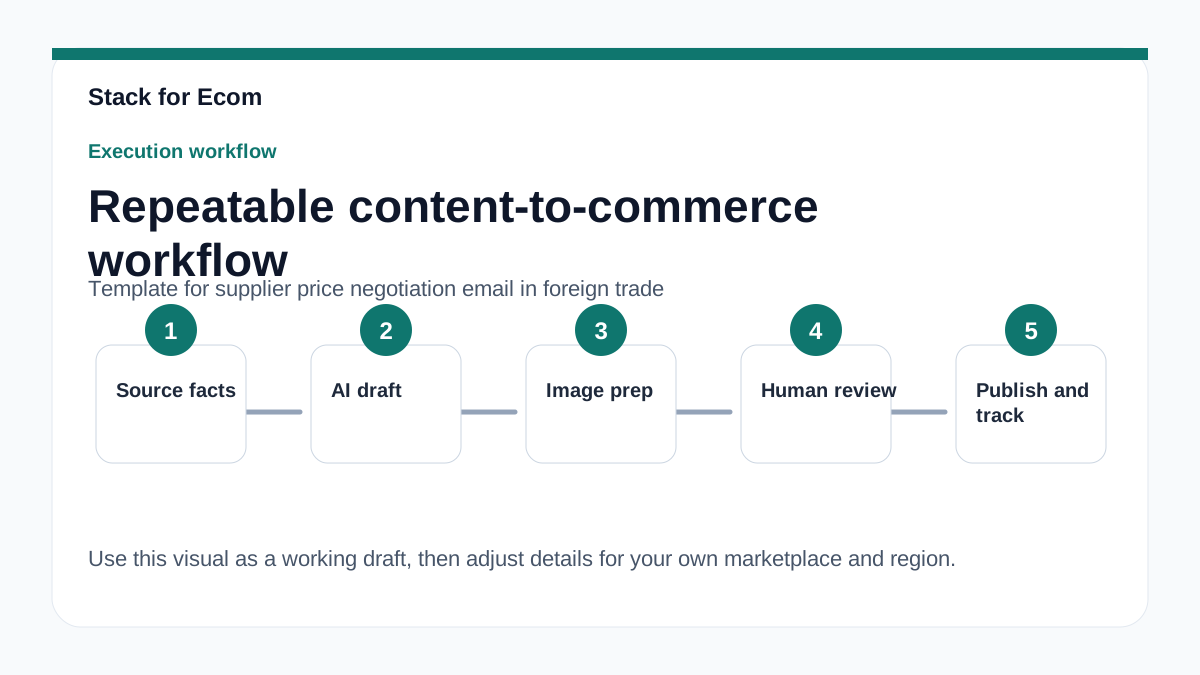
A single email does not create leverage. A cycle does. Set a cadence: request quotes, normalize them, send your target-price email, review counteroffers, confirm samples, and lock terms in a purchase order or contract. Keep every version in one folder so you can see how the price, MOQ, and lead time changed over time. This is especially important when you are scaling from 1,000 to 10,000 units, because suppliers often price differently at each tier.
Use data from your own operations. If you know your landed cost, duty exposure, and return rate, you can negotiate with more confidence. De minimis volume and value statistics are based on the number of Bills of Lading (BOLs) and their declared value at the time of import (CBP). In fiscal year 2023, total de minimis shipments reached 1 billion with a declared value of $54.5 billion (CBP). In fiscal year 2024, total de minimis shipments increased to 1.36 billion with a declared value of $64.6 billion (CBP). These figures show how much small-parcel volume moves through the system, and why precise documentation matters even for low-value shipments. For merchandise shipped through international postal service valued at less than $2,500 and not subject to quota or restriction, a CBP official will usually prepare import paperwork, assess duty, and release it for delivery (CBP). That does not remove your responsibility to provide accurate information.
CBP's E-Commerce Strategy focuses on four primary goals and identifies private industry and foreign governments as key resources (CBP). The strategy includes efforts to educate the public and trade community about importer responsibilities for customs compliance (CBP). Align your supplier negotiation emails with that direction: ask for accurate descriptions, correct values, and complete invoices every time. When a supplier pushes back on documentation, treat it as a cost of doing business and factor it into your supplier scorecard.
Step-by-step checklist
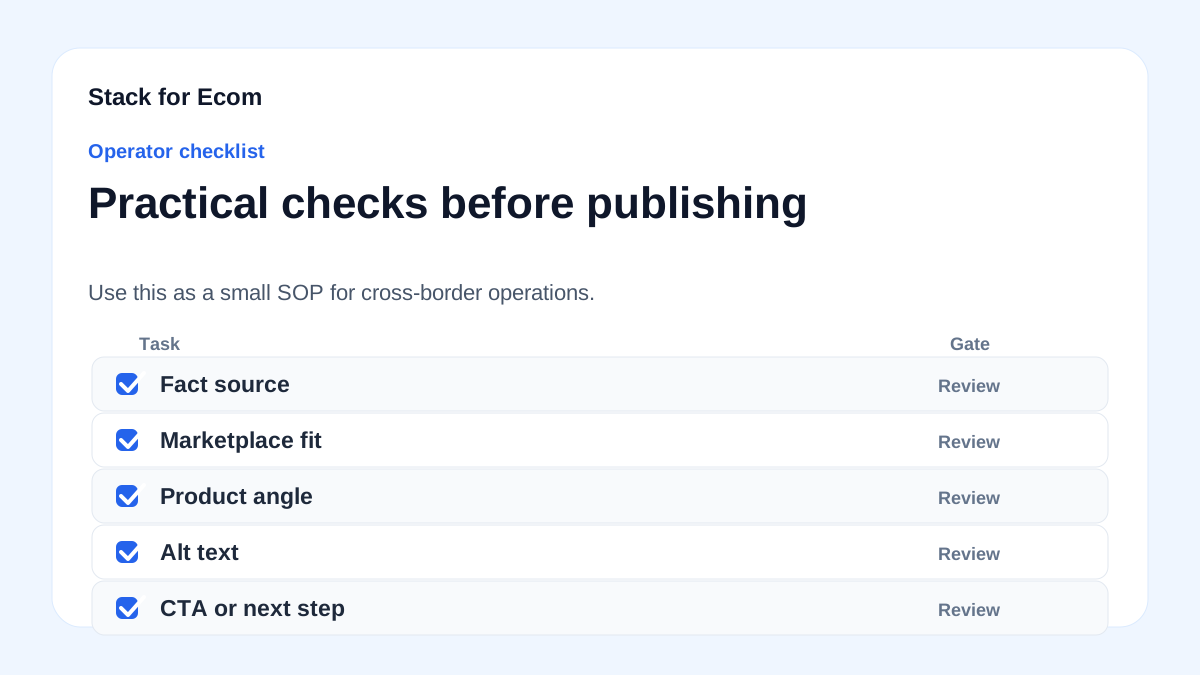
- Define the negotiation objective in one sentence: target unit price, quantity tier, Incoterms, payment terms, and deadline for reply.
- Normalize all supplier quotes before negotiating: unit price at each volume tier, MOQ, lead time, packaging, carton dimensions and weight, tooling or sample fees, and Incoterms.
- Confirm the seller will provide seller's name and address, description of items in English, quantity of each item type, purchase price in U.S. dollars, weight of items, and country of origin of the product itself (CBP).
- Require a precise cargo description that is clear, concise, in plain language, and detailed enough for U.S. Customs to identify size, shape, and characteristics of the commodity (CBP).
- Instruct suppliers not to include PII, type of packaging, or carrier disclaimers in the commodity description field (CBP).
- Verify that the commercial invoice and declaration form will be attached to the outside of the shipment where required; foreign shipments not accompanied by a U.S. Customs and Border Protection declaration form and an invoice may be subject to seizure, forfeiture, or return to sender (CBP).
- Ask whether the product is subject to quota, restriction, health code, or safety requirements, and request test reports or certificates where applicable; the importer is responsible for assuring that goods comply with state and federal government import regulations (CBP).
- Use the ITA's beta Global Business Navigator only for general export-process orientation, verify its responses on Trade.gov, and never enter PII, sensitive, or proprietary information (Trade.gov).
- Document every counteroffer and final agreement in writing, then convert it into a purchase order or contract with the agreed price, quantity, Incoterms, and documentation requirements.
- Review the negotiation outcome after each order: actual landed cost, duty paid, detention or delay incidents, and supplier responsiveness.
Potential pitfalls
- Negotiating price without normalizing Incoterms. A lower EXW price can be more expensive than a higher CIF price once freight, insurance, and destination charges are added. Prevention: require Incoterms in every quote and compare landed cost, not unit price alone.
- Leaving documentation to chance. Vague cargo descriptions or missing invoices can trigger seizure, forfeiture, or return to sender (CBP). Prevention: make the precise cargo description and invoice requirements a condition of the purchase order.
- Assuming the supplier handles compliance. The importer, which is the buyer when purchasing from foreign sources, is responsible for assuring that goods comply with state and federal government import regulations (CBP). Prevention: assign a named internal owner for compliance and verify supplier claims with documentation.
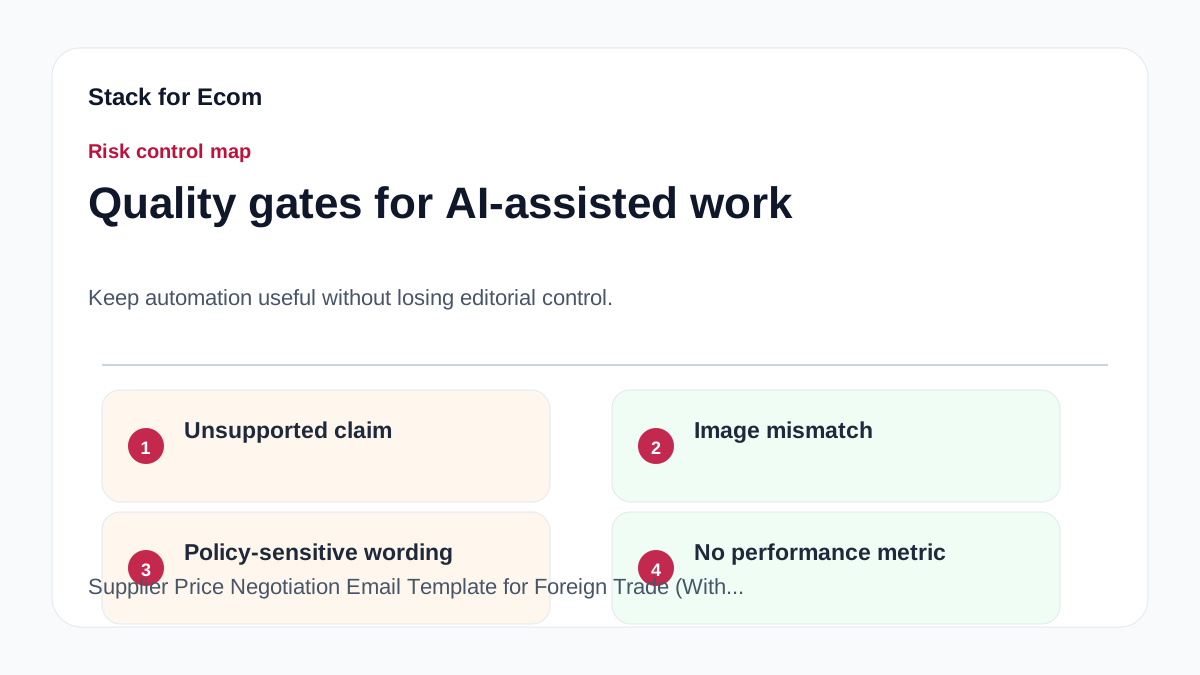
- Over-relying on AI output. The ITA chatbot is in beta, may produce inaccurate or incomplete information, and cannot provide responses specific to a company's product or a specific foreign market (Trade.gov). Prevention: use it for orientation only, verify on Trade.gov, and consult qualified professionals for legal or trade-compliance decisions.
- Sharing sensitive data in AI tools. The chatbot does not collect user information and all feedback is anonymous, but users should not enter PII, sensitive, or proprietary information (Trade.gov). Prevention: create a one-page internal rule that bans pasting contracts, buyer names, pricing, and formulas into any AI tool.
- Ignoring translation risk. The chatbot supports many languages but is trained in English, so translations may have difficulty with acronyms, abbreviations, and nuances (Trade.gov). Prevention: have a native speaker review any negotiation email drafted in a foreign language before sending.
Suggested visuals
- A one-page negotiation email anatomy diagram: subject line, context, ask, terms, documents, next step.
- A quote normalization table comparing three suppliers across unit price tiers, MOQ, Incoterms, lead time, payment terms, and documentation readiness.
- A compliance checklist screenshot or mock-up showing the required invoice fields: seller name and address, description of items in English, quantity, purchase price in U.S. dollars, weight, and country of origin (CBP).
- A simple workflow chart: request quote → normalize → negotiate → sample → PO → ship → review landed cost.
- A de minimis volume and value chart using FY2023 (1 billion shipments, $54.5 billion) and FY2024 (1.36 billion shipments, $64.6 billion) figures from CBP.
- A screenshot-style mock-up of a precise cargo description example versus a vague description, with annotations on what makes it clear, concise, and plain language (CBP).
Who this helps / Who should avoid
This helps foreign trade operators, ecommerce sellers, sourcing managers, and small export teams who need a repeatable way to negotiate supplier pricing while keeping U.S.-bound shipments compliant. It is especially useful for teams scaling from sample orders to recurring volume, and for anyone who has been burned by unclear quotes, missing invoices, or vague cargo descriptions.
This is not a substitute for legal, customs, or tax advice. If you are dealing with restricted goods, quota-limited products, health-code-regulated items, or high-value shipments, work with a qualified customs broker or trade attorney. If you need market-specific or product-specific guidance, the ITA chatbot cannot provide it, and its responses should not be used as legal or professional advice (Trade.gov). Details may vary; check references.
Conclusion
A supplier price negotiation email is a commercial document and a compliance document at the same time. The template that works is the one that states your ask clearly, normalizes quotes so comparisons are fair, and locks in the documentation required for a clean import. For U.S.-bound goods, that means respecting the importer's responsibility for compliance, providing a precise cargo description regardless of value, and ensuring every shipment is accompanied by the required declaration form and invoice.
Use the checklist as your SOP, review the pitfalls before every major negotiation, and keep your written record tidy. Use AI tools like the ITA's beta Global Business Navigator for orientation only, verify everything on Trade.gov, and never enter PII, sensitive, or proprietary information. Done consistently, this approach protects margin, reduces delays, and makes your supplier relationships more predictable. Details may vary; check references.
References
- https://www.trade.gov/export-solutions
- https://www.trade.gov/ecommerce
- https://www.cbp.gov/trade/basic-import-export/internet-purchases
- https://www.cbp.gov/trade/basic-import-export/e-commerce