TL;DR
- Track de minimis shipment volumes and declared values weekly to anticipate customs clearance bottlenecks and cost shifts.
- Monitor Entry Type 86 and 321 Data Pilot BOL counts to gauge how your low-value shipments are being processed.
- Review customs declaration accuracy metrics to avoid fines, seizures, and detention of goods.
- Check product feed compliance in Google Merchant Center to prevent disapprovals and lost visibility.
- Use the Global Business Navigator chatbot for general export questions, but always verify answers against official sources.
- Build a repeatable weekly SOP that combines logistics, compliance, and feed health metrics into one dashboard.
Introduction
Running a cross-border ecommerce operation means juggling dozens of moving parts: customs declarations, carrier performance, product feed compliance, and shifting import regulations. Most sellers focus on revenue and ad spend, but the weekly operations review is where you catch problems before they become expensive. If you are not tracking the right dashboard metrics, you are flying blind—and one customs error or feed disapproval can cost you more than a week of sales.
The business impact is real. U.S. Customs and Border Protection (CBP) reported that total de minimis Bills of Lading (BOLs) fell from 1.36 billion in FY2024 to 942.5 million in FY2025, while declared value dropped from $64.6 billion to $48.1 billion. These numbers reflect a tightening import environment. If your dashboard does not include de minimis trends, customs compliance rates, and feed health, you are missing the signals that affect your bottom line.
This article walks you through 12 dashboard metrics to review weekly, with concrete examples and a repeatable checklist. Use it as a template for your own operations review. You will learn what to track, why it matters, and how to turn raw data into actionable decisions.
Main Content
1. De Minimis Shipment Volume and Declared Value Trends
The de minimis threshold allows shipments under a certain value to enter the U.S. with reduced formalities. CBP tracks these shipments using BOLs, which are carrier-issued documents evidencing receipt and contract of carriage. Total de minimis BOLs rose from 636.7 million in FY2020 to 1.36 billion in FY2024, then fell to 942.5 million in FY2025. Declared value peaked at $67 billion in FY2020, dipped to $43.5 billion in FY2021, and reached $64.6 billion in FY2024 before falling to $48.1 billion in FY2025.
For your weekly review, track your own shipment volume against these macro trends. If your volume is growing while the overall market is shrinking, you may be gaining share—but also attracting more customs scrutiny. Conversely, if your volume is dropping, check whether it is due to carrier issues, pricing, or compliance problems.
Actionable step: Pull your weekly BOL counts by mode (air, truck, vessel, rail) and compare them to the previous four weeks. Flag any sudden spikes or drops. Use your freight forwarder's reports to get this data if you do not have direct access.
2. Entry Type 86 and 321 Data Pilot Utilization
Entry Type 86 is a formal entry process for de minimis shipments, while the 321 Data Pilot is a test program for certain low-value goods. CBP data shows Entry Type 86 BOLs grew from 122.1 million in FY2020 to 948 million in FY2024, then fell to 635.3 million in FY2025. The 321 Data Pilot peaked at 169.5 million in FY2021 and declined to 112.6 million in FY2025.
If you use Entry Type 86, monitor your acceptance rates and rejection reasons weekly. A rise in rejections could indicate incorrect data submission or changing CBP requirements. For the 321 Data Pilot, check whether your participation still makes sense given declining volumes and potential changes to the program.
Actionable step: In your dashboard, create a metric for "Entry Type 86 rejection rate" and "321 Data Pilot participation rate." Investigate any rejection that exceeds 2% of your submissions.
3. Customs Declaration Accuracy and Compliance Rate
CBP requires a declaration form with the seller's name and address, detailed English description of items, quantity, purchase price in U.S. dollars, weight, and country of origin. Inaccurate information can lead to wrong duty rates, seizure, or fines. Misrepresenting value is illegal and can expose you to legal action. Foreign shipments without a declaration form and invoice may be seized, forfeited, or returned to sender.
Your weekly review should include a compliance score: the percentage of your shipments that had accurate, complete declarations on the first submission. If this score drops below 95%, investigate the root cause—whether it is a data entry error, a supplier issue, or a misunderstood regulation.
Actionable step: Work with your customs broker to generate a weekly report of errors, penalties, and detention notices. Categorize them by cause and assign corrective actions.
4. Shipping Mode Performance: Air, Truck, Vessel, Rail
Air was the dominant de minimis mode, with BOLs growing from 539 million in FY2020 to 1.1 billion in FY2024, then dropping to 794.8 million in FY2025. Truck BOLs grew from 96.7 million to 174.2 million over the same period. Vessel BOLs increased steadily from 950,000 in FY2020 to 5.9 million in FY2025, while rail BOLs declined from 67,000 to 5,000.
For your operations, track transit times and cost per shipment by mode. If air is becoming more expensive or slower, consider shifting some volume to truck or vessel. Rail's sharp decline suggests it may not be a reliable option for your goods.
Actionable step: Create a weekly table showing average transit time, cost per unit, and on-time delivery rate for each mode. Use this to renegotiate carrier contracts or adjust your shipping strategy.
5. Express vs. Postal Shipment Trends
Express de minimis BOLs declined from 184.2 million in FY2020 to 130 million in FY2025, while postal BOLs fell sharply from 264.1 million to 68.6 million. This shift indicates that sellers are moving away from postal services, possibly due to slower transit times or tracking issues.
Review your own mix of express and postal shipments. If you still rely heavily on postal, check whether your delivery times are competitive. If you use express, monitor costs to ensure they do not erode your margins.
Actionable step: Calculate your average cost per shipment for express vs. postal and your customer satisfaction score for each. Adjust your carrier mix based on the data.
6. Cargo Description Quality and Regulatory Compliance
CBP regulations (19 CFR §§ 4.7a, 122.48a, 123.91, 123.92, 128.21) require a precise, plain-language cargo description detailed enough for U.S. Customs to identify size, shape, and characteristics. Superfluous info like PII, packaging type, or carrier disclaimers must not be included in the commodity description field.
Poor descriptions can cause delays, fines, or seizures. In your weekly review, audit a random sample of your cargo descriptions. Check that they are specific, accurate, and free of unnecessary information.
Actionable step: Build a checklist for your team to validate cargo descriptions before submission. Include examples of good and bad descriptions for reference.
7. Google Merchant Center Feed Compliance
Google Merchant Center requires product data attributes to be submitted in English for supported values. The ID [id] attribute must be unique per product, use the SKU where possible, and remain consistent across updates. The title [title] attribute must be under 150 characters, accurately describe the product, match the landing page title, and avoid promotional text or all caps. For variants, include distinguishing features like color or size.
Incorrect or missing product information can cause disapprovals, limited eligibility, or incorrect displays. This directly impacts your visibility and sales. Your weekly review should include a feed health score based on Google's diagnostics.
Actionable step: Export your Google Merchant Center diagnostics report weekly. Track the number of disapproved products and the reasons. Prioritize fixing issues that affect your best-selling items.
8. Product Title and Description Consistency
For free-form text attributes like title [title] and description [description], all attributes in a feed must use the same language. Attribute names with multiple words must use underscores (e.g., image_link). Inconsistencies can cause feed errors and disapprovals.
Review your titles and descriptions weekly to ensure they follow Google's guidelines. Check that titles match landing pages and do not include gimmicky characters or promotional language.
Actionable step: Create a template for your team to follow when writing titles and descriptions. Include character limits and examples of compliant and non-compliant text.
9. Variant Handling and Mobile-Specific Requirements
For product variants, the title must include distinguishing features such as color or size. For mobile devices, titles must include "with contract" if sold with a contract, and for the United States, include "with payment plan" if sold in installments. These requirements affect how your products appear in search results.
If you sell variants, check that each variant has a unique ID and a title that clearly differentiates it. For mobile products, verify that contract or payment plan information is included where required.
Actionable step: Audit your variant titles weekly. Use a spreadsheet to list all variants and check that each meets the requirements.
10. Global Business Navigator Chatbot Usage
The International Trade Administration launched the Global Business Navigator, an AI chatbot in beta, built on Microsoft Azure AI and trained on ITA export-related content. It provides general exporting process information for new and experienced U.S. exporters but cannot answer company-specific product or foreign market questions. As a beta product, it may produce inaccurate responses, so users must verify answers against references on Trade.gov.
You can use the chatbot for quick questions about export processes, but do not rely on it for legal or professional advice. It does not collect user information, and feedback is anonymous. Avoid entering personally identifiable, sensitive, or proprietary information.
Actionable step: Add the chatbot as a resource in your operations playbook. Train your team to use it for general questions and to verify all answers against official sources.
11. Import Compliance for Purchases from Individuals
When goods move from any foreign country to the United States, they are considered imported and must comply with U.S. import regulations, regardless of whether purchased from a business or individual. The buyer becomes the importer and is responsible for compliance. Non-compliance can result in fines, penalties, detention, or destruction of goods by CBP.
If you source products from individual sellers overseas, include a compliance check in your weekly review. Verify that each shipment has proper documentation and that the goods are legally importable.
Actionable step: Create a supplier compliance checklist for individual sellers. Include requirements for declarations, permits, and quota restrictions.
12. Quota and Permit Restrictions Monitoring
Certain products, such as dairy items from specific countries, may be prohibited without a permit, and quota restrictions can delay clearance and incur storage charges. Before purchasing, importers should verify if goods can be legally imported and consider shipping method costs and risks.
Your weekly review should include a check for any new quota restrictions or permit requirements that affect your product categories. This is especially important if you import regulated goods.
Actionable step: Subscribe to CBP alerts and review them weekly. Add any new restrictions to your compliance checklist and communicate them to your team.
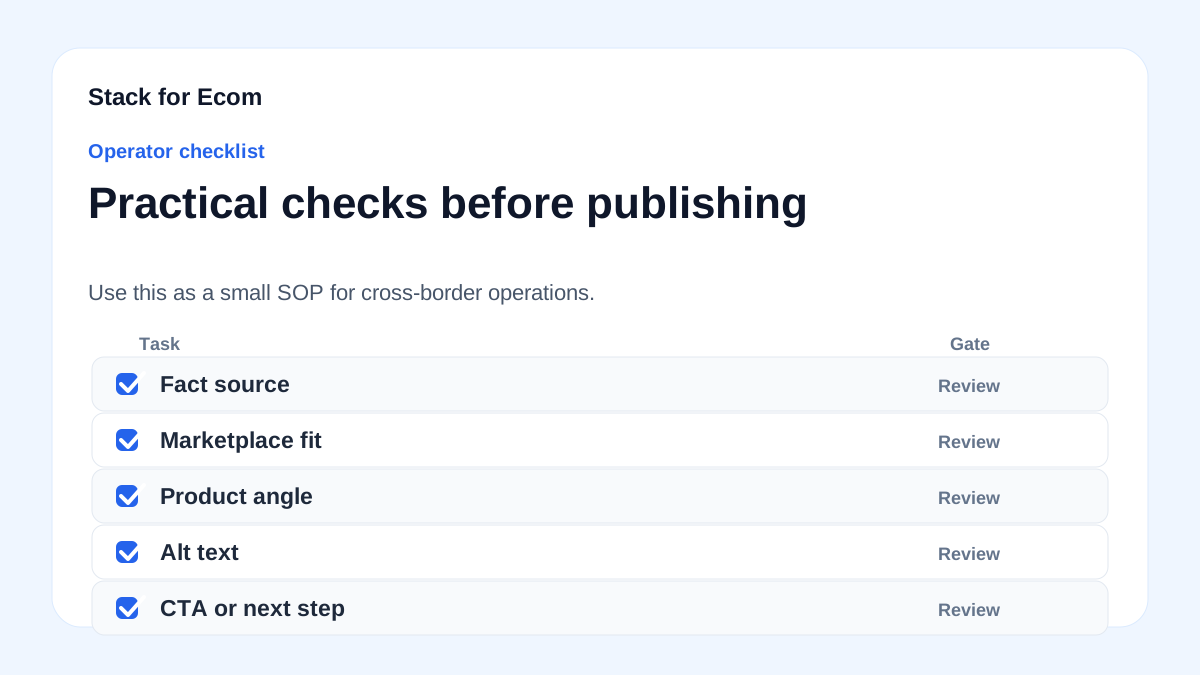
Step-by-step checklist
- Pull weekly BOL counts by mode (air, truck, vessel, rail) from your freight forwarder or carrier reports.
- Calculate your Entry Type 86 rejection rate and 321 Data Pilot participation rate.
- Generate a customs compliance score from your broker's error and penalty report.
- Compare transit times and costs per shipment across air, truck, vessel, and rail.
- Review your express vs. postal shipment mix and adjust based on cost and delivery performance.
- Audit a random sample of cargo descriptions for accuracy and compliance with CBP regulations.
- Export Google Merchant Center diagnostics and track disapproved product counts.
- Check product titles and descriptions for language consistency and character limits.
- Verify variant titles include distinguishing features and mobile-specific requirements.
- Test the Global Business Navigator chatbot for general export questions and document verified answers.
- Review supplier compliance for purchases from individuals, including declarations and permits.
- Monitor CBP alerts for new quota or permit restrictions affecting your product categories.
Potential pitfalls
- Ignoring de minimis volume drops: If your shipment volume falls while the market is stable, investigate carrier issues or compliance problems. Prevention: track volume trends weekly and set alerts for deviations.
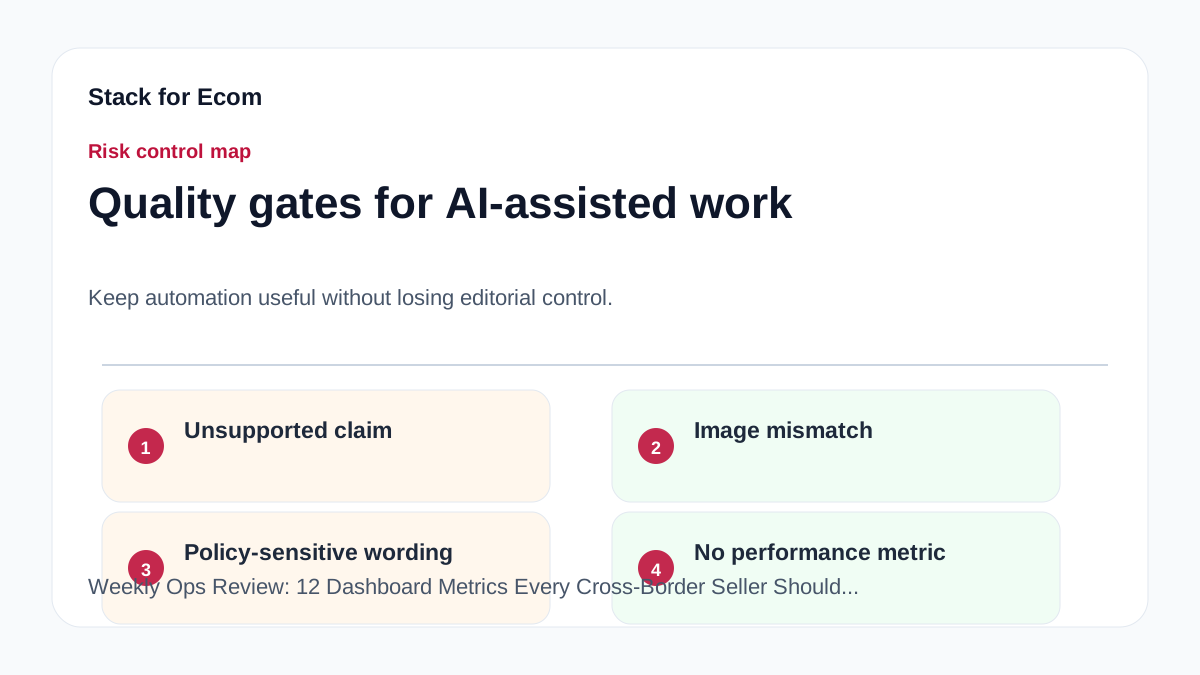
- Submitting inaccurate customs declarations: Misrepresenting value or providing incomplete descriptions can lead to fines or seizure. Prevention: implement a double-check process for all declarations before submission.
- Overlooking Entry Type 86 rejections: A rising rejection rate indicates data quality issues. Prevention: review rejection reasons weekly and correct your data entry templates.
- Using non-compliant product titles: Promotional text, all caps, or missing variant details can cause disapprovals. Prevention: use a title template and validate against Google's guidelines.
- Relying on the chatbot for legal advice: The Global Business Navigator is beta and may produce inaccurate responses. Prevention: verify all answers against Trade.gov references and consult a professional for legal questions.
- Neglecting quota restrictions: Quota limits can delay clearance and incur storage charges. Prevention: monitor CBP alerts and adjust your import plans accordingly.
Suggested visuals
- A line chart showing de minimis BOL volume trends from FY2020 to FY2025, with air, truck, vessel, and rail as separate lines.
- A bar chart comparing Entry Type 86 and 321 Data Pilot BOL counts across fiscal years.
- A table template for weekly shipping mode performance, including transit time, cost per unit, and on-time delivery rate.
- A screenshot of a Google Merchant Center diagnostics report highlighting disapproved products and reasons.
- A workflow diagram showing the customs declaration process from data entry to CBP clearance, with checkpoints for accuracy.
- A dashboard mockup that combines all 12 metrics into a single weekly review view.
Who this helps / Who should avoid
This article helps cross-border ecommerce sellers, export managers, and small operations teams that handle U.S. imports and manage product feeds. It is especially useful for those selling low-value goods that qualify for de minimis treatment and for those using Google Merchant Center to drive traffic.
Who should avoid: Large enterprises with dedicated customs compliance teams and advanced analytics platforms may find this too basic. Also, sellers who do not ship to the United States or do not use Google Merchant Center will find limited value.
Conclusion
A weekly operations review is only as good as the metrics you track. By focusing on de minimis trends, customs compliance, shipping mode performance, and feed health, you can catch issues early and keep your cross-border operation running smoothly. The 12 metrics outlined here give you a practical starting point, but adapt them to your specific products and markets.
Start with one or two metrics this week, then build up to a full dashboard. Use the checklist as your SOP and review it with your team every Monday. Over time, you will develop a rhythm that prevents costly mistakes and improves your overall efficiency. The data is available—you just need to look at it consistently.
References
- https://www.cbp.gov/trade/basic-import-export/internet-purchases
- https://www.cbp.gov/trade/basic-import-export/e-commerce
- https://support.google.com/merchants/answer/7052112
- https://www.trade.gov/ecommerce